Strong Dollar Pushes KRW-USD Exchange Rate Above 1410 Won Intraday
Foreign Exchange Authorities Sign Currency Swap with National Pension Service
Efforts to Stabilize Through High-Intensity Intervention Including Dollar Selling
However, External Uncertainties Increase Due to Fed's Additional Tightening
"Exchange Rate Expected to Continue Moderate Rise Amid Strong Dollar"
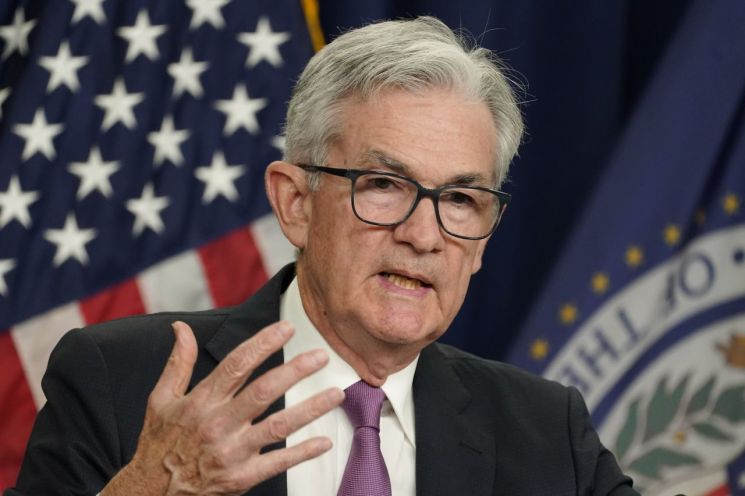 Jerome Powell, Chairman of the U.S. Federal Reserve (Fed), is holding a press conference after concluding the Federal Open Market Committee (FOMC) regular meeting at the Fed headquarters in Washington, DC on the 27th (local time). [Image source=Yonhap News]
As the US Federal Reserve's (Fed) aggressive tightening stance pushes the won-dollar exchange rate above 1,400 won, maintaining a high-level rally, foreign exchange authorities are increasing their market intervention efforts. In response to the strengthening dollar, they are boosting dollar sales and have signed a $10 billion currency swap agreement with the National Pension Service to try to ease upward pressure on the won-dollar exchange rate. However, analysts say it is challenging due to the Fed's caution over further tightening and escalating tensions in Ukraine.
According to the foreign exchange market on the 24th, the won-dollar exchange rate showed instability by surpassing 1,410 won during the previous day's trading session. Although it closed at 1,409.3 won after fluctuating before the market close amid concerns over foreign exchange authorities' intervention, the prevailing view is that the exchange rate will continue to rise for the time being as the dollar remains extremely strong.
The dollar index, which reflects the dollar's value against six major currencies, soared past the 112 mark, reaching its highest level in 20 years. After the Fed raised the benchmark interest rate by 0.75 percentage points on the 21st (local time) and even revised its dot plot upward, the market atmosphere has become very tense. According to the dot plot, which reflects Fed officials' interest rate forecasts, the benchmark rate is expected to rise further to 4.4% by the end of this year and 4.6% next year, which is up to 1 percentage point higher than previous projections.
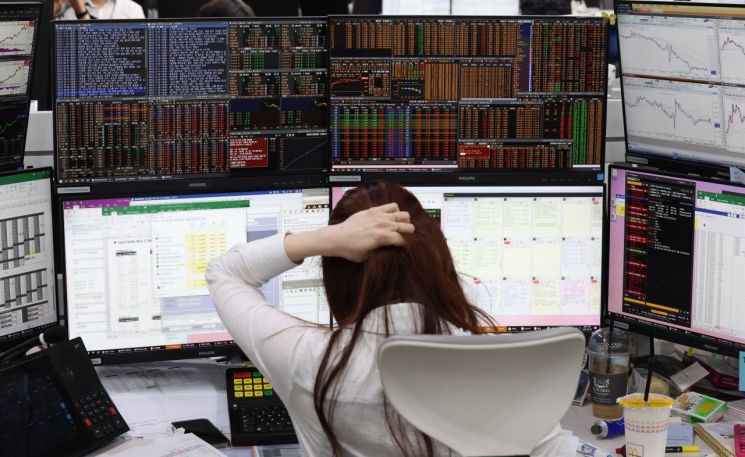 On the afternoon of the 22nd, a dealer is working in the dealing room of KB Kookmin Bank in Yeouido, Seoul.
 [Image source=Yonhap News]
Foreign exchange authorities are intensifying efforts to stabilize the market through verbal and actual interventions daily. Bang Ki-seon, the first vice minister of the Ministry of Economy and Finance, held an emergency economic task force meeting yesterday afternoon and said, "We reviewed the trends in our financial and bond markets, which have shown volatility since the September US Federal Open Market Committee (FOMC) meeting, and discussed response directions," adding, "We are closely monitoring the bond market situation and plan to implement market stabilization measures if necessary."
It is reported that foreign exchange authorities recently requested foreign exchange banks conducting dollar transactions to report their major dollar buying and selling statuses and each bank's foreign exchange-related positions. This is interpreted as a warning not to buy dollars unnecessarily and aims to prevent foreign exchange speculation amid the rapid rise in the won-dollar exchange rate. On the 23rd, after an emergency macroeconomic and financial meeting, Deputy Prime Minister and Minister of Economy and Finance Choo Kyung-ho emphasized to reporters regarding exchange rate concerns, "We plan to respond firmly and swiftly at the necessary moment by mobilizing all possible means."
The Bank of Korea and the Ministry of Economy and Finance have also agreed to sign a $10 billion currency swap with the National Pension Service next month. Once the swap is executed, the National Pension Service will be able to directly procure dollars from the Bank of Korea within a $10 billion limit until the end of this year. This is expected to reduce the demand for the National Pension Service to purchase dollars in the Seoul foreign exchange market for overseas investments, thereby lowering upward pressure on the won-dollar exchange rate.
The Ministry of Economy and Finance explained, "The National Pension Service can secure overseas investment funds stably without counterparty risk, and as the National Pension Service's spot foreign exchange purchase demand eases, it will also contribute to stabilizing supply and demand in the foreign exchange market." However, considering that the National Pension Service's annual new foreign exchange demand exceeds $30 billion, some evaluations suggest that the impact of this currency swap on the foreign exchange market may not be significant.
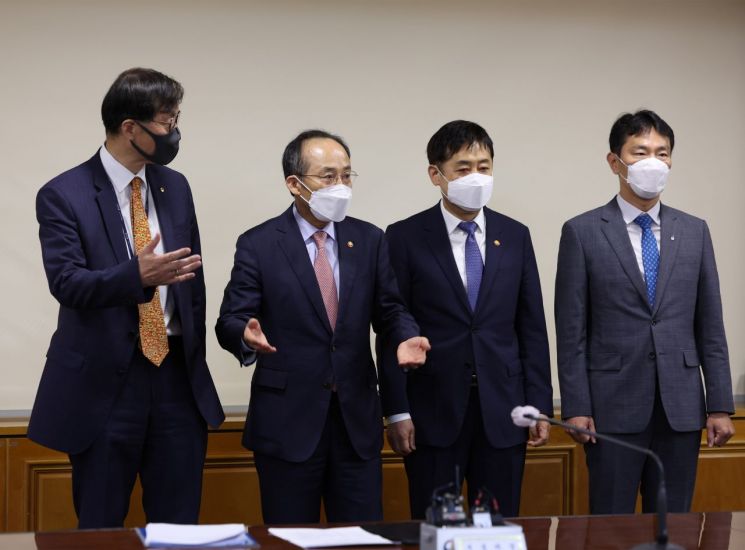 Deputy Prime Minister and Minister of Economy and Finance Choo Kyung-ho and heads of financial authorities are taking a commemorative photo before the Emergency Macroeconomic and Financial Meeting held on the morning of the 22nd at the Bankers' Hall in Jung-gu, Seoul. From the left, Lee Chang-yong, Governor of the Bank of Korea; Deputy Prime Minister Choo; Kim Ju-hyun, Chairman of the Financial Services Commission; Lee Bok-hyun, Governor of the Financial Supervisory Service.
 [Photo by Yonhap News]
Despite the efforts of foreign exchange authorities, many analysts believe that the won-dollar exchange rate's upward trend will continue for the time being. Fed Chair Jerome Powell, at the 'Fed Listens' event on the 23rd (local time), did not make any specific remarks regarding monetary policy but described the current US economy of high inflation and low growth as the "new normal," explaining that they are responding to unusual turmoil.
If the Fed maintains its hawkish stance, there is a forecast that the exchange rate could rise to 1,450 won in the short term. This is because tensions in the Russia-Ukraine war are escalating again, and South Korea's export situation is unfavorable due to the recent widening trade deficit, which could accelerate won depreciation. Shinhan Financial Investment stated, "The won-dollar exchange rate is expected to continue a gradual upward trend amid external strong dollar pressure," adding, "There is little expectation of a clear improvement in the Korean economy from the upcoming August industrial activity trends and September export-import data scheduled for release next week."
© The Asia Business Daily(www.asiae.co.kr). All rights reserved.
![Clutching a Stolen Dior Bag, Saying "I Hate Being Poor but Real"... The Grotesque Con of a "Human Knockoff" [Slate]](https://cwcontent.asiae.co.kr/asiaresize/183/2026021902243444107_1771435474.jpg)

















