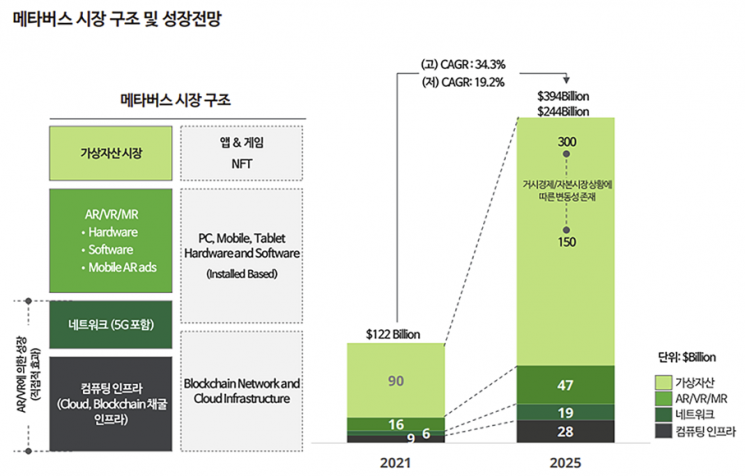
[Asia Economy Reporter Yuri Choi] The metaverse (extended virtual world) market is projected to grow to over 400 trillion won by 2025. This represents more than double the size from last year's 170 trillion won. Analysts expect rapid growth as companies utilize the metaverse to enhance customer experiences and target the MZ generation.
According to "Invitation to the Land of Opportunity: The Metaverse," published on the 24th by Deloitte Korea Group, the global metaverse market is expected to grow from 170 trillion won last year to over 400 trillion won by 2025.
Deloitte defined the metaverse market as the reconfiguration of devices and technological infrastructure required for user experience and immersion in virtual spaces. It consists of four components: virtual asset economy, extended reality (XR) hardware and software, network infrastructure, and computing infrastructure including cloud and blockchain.
Companies are actively leveraging the metaverse as a field of opportunity. Content providers are launching services that link intellectual property (IP) such as games, performances, and novels with the metaverse.
Kakao Entertainment plans to offer new services within the metaverse using its open 3D metaverse platform, "Colorverse." For example, it is possible to create metaverse worlds themed around K-pop or virtual space services using major story IPs.
Colorverse utilizes web streaming technology that allows movement without restrictions in web or app environments. This enables direct access and transition from 2D services like KakaoTalk to the 3D metaverse. Users can experience key services on mobile web without installing separate apps.
Users can watch performances by their favorite singers or explore novels by preferred authors in new ways within the metaverse. It is also expected that users with similar interests will gather in the metaverse to create, distribute, and share user-generated content (UGC) together.
LG Uplus is continuously advancing its platform ahead of launching a metaverse platform early next year targeting specific groups such as office workers, the MZ generation, and young children. Unlike existing open metaverse platforms accessible to all groups, it plans to compete with customized content tailored to user characteristics targeting specific demographics.
Marketing effectiveness is also enhanced by targeting the MZ generation, which has emerged as a major consumer base. For example, BeyondXR, an Israeli company headquartered in New York, USA, is creating new consumer experiences by implementing offline stores and showrooms of consumer brands in the metaverse using augmented reality (AR) and virtual reality (VR) technologies.
According to Deloitte's survey, 94% of consumers responded that their use of augmented reality (AR) when shopping will remain the same or increase. Products offering AR experiences showed a 94% higher conversion rate compared to those without.
Jung Dong-seop, Chief Marketing Officer (CMO) of Deloitte Korea Group and Deloitte Insights Leader, emphasized, "As the metaverse industrializes in unprecedented ways, most information and communication technologies (ICT) aim to realize the metaverse world. In this trend, it is important for companies to identify new opportunities, prepare strategies, and enter the metaverse market without delay."
© The Asia Business Daily(www.asiae.co.kr). All rights reserved.
![Clutching a Stolen Dior Bag, Saying "I Hate Being Poor but Real"... The Grotesque Con of a "Human Knockoff" [Slate]](https://cwcontent.asiae.co.kr/asiaresize/183/2026021902243444107_1771435474.jpg)
















