'Magok District Plus Energy Town' Demand Response Service Fully Launched
Benefits Provided for Reduced Usage During Peak Electricity Hours... 86% of Participating Households Experience Energy Savings
[Asia Economy Reporter Lim Cheol-young] The Seoul Metropolitan Government is creating a ‘Plus Energy Town’ in the Magok district and will provide benefits to citizens who participate in reducing electricity usage during peak demand hours.
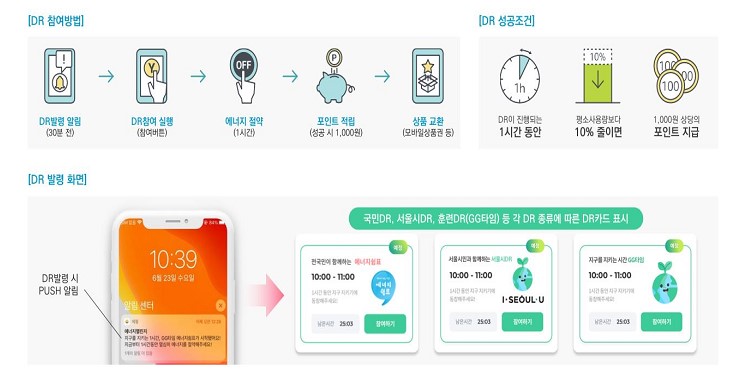
According to Seoul City on the 25th, the ongoing ‘Demand Response (DR) service’ is a service where electricity users pre-commit to reducing a certain amount of electricity during peak demand hours and receive benefits if they reduce their electricity usage according to the reduction mission. IoT-based electricity meters have been linked to 5,348 households across six apartment complexes in Magok, with 459 households currently participating in the Demand Response (DR) service.
Households subscribed to the service can check their electricity, water, and gas usage in real-time through a mobile app, and can view and compare usage details by month, day, and hour. Reduction missions are issued at least once a week, and successful completion rewards participants with points worth 1,000 KRW. Points can be exchanged for mobile gift certificates once 5,000 KRW or more is accumulated.
If 100,000 households participate in the Demand Response (DR) service, it is expected to secure a power reserve of 5,000 kW and reduce electricity consumption by 300,000 kWh annually. This amount of electricity is equivalent to what 1,400 households would use in one month.
Meanwhile, since 2015, Seoul City has been operating a virtual power plant applying the Demand Response service to public buildings and facilities such as the new city hall, Seoul Museum of Art, Arisu Water Purification Center, and Water Recycling Center. The electricity saved by reducing power demand during peak hours is sold, generating revenue. The city plans to cooperate with 25 autonomous districts to expand the foundation of the Demand Response (DR) service and increase citizen participation, as energy demand management is a major direction of energy policy.
Lee In-geun, Seoul City’s Environmental Planning Officer, stated, “In preparation for the prolonged high oil prices and power shortages, Seoul plans to increase small-scale power generation facilities using renewable energy on the production side and expand the Demand Response (DR) service on the demand management side. We will do our best to expand the foundation and promote the service so that more citizens can participate in the Demand Response (DR) service.”
© The Asia Business Daily(www.asiae.co.kr). All rights reserved.
![Clutching a Stolen Dior Bag, Saying "I Hate Being Poor but Real"... The Grotesque Con of a "Human Knockoff" [Slate]](https://cwcontent.asiae.co.kr/asiaresize/183/2026021902243444107_1771435474.jpg)















