Building and Land Property Tax Rate Increase Combined with Rising Official Land Prices Raises Tax Burden
Some Golf Courses Raise Green Fees Amid Delinquencies... Province Withdraws Benefits
"Communities Should Contribute as Much as They Benefit"... Groundwater Facility Seizures Also Occur
[Asia Economy Reporter Jang Hee-jun] A 'tax bomb' has fallen on golf courses across Jeju Special Self-Governing Province. As local communities criticized that golf courses, despite enjoying the COVID-19 boom, failed to fulfill their social responsibilities by eliminating local resident discount benefits, the local government withdrew tax benefits on buildings and land. In particular, property tax on buildings nearly quadrupled compared to last year.
Property Tax on Buildings Quadruples as Tax Rates Soar... Land Property Tax Also Rises by 50%
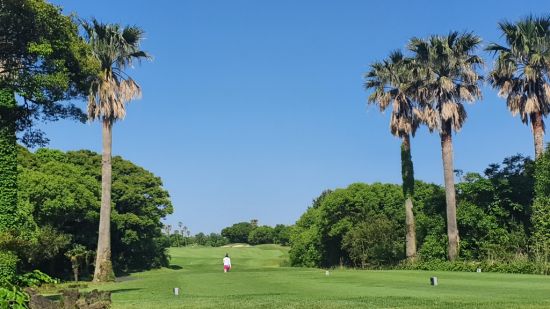
According to Jeju Province on the 25th, the total property tax levied on land and buildings of 32 golf courses in the province this year amounted to 25.7 billion KRW.
Among these, property tax on buildings was 2.99632 billion KRW, nearly four times the 793.8 million KRW recorded last year. By region, 18 golf courses in the Jeju City area saw an increase from 376 million KRW last year to 1.566 billion KRW this year, while 14 golf courses in the Seogwipo City area rose from 417.8 million KRW to 1.43032 billion KRW respectively.
The land property tax, levied every September, was tallied at 22.73382 billion KRW. This marks a 48% increase compared to last year's 16.9188 billion KRW. Jeju City golf courses were charged 10.915 billion KRW, and Seogwipo City golf courses 11.8188 billion KRW.
The sharp rise in property tax on golf courses in the province is due to the provincial government uniformly raising the property tax rate on buildings and land to 4%. Additionally, Jeju Province explained that the increase in official land prices this year was also reflected in the land property tax.
"No More Tax Reduction Privileges" Jeju Province Raises Tax Rates
Under the Local Tax Act, the property tax rate applied to membership golf courses is 4%. However, Jeju Province had applied a lower tax rate than other regions through provincial ordinances under the Special Act on the Establishment of Jeju Special Self-Governing Province and the Creation of an International Free City. This was a benefit given to golf courses in the province under the pretext of revitalizing the tourism industry.
When the special provision was first applied in 2002, the tax rate on golf course buildings was set at 0.3%. In 2005, it was lowered further to 0.25%, which is comparable to the 0.2?0.4% rate applied to public golf courses. Although the rate was slightly raised to 0.75% last year, it remained lower than in other regions. This means membership golf courses located in Jeju have enjoyed significant tax reduction benefits for a long time.
However, in January this year, the Provincial Council partially amended the relevant ordinance to exclude golf courses from the reduced tax rate category. As a result, the property tax rate on buildings within golf courses jumped from 0.75% to 4%. For land, the rate for separately registered land increased from 3% to 4%, and for preservation land from 0.2% to a maximum of 0.4%.
Ultimately, this was not so much a tax rate increase as the removal of 'privileges' enjoyed for 20 years.
"What Tax Arrears During Boom?" The Self-Inflicted Trouble of Brazen Golf Courses
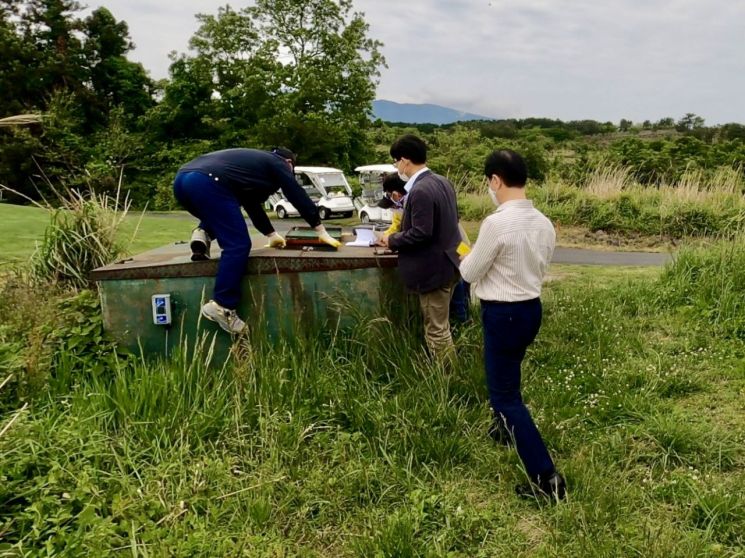 Jeju Island is seizing and sealing the groundwater facilities of a golf course that has overdue taxes. Photo by Jeju Island
Locals have pointed out that golf courses themselves caused the reason for the tax rate hike.
As overseas travel was blocked due to COVID-19, golfers flocked to Jeju, and golf courses in the area competitively raised green fees and other usage charges. In particular, many golf courses drastically reduced benefits previously offered to local residents and were caught avoiding reservations.
Especially, tax arrears by some golf courses sparked public outrage among local residents. In response, Jeju Province has recently taken a strong stance against tax delinquencies by golf courses in the province. They have seized accounts receivable from delinquent golf courses and searched business sites where cash transactions occur. Measures have even been taken to forcibly sell some or all of the land of golf courses that do not pay taxes.
The province is also employing measures such as sealing and seizing groundwater facilities. If groundwater facilities are seized, golf courses in Jeju, which already suffer from water shortages, will inevitably face critical disruptions in operations such as turf management. For example, one golf course failed to pay 6.8 billion KRW in local taxes for over seven years since 2014, but immediately paid 5 billion KRW of the arrears after its groundwater facilities were seized.
Seo Cheon-beom, director of the Korea Leisure Industry Research Institute, said, "Local resident discount benefits were implemented due to the island's characteristic of being difficult to attract golf users on weekdays, but suddenly removing these benefits inevitably caused dissatisfaction among local residents. This tax rate increase is the result of being obsessed with immediate profits without long-term vision."
Former Jeju Provincial Assembly member Kang Seong-gyun also stated, "Jeju golf courses clearly have a responsibility to make efforts for local residents as they receive tax reduction benefits."
© The Asia Business Daily(www.asiae.co.kr). All rights reserved.
![Clutching a Stolen Dior Bag, Saying "I Hate Being Poor but Real"... The Grotesque Con of a "Human Knockoff" [Slate]](https://cwcontent.asiae.co.kr/asiaresize/183/2026021902243444107_1771435474.jpg)

















