'Quiet Quitting' Started in the US
Performing Minimal Work Within Set Hours
"I Won't Prioritize Work Over Life" vs "Life Is Like Quitting, You'll Be Left Behind"
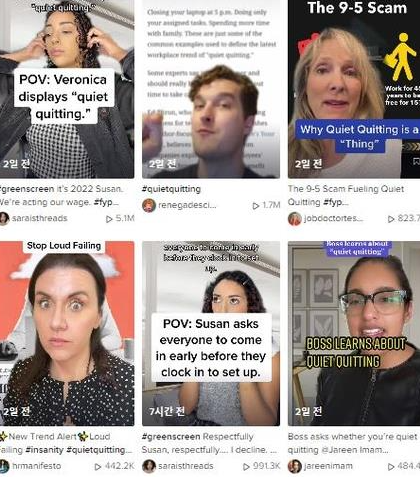 The "Quiet Quitting" trend, centered in the United States, is spreading worldwide. These workers do not quit their jobs but prefer to work only within the set hours and scope of their duties, refusing to do overtime. The photo shows a TikTok post supporting "Quiet Quitting." Photo by TikTok
[Asia Economy Culture Intern Reporter Young In] A, a second-year office worker, has recently shown interest in 'Quiet Quitting.' He said, "I was a 'workaholic' who only knew work after joining the company, but one day I suddenly thought, 'Why should I do this when the salary is the same?'" He added, "I'm not quitting my job. However, my mind is in a state of resignation, so engaging in hobbies after work rather than overtime helps me grow more."
Quiet Quitting refers to the attitude of not actually quitting the job but mentally detaching from the workplace and doing only the minimum required work. Quiet Quitting started from a TikTok video by American engineer Zaid Fellin.
In the video, he said, "It means stopping the thought that you have to do more than what is given," and emphasized, "Work is not your life." He also stressed, "Your value is not defined by the results of the work you do." The video recorded about 4 million views, and afterward, posts with the hashtag 'Quiet Quitting' rapidly spread on social networking services (SNS).
 Last July, engineer Zaid Pellin, who lives in New York, USA, popularized the new term "quiet quitting" by using it on the short-form platform TikTok. Photo by TikTok
A Gallup poll conducted in June on 15,091 American office workers found that 50% of workers are 'quiet quitters,' psychologically detached from their companies. The Washington Post (WP) analyzed the Quiet Quitting trend as showing that workers no longer pursue a lifestyle that prioritizes work over personal life and passionately engages in work.
In the American labor sector, the current popularity of Quiet Quitting is attributed to large-scale layoffs due to COVID-19 and workers exhausted by overtime.
At the beginning of the COVID-19 pandemic, the U.S. labor market experienced massive layoffs, and afterward, severe labor shortages occurred due to workers not returning. In such a situation, the remaining employees suffered from overwork due to additional duties, which is analyzed as a factor that made Quiet Quitting popular. Additionally, employees who faced resignation developed the view that "there is no need to cling to low-paying jobs."
In this regard, Quiet Quitting is not a phenomenon unique to the U.S. Signs of the Quiet Quitting trend are also emerging in Korea. According to a survey conducted by the recruitment platform Saramin in December last year on 3,293 office workers about 'the current attitude of office workers,' 70% answered, "I just work enough to get paid."
B, a third-year office worker, said, "I rushed breathlessly from college life to employment and worked hard at my job, but in the end, nothing remains," adding, "Now, I am minimizing both work and human relationships, and I especially do not want to do overtime." In China, last year, 'Tangpingism,' meaning to maintain livelihood with minimal effort without struggling hard, also became popular among young people. The Chinese government warned, "If Tangping solidifies as a social phenomenon, it will threaten a stable social structure," raising concerns about social conflicts surrounding Quiet Quitting.
However, some argue that Quiet Quitting is just another name for work negligence, low work engagement, and decreased motivation. In a capitalist society, competition is essential, and through Quiet Quitting, one inevitably falls behind within the organization.
Ariana Huffington, founder of The Huffington Post and CEO of Thrive Global, criticized the 'Quiet Quitter' trend, saying, "It's not just quitting work but quitting life." The Harvard Business Review (HBR) also stated, "Companies operate with personnel who willingly step up when needed," and "The Quiet Quitting trend is bad not only for companies but also for individual employees."
© The Asia Business Daily(www.asiae.co.kr). All rights reserved.
![Clutching a Stolen Dior Bag, Saying "I Hate Being Poor but Real"... The Grotesque Con of a "Human Knockoff" [Slate]](https://cwcontent.asiae.co.kr/asiaresize/183/2026021902243444107_1771435474.jpg)
















