Measures to Strengthen Cooperation Between Private and Public Institutions
[Asia Economy Sejong=Reporter Son Seon-hee] The government will fully open data held by public institutions in fields such as pensions, healthcare, and real estate to the private sector. Additionally, 20% of unused patents in areas like healthcare and bio will be freely shared with the private sector. The government estimates that this will generate an economic effect worth about 1 trillion won.
On the 23rd, the Ministry of Economy and Finance held the 12th Public Institution Management Committee chaired by Deputy Prime Minister and Minister of Economy and Finance Choo Kyung-ho, where it finalized the "Plan to Strengthen Cooperation between the Private Sector and Public Institutions" containing these measures. This is part of the Yoon Seok-yeol administration’s core national agenda of "public institution innovation," following the announcement of the Financial Risk Institution Intensive Management System in June to improve productivity and the restructuring of the public institution management system in August, marking the third innovation task.
Deputy Prime Minister Choo said, "Public institutions are key players in our economy, holding enormous tangible and intangible assets worth a total of 969 trillion won and procurement and purchasing power exceeding 63 trillion won annually," adding, "Public institutions operated with citizens’ taxes have the obligation to return such vast resources and capabilities to the people."
Public institutions that provide public services to citizens possess tangible and intangible assets such as data, patents, and overseas networks. The government intends to fully open these to the private sector to revitalize the economy and create synergy through active utilization.
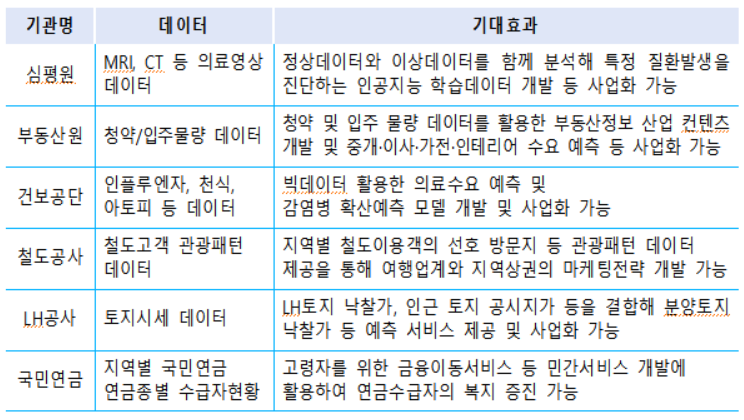
In November, 10 core institutions related to healthcare, real estate, pensions, and other fields will be selected to prioritize opening relevant data. For example, medical imaging data such as MRI and CT held by the Health Insurance Review and Assessment Service, subscription and move-in volume data held by the Korea Real Estate Board, various disease data held by the National Health Insurance Service, land price data held by Korea Land and Housing Corporation (LH), and pension recipient status data held by the National Pension Service are among the targets. The government expects that the private sector will be able to develop various services and commercialize businesses by utilizing this high-quality public data. Startups using these data will also be actively supported.
Furthermore, a "Public Institution Data Opening Task Force (TF)" will be established to continuously open important data in sectors such as industry, finance, and environment, with plans to expand the scope to include raw data held by each public institution by the first quarter of next year.
In addition, among about 55,000 unused patents and utility models held by public institutions, approximately 20% (11,000 cases) in high-demand fields such as healthcare, bio, and telecommunications will be freely shared with the private sector. The government estimates that the economic ripple effect gained by private companies through this will reach about 1 trillion won.
Cooperation between public institutions and the private sector will also be strengthened. When private companies expand overseas or secure orders, public institution consultative bodies will be established by sector?such as export, investment and startups, and resource development?to link support from public institutions at each stage including project discovery, financial support, and project implementation.
Meanwhile, the government plans to investigate indirect regulations through public institutions and announce the results early next year through a Regulatory Innovation TF. If public institutions improve various regulations, the management evaluation indicators will be specified to reflect this in performance, and the expansion of scoring will also be considered.
Deputy Prime Minister Choo emphasized, "For the success of public institution innovation, active efforts and roles of the relevant ministries and public institutions are important," adding, "Public institutions must now move away from a passive attitude and take a more proactive stance to support private sector innovation and growth."
© The Asia Business Daily(www.asiae.co.kr). All rights reserved.
![Clutching a Stolen Dior Bag, Saying "I Hate Being Poor but Real"... The Grotesque Con of a "Human Knockoff" [Slate]](https://cwcontent.asiae.co.kr/asiaresize/183/2026021902243444107_1771435474.jpg)















