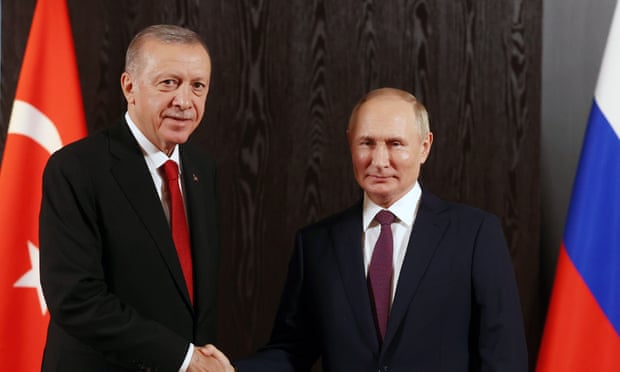
 President Recep Tayyip Erdogan of Turkey (left) and President Vladimir Putin of Russia. (Photo by EPA)
[Asia Economy Reporter Yujin Cho] "Even some of Russia's allies who tolerated the invasion of Ukraine are losing patience."
On the 22nd (local time), the British Guardian reported that even allies such as Turkey, India, and China are showing cold responses following the announcement of referendums across all Russian-occupied territories in Ukraine.
Amid a situation where the tide of war has turned due to consecutive defeats, Russian President Vladimir Putin's declaration of a military mobilization order and nuclear threats is being interpreted as an admission of failure, leading to a clear change in attitude even among pro-Russian friendly countries.
Turkey, which had played a mediating role between the West and Russia, strongly condemned the referendums for the annexation of Russian-occupied Ukrainian territories as illegal, the Guardian reported.
Turkey stated in a press release, "The international community will not recognize such illegal decisions," and pointed out that "(Russia) is deepening global instability."
Earlier, Turkish President Recep Tayyip Erdo?an expressed support for Ukraine's territorial integrity at the United Nations General Assembly held in New York. President Erdo?an said that if peace is established in Ukraine, which Putin claims to want, the territories occupied by Russian forces should be returned to Ukraine.
India, which had refrained from taking an official stance on Russia's invasion of Ukraine, is also reportedly refusing to continue 'siding with Russia,' according to the Guardian. Indian Foreign Minister S. Jaishankar recently stated in a lecture at Columbia University that India is reassessing its attitude toward the United States.
He said, "For 50 years, we viewed the United States with suspicion. Overcoming previous doubts and striving to build a different relationship with the U.S. is one of the major differences created by Prime Minister Narendra Modi." Earlier, Prime Minister Modi also confronted President Putin at the Shanghai Cooperation Organization (SCO) summit held in Samarkand, Uzbekistan, telling him to "stop the war."
Even China, which had been steadfast, is showing signs of change. The Guardian noted, "China is a 'hard nut to crack.' The opaque statements issued by the Chinese government often allow for contradictory interpretations," but added, "While China may think it needs an alliance with Russia to counter the U.S., the statement from the Chinese Foreign Ministry spokesperson this week clearly did not support President Putin's gamble."
Chinese Foreign Ministry spokesperson Wang Wenbin said at a regular briefing on the 21st, "China's position on the Ukraine crisis is consistent and clear," and urged a ceasefire by appealing that "(the parties involved in the Russia-Ukraine war) stop the war through dialogue and negotiations."
© The Asia Business Daily(www.asiae.co.kr). All rights reserved.
![Clutching a Stolen Dior Bag, Saying "I Hate Being Poor but Real"... The Grotesque Con of a "Human Knockoff" [Slate]](https://cwcontent.asiae.co.kr/asiaresize/183/2026021902243444107_1771435474.jpg)
















