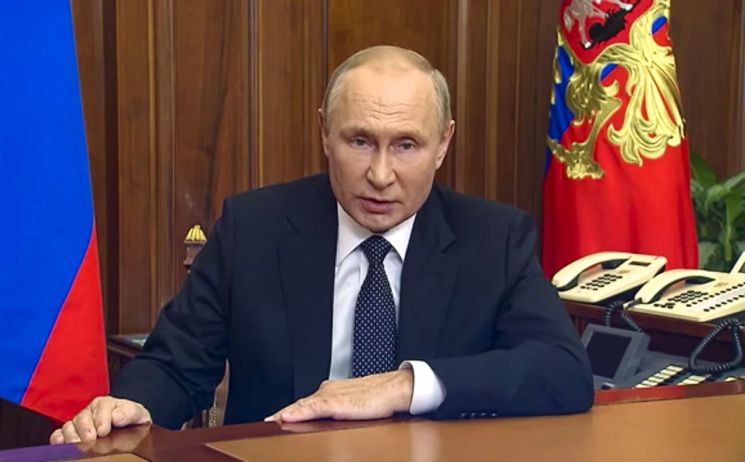
[Asia Economy Reporter Jeong Hyunjin] On the 21st (local time), Russian President Vladimir Putin declared a partial military mobilization order related to the Ukraine war, prompting major Western countries including the United States, the United Kingdom, and Germany to simultaneously condemn the move, pointing out that the mobilization order is evidence of Russia's failure in invading Ukraine.
Bridget Brink, the U.S. Ambassador to Ukraine, criticized on her Twitter that "the mobilization order following the sham referendums signals Russia's weakness and failure." She added, "The United States will never recognize Russia's claims regarding territorial annexation," emphasizing, "The United States will stand with Ukraine forever."
In a subsequent tweet, Ambassador Brink wrote that Russia attacked key infrastructure facilities in Ukraine, and the U.S. is cooperating with local governments to help rebuild Ukrainian communities on the ground. She mentioned assistance in repairing heating pipes at kindergartens and schools in Kyiv, the capital of Ukraine, which was hit by Russian missile strikes in March, and shared commemorative photos taken by those involved during their visit to the site.
This is interpreted as an emphasis on the United States' active support for Ukraine.
The United Kingdom also pointed out that President Putin's announcement of the military mobilization order is evidence that the invasion of Ukraine is failing. Downing Street, the UK Prime Minister's Office, stated, "Putin's speech and his move to mobilize the Russian people clearly acknowledge that the invasion is failing," adding, "The UK stands with international partners in condemning the actions of the Russian government."
UK Defense Secretary Ben Wallace said, "Putin breaking his promise not to mobilize part of the population or illegally annex parts of Ukraine is an admission that his invasion is failing," adding, "No matter how many threats and propaganda there are, it cannot hide the fact that Ukraine is winning this war. The international community is united, and Russia has become a global pariah."
Robert Habeck, Germany's Vice Chancellor and Minister for Economic Affairs and Climate Protection, strongly condemned President Putin's sudden announcement of the military mobilization order. Speaking to reporters in Berlin, he said, "This is a very concerning wrong step," mentioning that discussions on how to respond are underway and that Germany will provide full support.
Leaders of other major European countries also criticized President Putin's announcement. Dutch Prime Minister Mark Rutte condemned it as a "sign of panic." According to The Guardian and others, in an interview with the Dutch public broadcaster NOS, Rutte said, "The military mobilization order is a sign of panic," adding, "His (Putin's) rhetoric about nuclear weapons has been heard many times before. It's rhetoric we already know well. We hope for calm."
Czech Prime Minister Petr Fiala also tweeted, "The partial military mobilization order announced by President Putin is an attempt to escalate the war Russia triggered in Ukraine and further evidence that Russia is the sole aggressor," encouraging additional support for Ukraine.
Earlier, in a national address, President Putin announced a partial military mobilization order. The Russian Ministry of Defense stated it would mobilize 300,000 reservists. President Putin also expressed support for holding referendums on the annexation of occupied territories within Ukraine by Russia.
© The Asia Business Daily(www.asiae.co.kr). All rights reserved.
![Clutching a Stolen Dior Bag, Saying "I Hate Being Poor but Real"... The Grotesque Con of a "Human Knockoff" [Slate]](https://cwcontent.asiae.co.kr/asiaresize/183/2026021902243444107_1771435474.jpg)











