OECD Announces 'Korean Economic Report 2022'
Delaying Pension Eligibility Age Reduces Expenditure Pressure by 2%
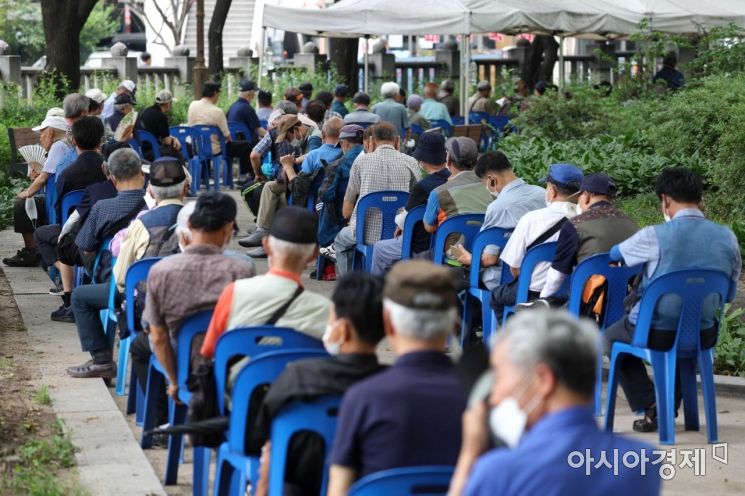 On the 5th, as the heatwave intensifies, elderly people are waiting to receive free meals at Tapgol Park in Jongno-gu, Seoul. Photo by Mun Ho-nam munonam@
[Asia Economy Sejong=Reporter Kwon Haeyoung] As the rapid aging of the population causes national debt to increase quickly, the Organisation for Economic Co-operation and Development (OECD) has recommended expenditure cuts equivalent to 10% of the Gross Domestic Product (GDP) by 2060.
On the 19th, the OECD released the "Korean Economic Report 2022," which contains these findings.
According to the report, the government debt ratio is expected to exceed 140% of GDP by 2060, up from the current level of about 50%. Due to rapid population aging, the elderly population ratio in Korea is projected to exceed 20% by 2050, and social spending, currently about 12% of GDP, is expected to nearly double by 2060.
Regarding this, the OECD stated, "Considering the rapid population aging and the urgent tasks to expand the social safety net, Korea will face greater long-term expenditure pressures compared to most other OECD countries," adding, "To stabilize debt, additional revenue or expenditure cuts equivalent to 10% of GDP will be necessary by 2060."
To manage the rapidly increasing national debt, the OECD pointed out the need to raise the pension eligibility age and curb the growth of healthcare-related expenditures.
First, it was analyzed that if the pension eligibility age is raised earlier, expenditure pressure equivalent to 2% of GDP in 2060 could be reduced. This estimate assumes raising the National Pension eligibility age, currently scheduled to increase to 65 in 2033, to 68 in 2034, and thereafter increasing it by two-thirds of the increase in life expectancy. Under this scenario, per capita GDP is projected to rise by 4.3% and the potential employment rate by 4.5% by 2060.
Additionally, if efforts are made to curb the increase in medical expenses, expenditure in 2060 could be reduced by about 0.6% of GDP.
The OECD analyzed, "Expenditure pressure due to aging, especially pension and healthcare spending, will increase by about 10% of GDP by 2060," and added, "If broad reforms are implemented, including reducing employment and productivity gaps among youth, women, and the elderly, raising the pension eligibility age, and curbing healthcare expenditure growth, expenditure pressure could decrease from 9.8% to 6.6% of GDP, a reduction of about one-third."
Furthermore, the OECD emphasized the need to introduce new fiscal rules. It stated, "Aging threatens fiscal sustainability in the long term," and added, "The pension eligibility age should be raised more significantly and adjusted in connection with life expectancy, while new fiscal rules should be introduced and strictly adhered to."
© The Asia Business Daily(www.asiae.co.kr). All rights reserved.
![Clutching a Stolen Dior Bag, Saying "I Hate Being Poor but Real"... The Grotesque Con of a "Human Knockoff" [Slate]](https://cwcontent.asiae.co.kr/asiaresize/183/2026021902243444107_1771435474.jpg)















