OECD Announces 'Korean Economic Report 2022'
Growth Rate 2.8% This Year, Forecast 2.2% Next Year... Inflation Lowers Next Year's Growth from 2.5% to 2.2%
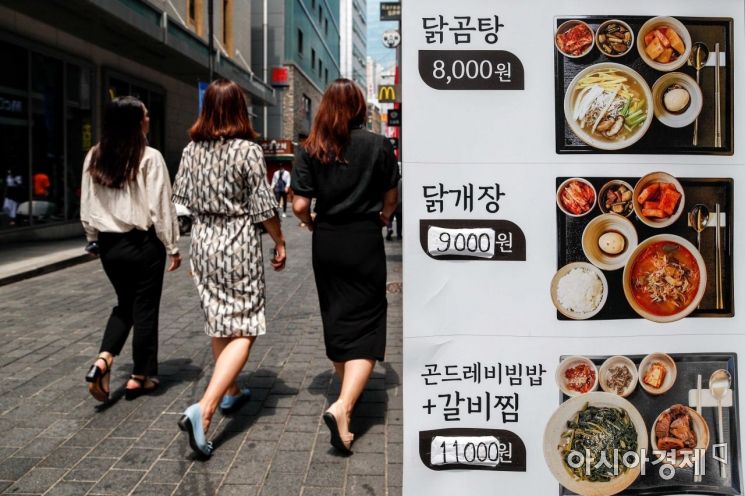 On the 28th, as the cost of dining out has recently surged, the burden of lunch expenses on office workers has increased. A restaurant sign in Seoul shows updated prices. Photo by Jinhyung Kang aymsdream@
[Asia Economy Sejong=Reporter Kwon Haeyoung] The Organisation for Economic Co-operation and Development (OECD) has revised South Korea's inflation rate forecast for this year upward from 4.8% to 5.2%. While the growth rate forecast for this year was adjusted up by 0.1 percentage points to 2.8%, the OECD expects that high inflation exceeding 5% annually will slow the pace of economic recovery, leading to a downward revision of next year's growth forecast by 0.3 percentage points to 2.2%. Concerns about 'stagflation,' where recession and inflation occur simultaneously, are spreading.
On the 19th, the OECD released the "Korean Economic Report 2022," raising South Korea's growth forecast for this year from 2.7% announced in June to 2.8%, an increase of 0.1 percentage points. This is higher than the forecasts by the International Monetary Fund (IMF) and the Bank of Korea, which are 2.3% and 2.6%, respectively. This revision reflects the implementation of government fiscal stimulus measures such as supplementary budgets and the lifting of social distancing measures in late spring, which created an environment conducive to the recovery of face-to-face service industries.
However, anticipating that inflation will constrain the economic recovery, the OECD lowered next year's growth forecast to 2.2%, down 0.3 percentage points from the previous 2.5%. The inflation rate for this year is expected to be 5.2%, an upward revision of 0.4 percentage points from the previous forecast of 4.8%.
The OECD analyzed, "Although economic activities were contracted in early 2022 due to the Omicron variant outbreak and supply chain disruptions, the lifting of social distancing measures in late spring created an environment for the recovery of face-to-face service industries," but added, "Rising raw material prices and supply chain disruptions are passing inflationary pressures onto consumers, so the recovery pace is expected to be gradual."
It cited the war in Ukraine, the possibility of global economic slowdown due to China's lockdowns, and high household debt as domestic and external downside risks. The OECD stated, "Supply disruptions caused by COVID-19, the sharp rise in energy prices, and the war have combined to push energy prices and inflation rates higher," and "The full lockdown in China has adversely affected corporate activities, and high household debt and housing prices also pose downside risks."
The OECD also emphasized the need for normalization of monetary policy to ease inflation and a reduction in the scale of fiscal support. It recommended, "Monetary easing should be gradually reduced to manage inflation expectations," and "Fiscal support should be implemented in a way that does not exacerbate inflationary pressures, focusing on providing maximum support to the most vulnerable groups at the lowest cost." However, it added that monitoring should be strengthened to prevent increased household financial burdens, sluggish consumption, and a hard landing in the housing market due to rising risks of principal and interest repayment burdens.
Furthermore, the OECD noted that fiscal burdens are expected to increase rapidly due to population aging and stated that the introduction and adherence to fiscal rules announced by the new government are necessary.
© The Asia Business Daily(www.asiae.co.kr). All rights reserved.
![Clutching a Stolen Dior Bag, Saying "I Hate Being Poor but Real"... The Grotesque Con of a "Human Knockoff" [Slate]](https://cwcontent.asiae.co.kr/asiaresize/183/2026021902243444107_1771435474.jpg)















