Ministry of Land, Infrastructure and Transport Announces 'Mobility Innovation Roadmap'
Reducing Annual Traffic Accident Deaths to Under 1,000
Digital Logistics Including Apartment and Remote Area Robot Delivery
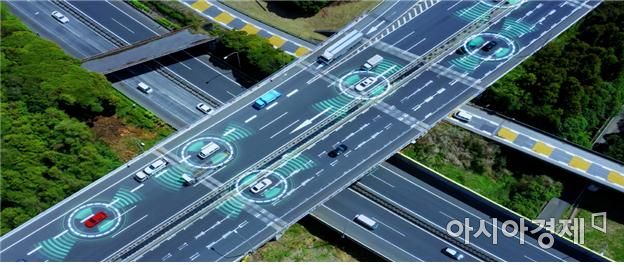
By the end of this year, Level 3 autonomous vehicles will be commercialized, and by 2025, fully autonomous vehicles (Level 4) that require no driver are expected to roam urban areas.
In 2025, the first commercial urban air mobility (UAM) services such as 'Sky Taxi' will be launched, and by 2035, wide-area services similar to express and intercity buses will be fully implemented.
On the 19th, the Ministry of Land, Infrastructure and Transport announced the 'Mobility Innovation Roadmap' containing these plans. The strategy was jointly created by the public and private sectors through the operation of the 'Mobility Innovation Committee,' co-chaired by Minister Won Hee-ryong and Professor Ha Heon-gu of Inha University, with 27 experts from the private industry participating.
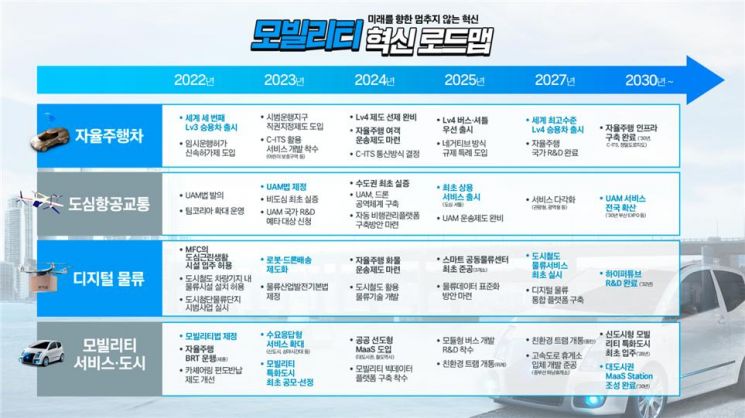
◆The Era of Fully Autonomous Driving Without Drivers Begins in 2025
First, by the end of this year, Korea will become the third country in the world, after Japan and Germany, to commercialize partial autonomous vehicles (Lv3). By 2025, fully autonomous buses and shuttles will be launched, and the public transportation system will undergo a major transformation based on autonomous driving.
Then, to commercialize fully autonomous driving by 2027, regulations for Level 4 (Lv4) will be proactively established by 2024.
Automotive safety standards (manufacturing standards) will be set for Lv4 vehicle systems (such as responses to malfunctions) and driving safety (such as ensuring safety in collisions), and even before these standards are established, a separate performance recognition system will be operated to support unrestricted operation of autonomous vehicles.
Currently, vehicles with temporary operation permits can operate for five years, but it is planned to improve the system so that vehicles with separate performance certification can operate freely regardless of the temporary operation permit period.

The current system, which centers on drivers who must directly operate the steering wheel, will also be supplemented, and driving and insurance systems suitable for Lv4 will be established.
Additionally, nationwide real-time communication infrastructure will be built to support autonomous driving systems by overcoming the limitations of vehicle sensors through real-time communication between autonomous vehicles and between autonomous vehicles and infrastructure.
By 2030, real-time communication infrastructure will be established on approximately 110,000 km of roads nationwide, with priority preemptive construction in congested urban areas where support for autonomous driving systems is especially required, in collaboration with local governments by 2027.
In the first half of next year, a mobility innovation highway will be selected for the first time, targeting existing expressways, to demonstrate various autonomous driving services such as autonomous platooning of freight trucks through designation and operation of autonomous driving-only lanes.
◆Sky Taxi Takes Off in 2025... Air Mobility Without Traffic Congestion Worries

Starting with the first commercialization of UAM services in 2025, various services will drastically reduce travel time without traffic congestion, while activating lifestyle-oriented drone services to foster high value-added new industries.
To launch the first UAM service, from next year, safety of aircraft and communication systems will be verified in Goheung, Jeollanam-do, and in 2024, demonstration projects will be conducted in environments similar to actual service conditions, such as operations between urban areas and airports.
Demonstration projects to implement lifestyle-oriented services using drones, such as emergency delivery in island areas, urban freight transport, and facility inspections, will also be continuously expanded.
To systematically foster the UAM industry, a UAM Act will be enacted. In particular, during demonstration and pilot projects, bold exemptions from existing regulations on aviation safety, business, and security will be applied to actively support the new industry.
To ensure smooth commercialization in 2025, requirements for operators, allocation of transport rights, insurance systems, and other aspects will be proactively completed for various service types such as urban, tourism, and wide-area services.
◆Expansion of Apartment Robot Delivery and Smart Mobility Services
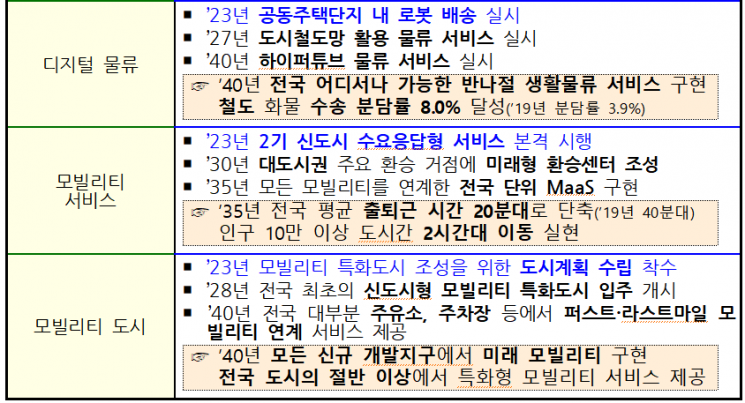
Through smart logistics mobility, customized services will be provided to receive desired goods anywhere nationwide at desired times, increasing productivity in the logistics industry and securing competitiveness.
To realize nationwide same-day delivery services, unmanned delivery using robots and drones will be activated in urban areas and island/mountainous regions with high delivery demand.
To this end, delivery means currently limited to freight trucks and two-wheelers will be expanded to include robots and drones (under the Living Logistics Act), and delivery robots meeting safety standards will be allowed to travel on sidewalks.
Services that dramatically meet various mobility demands by converging ICT, platforms, and advanced technologies with existing transportation services will also be discovered and expanded.
Demand-responsive transport (DRT) services that reflect real-time demand using artificial intelligence (AI) algorithms will help eliminate mobility blind spots.
In particular, legal grounds will be clarified to allow installation of dedicated parking spaces for shared vehicles (car sharing) at transportation hubs such as railway stations and public parking lots, and current regulations requiring operators to move vehicles back to rental locations after one-way returns will be rationally improved to facilitate smooth one-way returns according to travel demand.
Minister Won Hee-ryong of the Ministry of Land, Infrastructure and Transport said, "During the government's term, future mobility such as fully autonomous vehicles and UAM will be realized in the daily lives of the people, and the government will concentrate all its capabilities to support our companies to lead the global market without any setbacks."
He added, "We will quickly specify the details of the major tasks indicated in the roadmap to resolve policy uncertainties, and since legal enactment/amendment and related budget allocation are essential for the roadmap to have immediate effects, we request active interest and cooperation from the National Assembly."
© The Asia Business Daily(www.asiae.co.kr). All rights reserved.



















