Dr. Park Sang-hoon of the Future Research Institute's Lecture on the 14th Sparks Interest
"It Was a Hard-Hitting Critique," Reactions Say
Pointing Out Korean Political Issues with Seven Words: 'Governance, Authority, Vision, Agenda, Organization, Institution, Speech'
"Change Seems Unlikely Without Long Effort"
"Politicians? Pseudo self-employed individuals obsessed with constituency interests and re-election opportunities, or open-type public officials with temporary terms."
"What about political parties? Franchise owners with individual member deputies or quasi-public enterprises dependent on government subsidies."
The above remarks were included in the keynote paper at the first public debate of Season 2 of the 'Democratic Party Reflection and Innovation Continuous Forum,' co-hosted by 27 members of the Democratic Party of Korea in the National Assembly on the 14th. Park Sang-hoon, a research fellow at the National Assembly Future Institute who presented the keynote, candidly criticized the problems of Korean politics as if he had made up his mind.
The reactions were as striking as the criticisms.
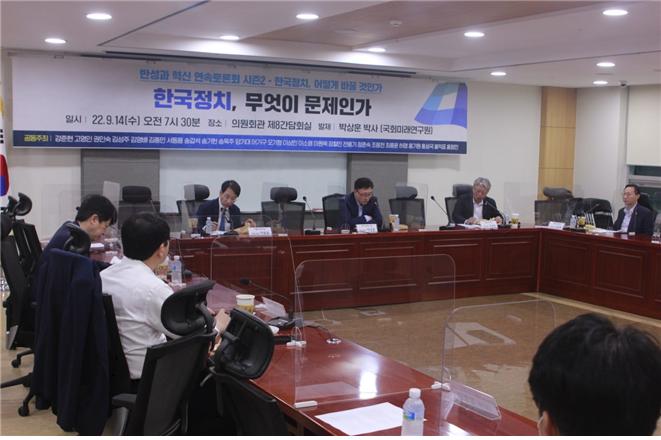
"It was a piercing statement." (Assemblyman Cho Eung-cheon)
"We are engaged in a war to survive as winners and losers, and at a time when I was wondering whether to join this fight or keep my distance, I decided to try the original goals I had for politics." (Assemblyman Kim Sung-joo)
"He expressed the reality, where all three parties were under emergency committee systems, with words and language that made one click their tongue in disbelief." (Assemblyman Heo Young)
"I will try to promote a plan for everyone to listen to this at the next assembly workshop." (Assemblyman Lee Won-wook)
After the keynote filled with countless question marks ended, the assembly members each expressed their refreshing feelings. Generally, they felt that the core had been struck. Some evaluations said that the members were shocked by Dr. Park’s lamentation of the 'despair' of Korean politics, whereas he had previously mentioned even a 'small hope' and possibilities.
What was it that touched the hearts of the assembly members who listened to the 7:30 a.m. keynote?
Dr. Park’s lecture was organized by reflecting on Korean politics through seven words: governance and authority, vision, agenda, organization, system, and language. After defining each word, questions followed about whether our politics truly corresponded to those values. It was a cold evaluation that none of these seven basic frameworks of politics fulfilled their roles.
Dr. Park pointed out that the main practical political area is decided by bureaucrats rather than politicians, and he questioned, "Is our Korean-style democracy, where politics and politicians do not have the authority of governance, really okay?" He pinpointed the reason politicians lack authority as "meaning that political parties lack authority," and "political parties lacking authority means they do not have a stable vision."
Defining vision as "a collection of thoughts on leading politics and government to create a certain society, or the social planning that follows," Dr. Park criticized whether politicians have been motivated or called by a sense of mission to pursue that vision.
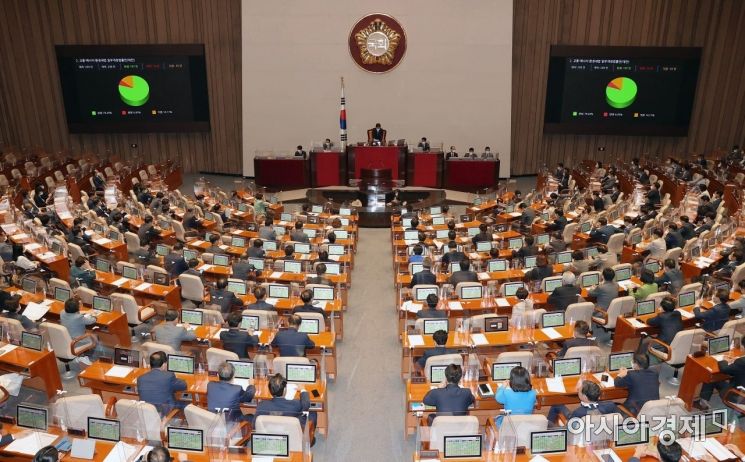 On the 2nd, the amended bill on the Transportation, Energy, and Environment Tax Act (alternative) was passed at the plenary session held at the National Assembly with 197 votes in favor, 16 against, and 35 abstentions out of 248 members present. Photo by Yoon Dong-joo doso7@
He continued with harsh words about the political agenda of Korean society. "Political parties have collapsed, becoming speculative marketplaces that deceive the world by talking about extraordinary innovation, and only rude and destructive fandom politics remain. Is this democracy adrift without politics, governance, authority, vision, or agenda, just following public opinion and fandom without direction?" He asked, "Even if we aim to be a leading country, an inclusive country, or an innovative country with nationalist discourse, without discourse on what kind of society or community to build, hasn’t the silent despair of the lower classes who cannot escape suicide, accidents, neglect in old age, and the cycle of poverty become more entrenched? Besides cutting taxes, investing more in development budgets, and deregulation, have we ever developed systematic policy programs to solve the economic, social, and community agendas we face?"
He also questioned political parties. Dr. Park asked, "How can we explain party politics with 8.77 million party members, about 16.9% of the population and nearly 20% of voters?" and "Isn’t the problem the strange Korean-style political participation or mobilization pattern where political involvement becomes money and business? Despite the unprecedented increase in party members worldwide, why do our parties keep splitting, facing crises, and continuing emergency committees and innovation committees?" He asked, "Is Korean politics easily captured by outsiders and fandoms of party politics? Do our parties even have an independent foundation?" and "Who exactly owns the parties, who are the responsible leaders, and are the party’s culture and traditions being established?"
In particular, Dr. Park lamented politics where 'language' has lost its role. He said, "Politics is a human act done through language," and "Politics can start only when language has value and change can begin." Therefore, "Politics begins by first opening a 'space of possibility' through language," and he asked, "What else did Kim Dae-jung or Roh Moo-hyun have besides language? They gathered meaning, comrades, and organizations through language; what else was there in their political energy?"
On the other hand, he criticized, "Why is there no politician protesting that the current politicians’ words make people give up expectations for politics and tire the world?"
After many questions, Dr. Park talked about ways to overcome the problems of Korean politics and the difficulties of that path. He concluded, "Without a vision that can exert political authority, systematizing appropriate policy agendas, organizing those who need democracy’s help, creating institutions that can last long in our reality, and developing and using political language accordingly, change does not seem possible."
© The Asia Business Daily(www.asiae.co.kr). All rights reserved.
![Clutching a Stolen Dior Bag, Saying "I Hate Being Poor but Real"... The Grotesque Con of a "Human Knockoff" [Slate]](https://cwcontent.asiae.co.kr/asiaresize/183/2026021902243444107_1771435474.jpg)
















