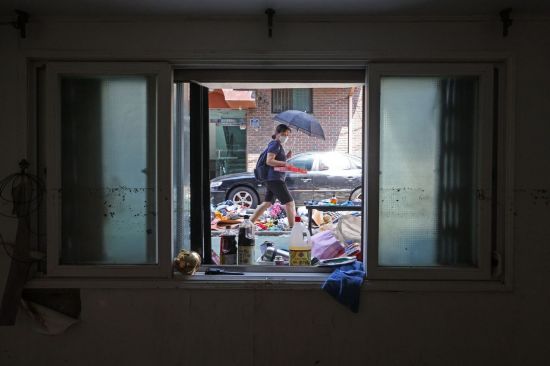
 On the afternoon of August 12, in front of a semi-basement window in the Sillim-dong area of Gwanak-gu, Seoul, items flooded by heavy rain were scattered around. [Image source=Yonhap News]
[Asia Economy Reporter Noh Kyung-jo] Gangbuk-gu was found to have the highest number of aging underground and semi-underground houses in Seoul.
According to the Seoul Infographics recently published by the Seoul Institute on the 17th, as of the end of last year, there were 202,741 underground and semi-underground houses in Seoul, accounting for 5% of the total households in the city (4,046,799 households).
By housing type, there were ▲multi-family houses 80,303 households (39.6%) ▲detached houses 73,581 households (36.3%) ▲multi-unit houses 42,130 households (20.8%) ▲multi-occupancy houses 6,727 households (3.3%).
By autonomous district, the numbers were highest in ▲Gwanak-gu (16,265 households) ▲Gangbuk-gu (14,121 households) ▲Jungnang-gu (12,793 households), in that order.
However, the results differed when considering aging. Based on the number of households, ▲Gangbuk-gu (6,434 households out of 14,121, 45.6%) ▲Jungnang-gu (5,731 households out of 12,793, 44.8%) ▲Seongbuk-gu (5,703 households out of 12,604, 45.2%) had many aging underground and semi-underground houses.
In terms of proportion, ▲Geumcheon-gu 57.2% (3,562 out of 6,222 households) ▲Gangdong-gu 53.4% (3,436 out of 6,429 households) ▲Seodaemun-gu 50.3% (4,379 out of 8,701 households) showed severe aging.
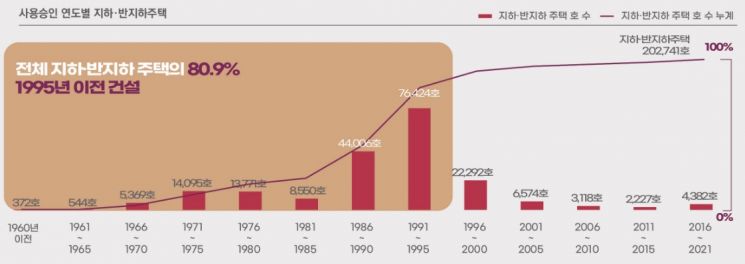
Seoul’s underground and semi-underground houses were intensively built from the late 1980s to the early 1990s. 80.9% of the total are aging houses approved for use before 1995. In particular, the approval rate between 1991 and 1995 was the highest at 37.7%.
The Seoul Institute explained, "Underground housing rapidly expanded following the 1984 revision of the Building Act, which legalized underground residences. Subsequently, as part of the '2 Million Housing Construction Plan' promoted in 1988, the construction standards for underground floors in apartment buildings were relaxed, leading to an explosive increase in underground and semi-underground houses."
Meanwhile, the government plans to release a comprehensive plan within the year after conducting a survey on disaster-vulnerable houses in cooperation with local governments including Seoul. A pan-government task force (TF) was launched this month, and related research projects have also begun.
© The Asia Business Daily(www.asiae.co.kr). All rights reserved.
![Clutching a Stolen Dior Bag, Saying "I Hate Being Poor but Real"... The Grotesque Con of a "Human Knockoff" [Slate]](https://cwcontent.asiae.co.kr/asiaresize/183/2026021902243444107_1771435474.jpg)
















