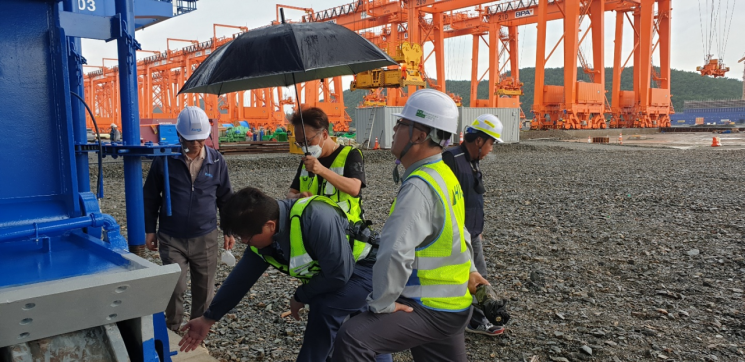
[Asia Economy Yeongnam Reporting Headquarters Reporter Hwang Du-yeol] Although Typhoon ‘Hinnamnor’ swept across the Korean Peninsula leaving various damages, the damage scale at Busan Port was significantly reduced compared to Typhoon ‘Maemi’ thanks to thorough preemptive measures.
The Korea Meteorological Administration forecasted that Typhoon ‘Hinnamnor’, maintaining a powerful strength with maximum wind speeds exceeding 54m/s, would make landfall on the coast of Gyeongnam and directly affect Busan Port between the 5th and 6th of last month.
In fact, at 6 a.m. on the 6th, when the typhoon made landfall, the central pressure was 955 hPa, similar to Maemi’s 954 hPa, and it was the worst weather condition with landfall coinciding with high tide.
The Busan Port Authority (BPA) proactively operated an emergency response team from the 1st in preparation for Hinnamnor.
Under the leadership of President Kang Jun-seok, pre-inspections of vulnerable facilities, strengthening of safety measures, and daily inspection meetings were conducted to minimize damage at Busan Port.
Considering the typhoon’s scale and approach timing, the emergency response team was elevated to an emergency headquarters from the 4th, and from 4:30 p.m. on the 4th, a 24-hour emergency response system was maintained at the highest crisis level, ‘Severe’, until the typhoon moved out of the affected area.
In cooperation with related organizations such as the Busan Maritime Affairs and Fisheries Office, Busan Coast Guard, and Tugboat Association, joint inspections of collective mooring facilities were conducted under a 24-hour emergency communication system, completing priority evacuation measures for small vessels and barges.
Additionally, to prepare for emergencies such as mooring line breakage caused by strong winds, public tugboats were mobilized, ensuring full readiness for Typhoon Hinnamnor.
In particular, based on the experience of the complete shutdown of the wharf due to the overturning and detachment of 11 quay cranes at Busan Port during Typhoon Maemi in September 2003, BPA strengthened the wind speed criteria for securing devices on the quay cranes at North Port from 50m/s to 60m/s.
From the night of the 5th through the morning of the 6th, when Typhoon ‘Hinnamnor’ passed through Busan Port, the BPA Disaster Safety Countermeasures Headquarters, including the president and executives, monitored the typhoon damage status in real time.
Thanks to these thorough pre-inspections and safety measures, aside from some damage to facilities and pier fences, no major damage or casualties occurred at Busan Port.
Kang Jun-seok, president of BPA, said, “We have confirmed once again that thorough preparation is the only way to reduce damage,” and added, “Please accurately assess the damage caused by this typhoon and promptly proceed with restoration work.”
© The Asia Business Daily(www.asiae.co.kr). All rights reserved.
![Clutching a Stolen Dior Bag, Saying "I Hate Being Poor but Real"... The Grotesque Con of a "Human Knockoff" [Slate]](https://cwcontent.asiae.co.kr/asiaresize/183/2026021902243444107_1771435474.jpg)















