[Asia Economy New York=Special Correspondent Joselgina, Reporter Joyujin] On the 15th (local time), the day after China and Russia held their first face-to-face summit since the Ukraine war, the United States is increasing pressure on China and Russia.
According to the White House and major foreign media, on this day, U.S. President Joe Biden signed an executive order to thoroughly oversee foreign investments from a national security perspective to protect supply chains and core technologies.
This executive order instructs the Committee on Foreign Investment in the United States (CFIUS) to consider five factors when evaluating the impact of foreign investments on national security: key supply chains, advanced technology, investment trends, cybersecurity, and protection of Americans' personal information.
It aims to strengthen foreign investment reviews to prevent China, which is competing for hegemony in fields such as semiconductors and artificial intelligence (AI), from acquiring U.S. companies with cutting-edge technology.
This move is interpreted as a blatant effort to thoroughly examine the potential impact on national security through stricter reviews and to prevent China from obtaining advanced U.S. technology.
Although this executive order is effectively targeted at China, it does not specify transactions with China as the subject of the measures, mindful of controversies over violations of World Trade Organization (WTO) regulations.
With the strengthening of CFIUS reviews, foreign companies planning investments in the U.S., including those from South Korea, are also expected to be affected. It is anticipated that CFIUS will closely scrutinize the relationship between Korean companies and China, such as their business operations in China, when reviewing Korean companies’ acquisitions of U.S. firms.
The U.S. Treasury Department also imposed sanctions on numerous companies and individuals suspected of supporting Russia, which is at war with Ukraine.
On this day, the Treasury Department’s Office of Foreign Assets Control (OFAC) announced that it would add two companies and 22 individuals who helped circumvent international financial sanctions imposed after Russia’s invasion of Ukraine to the sanctions list.
The sanctions list includes Vladimir Valerievich Komlev, CEO of Russia’s own national payment system (NSPK), and Viktor Zidkov, head of the Depository.
NSPK is a payment network established independently to bypass Western financial sanctions imposed on Russia following its annexation of Crimea in 2014. After being expelled from the Society for Worldwide Interbank Financial Telecommunication (SWIFT) payment network immediately after the outbreak of the Ukraine war in March, Russia has been using this domestic payment network.
OFAC stated in a release, "This action was taken in cooperation with the Department of Commerce, which imposed new export controls on Russia, and the Department of State, which targets Russia’s defense and advanced technology industries, resulting in new sanctions."
The Treasury Department further announced that the ban on the sale or export of quantum computing services to all individuals residing in Russia will take effect at 0:00 on October 15.
U.S. Treasury Secretary Janet Yellen emphasized in a press release, "As Ukraine advances to defend freedom, we will continue strong actions to undermine Russia’s military rebuilding efforts and hold Russia accountable for war crimes," adding, "We will also take measures to financially isolate President Putin."
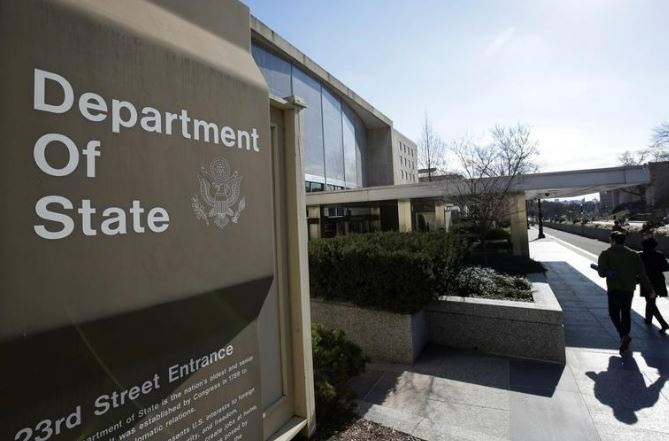
The U.S. State Department also announced sanctions on dozens of Russian and Ukrainian officials and Russian public institutions for human rights abuses and theft of Ukrainian grain in a separate statement.
At least 23 officials and 31 Russian institutions and companies played roles in Russia’s invasion of Ukraine, some of which have already been sanctioned, the State Department said.
Assets of individuals and entities on the State Department’s sanctions list within the U.S. will be seized, and all business activities within the U.S. will be halted.
Earlier, Chinese President Xi Jinping and Russian President Vladimir Putin held a bilateral meeting on the sidelines of the Shanghai Cooperation Organization (SCO) summit held in Samarkand, Uzbekistan.
This meeting took place about 200 days after the outbreak of the war following Putin’s declaration of a special military operation on February 24. During the meeting, the two leaders publicly confirmed their support for each other’s positions regarding the Taiwan issue and the invasion of Ukraine.
© The Asia Business Daily(www.asiae.co.kr). All rights reserved.
![Clutching a Stolen Dior Bag, Saying "I Hate Being Poor but Real"... The Grotesque Con of a "Human Knockoff" [Slate]](https://cwcontent.asiae.co.kr/asiaresize/183/2026021902243444107_1771435474.jpg)
















