Since the Foreign Exchange Crisis and Financial Crisis
Never Surpassed 1,400 Won
Import Prices Also Spread Anxiety
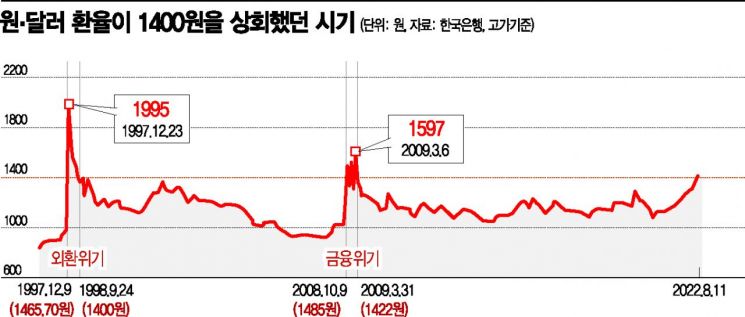
[Asia Economy Reporters Seo So-jeong and Moon Je-won] The won-dollar exchange rate has sharply approached 1,400 won. An exchange rate in the 1,400 won range is a level not experienced since the 1997 Asian financial crisis and the 2008 global financial crisis, causing extreme fear in the financial markets.
According to the Seoul foreign exchange market on the 16th, as of 10 a.m., the won-dollar exchange rate was 1,395.7 won, fluctuating between 1,395 and 1,399 won in the early trading hours. Starting the day at 1,399.0 won, up 5.3 won from the previous day's closing price, the exchange rate immediately broke its previous high again at the opening and is continuously testing the 1,400 won level. This level is the highest since March 31, 2009 (high of 1,422.0 won), marking the highest point in 13 years and 5 months.
Recently, the value of the won has been falling relentlessly, threatening the 1,400 won level and reviving past traumas. The periods when the won-dollar exchange rate exceeded 1,400 won were only twice since the government introduced the floating exchange rate system: from December 1997 to June 1998 during the Asian financial crisis, and from November 2008 to March 2009 during the global financial crisis. Having experienced high exchange rates during times when the Korean economy was in serious crisis, market anxiety is higher than ever.
The government maintains that the current situation differs from previous crises, as the 'King Dollar' trend continues and major currencies such as the euro, yen, and yuan are also weakening alongside the won. However, as the psychological barrier of 1,400 won approaches, the atmosphere has changed. President Yoon Suk-yeol held a luncheon meeting yesterday with Lee Chang-yong, Governor of the Bank of Korea, Kim Ju-hyun, Chairman of the Financial Services Commission, and Lee Bok-hyun, Governor of the Financial Supervisory Service, to review the macroeconomic and financial market situation and discuss response strategies.
In preparation for a market panic if the won-dollar exchange rate breaks through 1,400 won, the government has been barely defending the level by conducting verbal interventions followed by stronger smoothing operations (fine adjustments) than before. A foreign exchange dealer at a foreign bank branch said, "I was eating lunch when market volatility increased sharply, so I rushed back to the office," adding, "It seems the government's actual intervention was larger than expected."
Experts believe that since the won-dollar exchange rate is already in the final countdown to reaching 1,400 won, breaking through 1,400 won by next week's Federal Open Market Committee (FOMC) meeting is highly likely. Yoon Yeo-sam, a researcher at Meritz Securities, said, "While the government's defensive will to block the psychological barrier of 1,400 won will be in effect, if the U.S. FOMC raises the policy rate by 1 percentage point or more, tightening will intensify, making it difficult to prevent the exchange rate from rising." Moon Hong-chul, a researcher at DB Financial Investment, expressed concern, saying, "Although we raised the upper limit of the exchange rate to 1,450 won by the end of the year, if the 1,400 won level is surpassed, an overshooting (temporary price surge) could push it close to 1,500 won."
As the won-dollar exchange rate rises sharply, concerns about import prices are also growing. According to the Bank of Korea, last month's import price index (provisional) fell 0.9% from the previous month, marking a decline for two consecutive months following July's -2.6%. This was influenced by the drop in Dubai crude oil prices, which averaged $96.63 per barrel last month. However, since the exchange rate, which directly affects import prices, has risen significantly recently, there is analysis that the rate of increase could accelerate starting this month.
Professor Ha Jun-kyung of Hanyang University's Department of Economics said, "Since the Bank of Korea has refrained from strong statements and contrasts with the U.S., it seems to be influencing the exchange rate, but if the concentration phenomenon becomes uncontrollable, the Bank of Korea will have no choice but to consider other possibilities."
© The Asia Business Daily(www.asiae.co.kr). All rights reserved.
![Clutching a Stolen Dior Bag, Saying "I Hate Being Poor but Real"... The Grotesque Con of a "Human Knockoff" [Slate]](https://cwcontent.asiae.co.kr/asiaresize/183/2026021902243444107_1771435474.jpg)















