Some Residents Say, "Where Are We Supposed to Dispose of the Waste Generated Within the Industrial Complex? What If It Is Processed in Another Area?"
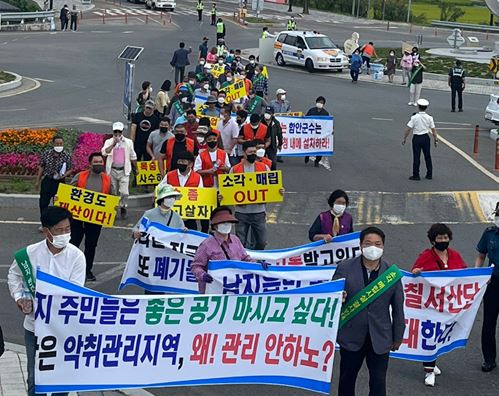 Residents of Namji-eup, Changnyeong-gun, Gyeongnam, are holding a protest against the construction of an incineration facility operator in the nearby Chilseo Industrial Complex in Haman. / Photo by Kim Wook assa113@
[Asia Economy Yeongnam Reporting Headquarters Reporter Kim Wook] Amid the fierce opposition of the residents of Namji-eup, Changnyeong-gun, to the approval of the construction of a waste incineration plant in Chilseo Industrial Complex, Haman-gun, Gyeongnam, some voices are also raising the question, "What about the waste generated within the industrial complex?"
The NC Haman Opposition Promotion Committee of Namji-eup, Changnyeong held a rally titled "Resolute Opposition to the Construction of a Waste Incineration and Landfill Site near Chilseo Industrial Complex in Namji, Changnyeong" on the 15th at 11 a.m. near Namji Rotary, with about 150 participants including Namji residents and local association members.
Lee Pan-am, co-chairman of the Anti-Incineration Committee, raised his voice saying, "Residents of Namji are suffering from harmful air coming from Chilseo Industrial Complex, which has been designated as an odor control area," and added, "If the incineration plant called NC Haman is built, how can it be acceptable to burn and landfill 96 tons of waste daily for 63 years?"
He continued, "Among the 42 residents of Daechi Village near Chilseo Industrial Complex, 7 have died of cancer, 5 are battling illness, and malformed animals have appeared," and said, "In the past three years, the population of Namji-eup has decreased by 506 people, and can the water intake facility, which is used by 1.02 million citizens of Changwon City, be considered safe?"
On the other hand, NC Haman stated, "When Chilseo Industrial Complex was established, it was an obligation under the Waste Control Act that 'waste generated within the complex must be treated within the complex.' Our company was admitted through a public competitive bidding among similar companies when the industrial complex site was allocated, receiving high scores," and questioned, "A currently operating company processes about 500 tons per hour with a large incinerator, and our facility is a confirmed plan to process 98 tons per hour. Is it logical to oppose this?"
They added, "Our facility has introduced a non-combustion catalytic reaction system, reducing emissions to 60 if the Ministry of Environment's standard is 100, and we have adopted state-of-the-art equipment to minimize the external release of odors and dust," and said, "We will listen to the complaints of nearby residents and do our best to minimize inconvenience."
Some Namji residents also expressed the view, "If waste generated within the industrial complex is transported to other areas for incineration, would the residents of those areas welcome it?" and stated, "We need to seek solutions through local residents' control over hospital waste incineration and minimize odor and pollution using state-of-the-art technology."
© The Asia Business Daily(www.asiae.co.kr). All rights reserved.
![Clutching a Stolen Dior Bag, Saying "I Hate Being Poor but Real"... The Grotesque Con of a "Human Knockoff" [Slate]](https://cwcontent.asiae.co.kr/asiaresize/183/2026021902243444107_1771435474.jpg)















