Tourism Master Plan 'Seoul Tourism Revitalization Plan' Established... 17 Tasks in 4 Major Areas
Developing New Content by Utilizing Tourist Resources like Hangang and Hiking... Lifestyle Experience Tourism Including Beauty and Gourmet
MICE Creating Non-Face-to-Face Environments like Metaverse... Discovering Seoul Signature Events
Developing Seoul-Type Tourism Indicators for Quality Management... Enhancing Tourism Competitiveness
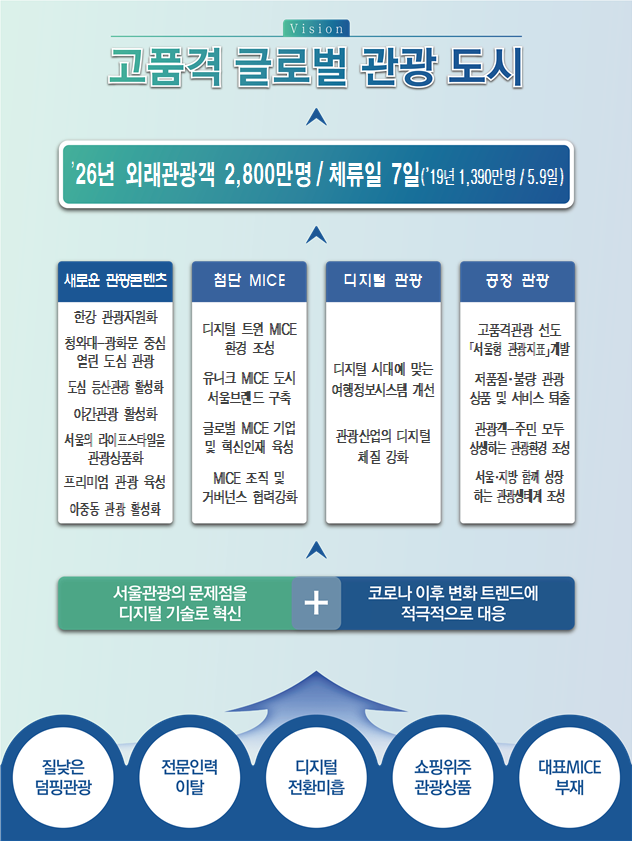
[Asia Economy Reporter Lim Cheol-young] The Seoul Metropolitan Government has prepared a plan to revitalize Seoul tourism with the goal of welcoming 30 million overseas tourists and will implement it until 2026. The plan involves developing new content by turning the Han River, hiking, night views, and downtown areas into tourism resources, creating lifestyle experience tourism programs such as beauty and gourmet food, and developing a 'Seoul-type tourism index' to manage quality.
On the 15th, Seoul announced that it will promote this Seoul tourism revitalization plan to make Seoul a city that tourists worldwide want to visit and use it as an opportunity to leap forward as a global top 5 city.
The Seoul tourism revitalization plan aims for the long-term goal of creating a ‘30 million tourist city Seoul’ by leveraging the attraction of 28 million foreign tourists annually by 2026. It will be promoted through 17 core tasks across four major areas: expanding new tourism content, establishing an advanced MICE (Meetings, Incentives, Conferences, and Exhibitions) environment, innovating the digital tourism environment, and realizing fair tourism for a sustainable tourism environment.
Han River and Downtown Tourism Resources... New Tourism Content
Seoul will first focus investment on developing specialized tourism resources unique to Seoul into new tourism content that rediscover Seoul’s charm. In addition to existing competitive tourism resources such as the Han River that crosses Seoul, the inner and outer mountains connected to Seoul’s hills, and the 24-hour never-sleeping night views, Seoul’s downtown areas such as the newly opened Blue House and the renovated Gwanghwamun Square will also be actively utilized as tourism materials.
Seoul plans to expand the Han River fireworks display by linking it with major festivals such as Seoul Festa and will newly hold drone light shows. The city will also promote the ‘Seoul Wellness Tourism Festa,’ where visitors can enjoy large-scale yoga events, night tours, and water sports on the Han River. In the long term, Seoul will implement the ‘Great Sunset Han River Project,’ creating various attractions and infrastructure centered on the beautiful sunset as a tourism point.
To offer a unique experience of hiking in a metropolitan downtown, hiking tourism content will be developed and convenience services provided focusing on Bukaksan and Inwangsan Mountains, which have improved accessibility due to the opening of the Blue House, and Bukhansan, Seoul’s only national park. To activate night tourism, which has a significant effect on attracting foreign tourists, various experiential and viewing content will be diversified. A night view experience site where visitors can enjoy the night view by hot air balloon will be created, and a night bike course linked with the Blue House and Gwanghwamun Square will be developed and operated. Additionally, night hiking, night walking tours with guides, night gourmet tours, and night city tour buses will also be promoted.
Furthermore, as interest and favorable attitudes toward Hallyu (Korean Wave) increase, tourism demand for beauty, famous restaurants, and fashion is also growing. Therefore, Seoul will focus on discovering and developing tourism products that allow visitors to experience Seoul’s lifestyle. To attract high-value premium tourism demand to Seoul, premium tourism targeting high-spending overseas customers will be fostered, and halal tourism infrastructure will be continuously expanded to diversify and expand the target markets to Asia and the Middle East.
Creating a Contactless Environment with Metaverse... Discovering Seoul’s Representative Events
The MICE industry, a representative high-value tourism industry that creates synergy through linked development with other sectors, will be nurtured as a key tourism industry. By utilizing advanced technologies such as metaverse and digital twin, a digital environment will be created, and Seoul will discover representative MICE events like CES (Consumer Electronics Show) in Las Vegas and MWC (Mobile World Congress) in Barcelona, while also fostering companies and talent.
Seoul will build a platform where the virtual world metaverse platform and the physical space of exhibition and convention centers interact to create a digital-hybrid ecosystem. Then, it will develop Seoul’s representative hybrid (online-offline combined) MICE events incorporating digital twin technology. The city will select and intensively nurture ‘Seoul Global Representative MICE 12’ (one event per month, 12 events annually) to secure Seoul’s representative content.
Tourism Environment Innovation for Convenience of MZ Generation, Individual Travelers, and Foreign Tourists
A smart tourism environment will be created to enhance travel convenience from the perspective of the MZ generation and individual travelers, who have emerged as the main consumer groups in tourism. Before traveling, visitors can experience Seoul tourism in advance through the metaverse, and during their trip, foreign tourists can make reservations and call taxis more conveniently through apps. The tourism industry will be provided with a customized tourism service base using big data and a digital management environment.
Seoul provides mobile and internet services for pre-travel information and reviews, as well as for transportation, reservations, and payments during travel, tailored to each stage of travel activities. The ‘Seoul Tourism Knowledge Information System,’ which can accumulate and analyze tourism big data, and metaverse content will be fully operational from 2023. A B2B platform called ‘Seoul 365 Travel Platform’ will be established to enable small and medium tourism companies to directly market to overseas travel agencies, creating a digital management environment. Additionally, Seoul will support the discovery of new tourism startups and win-win cooperation projects to foster an autonomous tourism ecosystem innovation.
Developing ‘Seoul-type Tourism Index’ for Quality Management... Strengthening Metropolitan Area Cooperation
Moreover, Seoul will raise the quality of Seoul tourism and create a sustainable fair tourism environment where tourists, residents, and the tourism industry can all coexist. The ‘Seoul-type tourism index,’ which can evaluate the quantitative and qualitative levels of Seoul tourism, will be developed by next year to periodically assess and manage the growth of Seoul tourism. Crackdowns will be strengthened to prevent the proliferation of low-quality and substandard tourism products.
The ‘Seoul-type tourism index’ is an indicator that considers balanced growth between quantitative growth and qualitative development of Seoul tourism. Moving away from simple quantitative evaluations focused on the number of tourists, it presents a new standard for managing Seoul tourism by considering qualitative evaluations such as tourists’ length of stay, per capita expenditure, and satisfaction index. Low-quality and substandard tourism products will be eliminated. Seoul plans to explore measures to strengthen management and supervision of poor-quality tourism products through supplementing the tourism police system, expanding special judicial police investigative authority, operating a tourism citizen monitoring group, and reinforcing the Seoul Tourism Complaint Center. The travel standard terms and conditions will be revised to mandate the disclosure of travel fees, encouraging the travel industry’s self-purification to create a reasonable tourism ecosystem.
Efforts will also be made to create a tourism environment where tourists, residents, Seoul, and local areas coexist. Residents living near famous tourist spots will be protected from overtourism, and support will be provided for residents to directly participate in developing village tourism products. Furthermore, specialized tourism courses linking Seoul visitors to other provinces will be developed, and a solidarity and cooperation system with the metropolitan area will be established to promote balanced regional growth and strengthen the overall tourism competitiveness of South Korea.
Choi Kyung-joo, Director of the Seoul Tourism and Sports Bureau, said, “In recent years, the rise of Hallyu content through online media has helped promote South Korea and Seoul to the world and increased overseas interest in Seoul.” He added, “We will actively promote the 8th term Seoul tourism revitalization plan to fully utilize this interest in Seoul tourism, restore the Seoul tourism ecosystem, and take a step further to establish Seoul as a global top 5 city.”
© The Asia Business Daily(www.asiae.co.kr). All rights reserved.
![Clutching a Stolen Dior Bag, Saying "I Hate Being Poor but Real"... The Grotesque Con of a "Human Knockoff" [Slate]](https://cwcontent.asiae.co.kr/asiaresize/183/2026021902243444107_1771435474.jpg)















