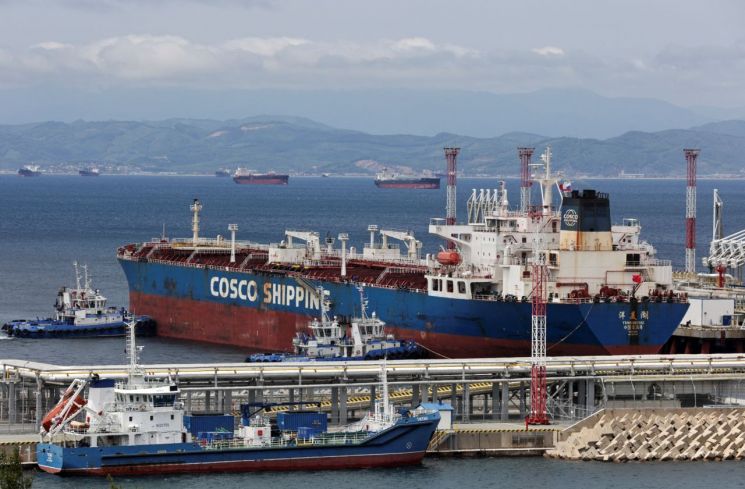
 The Chinese oil tanker Yangmeihu is docked at the Kozmino oil terminal near Nakhodka, Primorsky Krai, Russia, in June.
 [Image source=Yonhap News]
[Asia Economy Reporter Donghoon Jeong] Amid the sanctions imposed by the United States and the European Union (EU), China has been importing Russian fossil fuels at low prices, gaining an unintended advantage.
According to major foreign media reports on the 14th (local time), China's imports of Russian crude oil from April to July increased by 17% compared to the same period last year. During the same period, China's imports of Russian coal and liquefied natural gas (LNG) also rose by more than 50% and 6%, respectively. Imports of Russian electricity via the wide-area transmission lines between China and Russia jumped by 39%.
China spent $43.68 billion (approximately 60.75 trillion KRW) this year on purchasing oil, coal, gas, and electricity from Russia. However, this amount is significantly lower than in previous years, and through this, China was able to help ease inflation during the economic downturn caused by the 'Zero COVID' policy.
Dutch bank ING forecasted that this year China's share of Russian crude oil imports could exceed 20% of its total crude oil imports. Reuters estimated that China saved $3 billion (approximately 4.17 trillion KRW) by purchasing Russian crude oil from April to July. The price of Russian crude oil was about $708 per ton, while the average price of crude oil from other countries was $816 per ton.
From January to July this year, China's imports of Russian LNG increased by 26% compared to the same period last year. During this time, China also profited by re-exporting surplus LNG, caused by reduced domestic consumption, to Europe and Japan.
Due to Western sanctions, China's imports of Russian coal in July reached the highest level in five years. The import price of Russian coal was $150 per ton, much cheaper than Australian coal of the same quality, which costs $210 per ton.
© The Asia Business Daily(www.asiae.co.kr). All rights reserved.









![The Special Connection Between the Statue of Martyr Lee Jun in Jangchungdan Park and Mayor Oh Sehoon ③ [Current Affairs Show]](https://cwcontent.asiae.co.kr/asiaresize/319/2026012110001599450_1768957215.jpg)
