Chinese Companies Posting Experienced Worker Job Ads on Korean Recruitment Sites
Talent Drain Leading to Technology Leakage
Government-Level Measures Needed
[Asia Economy Reporter Han Ye-ju] For advanced technology companies, securing skilled personnel is as urgent a 'survival' issue as equipping production facilities. However, in leading industries of the Fourth Industrial Revolution era such as display, semiconductors, and electric vehicle batteries, attempts by China to poach talent continue unabated. Experts point out that as the importance of protecting advanced technology in the era of economic security is emphasized more than ever, measures to prevent talent outflow should be devised not only by companies but also at the government level.
◆ Emergency Signal for Korean Display Industry Amid China's Pursuit = According to industry sources on the 14th, a recent job posting on a recruitment site sought mid- to senior-level professionals in small OLED (organic light-emitting diode) development and process fields who are available to work in China. The hiring conditions include candidates with over 5 years of experience in comprehensive small display processes or over 8 years in semiconductor CF processes. The headhunting company posting the ad only mentioned the client as a Chinese panel company, but the industry suspects it to be BOE, China's top display company known for mass-producing small OLED panels supplied to Apple.
China's methods of poaching core OLED personnel and technology are evolving day by day. Initially, China contacted individuals discreetly through headhunting firms, but now openly recruits talent on public job sites. The approaches also include information gathering via research firms and requests for materials under industry-academia cooperation. Recently, the use of new platforms hosted overseas, such as LinkedIn, has increased, making detection even more difficult. In fact, major Chinese display companies like BOE and CSOT are known to have a significant number of Korean engineers. Industry insiders say that over 20% of their employees are Korean.
Domestic companies try to prevent talent outflow by including clauses in contracts that prohibit employees handling core technologies from joining competing companies for several years after resignation. However, it is difficult to completely block job changes because Chinese companies use loopholes such as employing personnel through subsidiaries.
Talent outflow leads to technology leakage. According to the National Intelligence Service and the Ministry of Trade, Industry and Energy, from January 2016 to June last year, there were a total of 17 cases where major Korean display technologies were caught attempting to be transferred overseas over five and a half years. Among these, 5 cases involved core technologies that have a significant impact on national security and the economy.
China's relentless offensive is also evident in market share. The phenomenon of the display market being overtaken by China has become a reality. According to market research firm Omdia, China recorded sales of $64.8 billion in the global display market last year, including LCD and OLED, capturing a 41.5% market share and overtaking Korea to take first place. Korea's market share was 33.2%, 8.3 percentage points lower. This is the first time in 17 years since 2004 that Korea has lost the top spot.
An industry official said, "Even if Chinese companies use the same equipment and materials as Korean companies, it is difficult to catch up with the know-how accumulated over several years," adding, "China is putting great effort into recruiting domestic talent by promising salaries two to three times higher to quickly enhance their capabilities."
◆ Copying and Stealing... Shaking the Foundation of Future Manufacturing = Attempts by China to poach talent are intensifying not only in displays but also in advanced industries where Korea has strengths, such as electric vehicle batteries and semiconductors.
Last year, CATL, the world's number one battery company based in China, conducted large-scale recruitment offering Korean talent exceptional conditions with salaries three to four times higher than their current pay. In particular, for employees at the department head level or above, they proposed an annual salary of about 300 million KRW after tax in Korean won. The semiconductor industry faces an even more serious situation. A former researcher at Semes, a Samsung Electronics subsidiary, who stole semiconductor cleaning equipment technology developed by Semes and sold it to Chinese companies for hundreds of billions of won, along with a cooperating company representative, was recently sentenced to 1 year and 6 months in prison. Last year, groups that transferred Samsung Electronics and SK Hynix technologies to Chinese competitors were also caught and arrested consecutively.
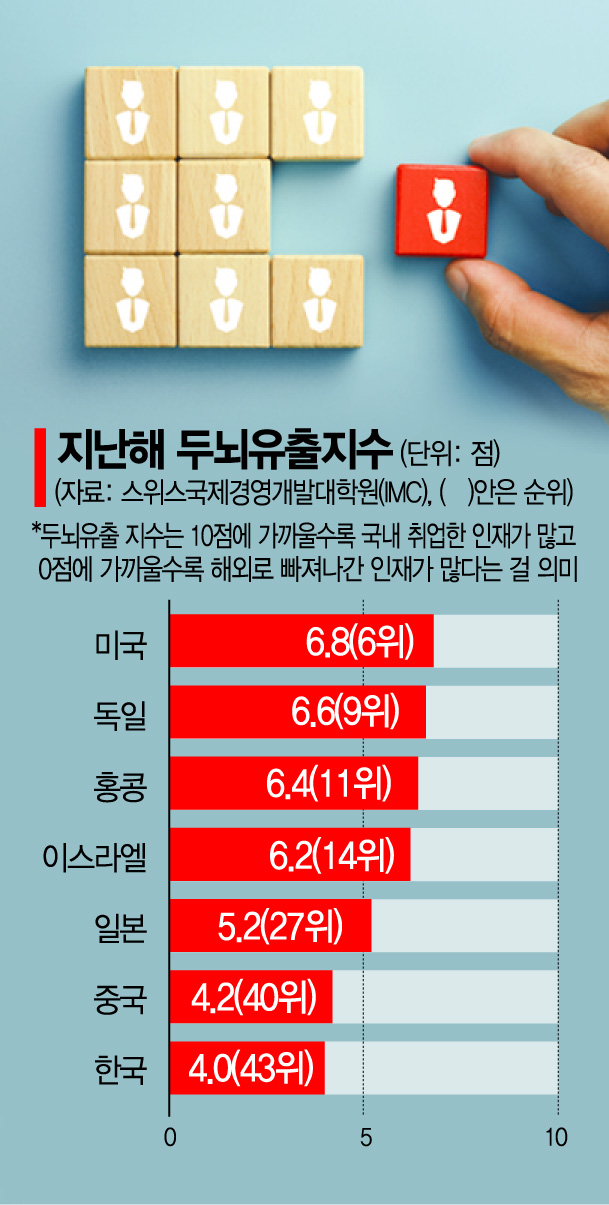
With no resources or market size to rely on, Korea must also worry about the massive outflow of competitive talent. According to the Ministry of Science and ICT's report on the "Domestic and Overseas Inflow and Outflow of Science and Engineering Personnel," since 2010, the annual inflow of science and engineering personnel into Korea has stagnated at around 4,000 people. In contrast, the outflow reaches about 40,000 people annually. The serious trend of talent outflow is also confirmed by the Swiss International Institute for Management Development (IMD). According to IMD's "Brain Drain Index" last year, Korea scored 4 points, ranking 43rd out of 64 major countries. The brain drain index means that the closer to 10 points, the more talent is employed domestically, and the closer to 0 points, the more talent has left overseas. Compared to major countries such as the U.S. (6.4 points, 6th), Germany (6.6 points, 9th), and Japan (5.2 points, 27th), Korea's talent outflow is at a severe level.
Experts predict that as economic security is emphasized, various methods of stealing advanced technology will become rampant. They stressed that strengthening human capabilities is the most necessary policy for sustainable technology security. Moon Sam-seop, Director of the Industrial Property Protection Cooperation Bureau at the Korean Intellectual Property Office, said, "An effective technology leakage prevention system can be established only when the three elements of preventive measures, effective response to leakage, and infrastructure for recurrence prevention are evenly equipped," adding, "No matter how well security systems are established, there will always be vulnerabilities." He continued, "The most important thing is the awareness of employees," emphasizing, "Security awareness must be fostered through fair compensation systems, security education, and strict punishment."
© The Asia Business Daily(www.asiae.co.kr). All rights reserved.













![The Special Connection Between the Statue of Martyr Lee Jun in Jangchungdan Park and Mayor Oh Sehoon ③ [Current Affairs Show]](https://cwcontent.asiae.co.kr/asiaresize/319/2026012110001599450_1768957215.jpg)
