TSMC CEO "10-Dollar Semiconductors Impact $600 Billion Semiconductor Market"
Increasing Demand for Low-Cost Semiconductors Amid 3nm Foundry Competition
Expansion of Low-Cost Semiconductors Centered in China... Experts Say "Not a Cause for Concern"
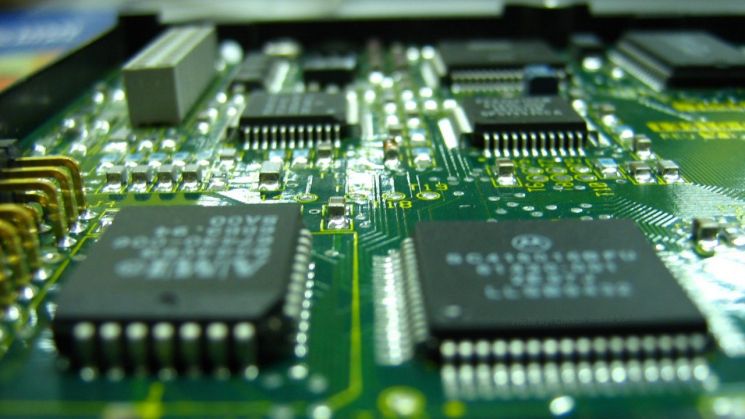
[Asia Economy Reporter Kim Pyeonghwa] As competition intensifies in the foundry (semiconductor contract manufacturing) market centered on Samsung Electronics and Taiwan's TSMC over the 3-nanometer (nm, one billionth of a meter) process, concerns are emerging that low-cost semiconductors with processes of 28nm or larger could cause bottlenecks in the semiconductor supply chain focused on ultra-fine processes. While major foundry operators concentrate on high value-added businesses, the increasing demand for low-cost semiconductors may lead to supply shortages. Although some claim that China could increase its influence in this situation, experts assess that it is not a concern to the extent of worry.
According to the semiconductor industry on the 14th, Wei Zhejia, CEO of TSMC, addressed the supply chain disruption caused by the shortage of low-cost semiconductors at the TSMC Annual Technology Forum held in Taiwan on the 30th of last month (local time). CEO Wei emphasized, "Low-cost semiconductors priced between 50 cents (677 KRW) and 10 dollars (13,531 KRW) are slowing down the $600 billion (811.86 trillion KRW) global semiconductor industry." He also mentioned difficulties in securing $10 semiconductors included in equipment manufactured by the Dutch company ASML, which produces extreme ultraviolet (EUV) equipment used in ultra-fine processes.
EUV is a next-generation lithography technology used in the process of engraving circuit patterns on semiconductor wafers. Since semiconductor performance depends on how finely the circuits are drawn, the use of EUV equipment is essential for ultra-fine processes. ASML is the only producer of this EUV equipment, leading to fierce competition among foundry (semiconductor contract manufacturing) operators to secure the equipment. One of the main reasons Samsung Electronics Vice Chairman Lee Jae-yong visited the Netherlands during his European trip in June was to secure EUV equipment. Although Samsung Electronics and TSMC have recently ushered in the 3nm process era, low-cost semiconductors have become a stumbling block.
Low-cost semiconductors include microcontroller units (MCUs) mainly used in vehicles and power management integrated circuits (PMICs) included in various products such as home appliances and IT devices. They are produced using mature processes of 28nm or larger, and since production conditions vary by product, they are characterized by low profitability. Naturally, foundry operators tend to focus on advanced processes that can generate high added value rather than legacy processes.
In this situation, demand for low-cost semiconductors is growing. According to IBS, an IT industry consulting firm, mature processes of 28nm or larger accounted for about two-thirds of the entire foundry market in 2020. IBS forecasts that demand for 28nm process semiconductors will more than triple to $28.1 billion (29.5 trillion KRW) by 2030. Although there are recent projections that mature process demand is declining due to lower utilization rates of 8-inch and 12-inch foundries producing low-cost semiconductors, experts believe that long-term demand will remain robust despite cyclical fluctuations caused by internal and external market factors. This implies that another case like the vehicle MCU supply shortage, which disrupted automobile production, could occur.
There is also an argument that China could exploit this gap as mature processes fail to attract attention from major foundry operators. Chinese foundry operators such as SMIC have a high proportion of mature processes because they cannot import advanced EUV equipment due to U.S. sanctions. Given that China is the largest semiconductor consumer, this also serves demand response purposes. IBS expects China's share of 28nm semiconductor production to increase from 15% of global production in 2021 to 40% in 2025 due to this influence. SMIC also announced this month that it will invest $7.5 billion (10.1 trillion KRW) to build a mature process-based factory in Tianjin, China. Amid worsening U.S.-China tensions, concerns have arisen that the expansion of China-centered low-cost semiconductor supply could negatively impact the overall semiconductor supply chain.
Experts believe China's influence will not be significant. Kim Yangpaeng, a senior researcher at the Korea Institute for Industrial Economics & Trade, said, "Since semiconductors are used for temperature control even in electric rice cookers we use, demand for low-cost semiconductors will inevitably continue, and supply shortages may occur at times. However, even if China's share increases, other advanced countries still maintain production shares, so there is no need to feel a crisis."
© The Asia Business Daily(www.asiae.co.kr). All rights reserved.
![Clutching a Stolen Dior Bag, Saying "I Hate Being Poor but Real"... The Grotesque Con of a "Human Knockoff" [Slate]](https://cwcontent.asiae.co.kr/asiaresize/183/2026021902243444107_1771435474.jpg)















