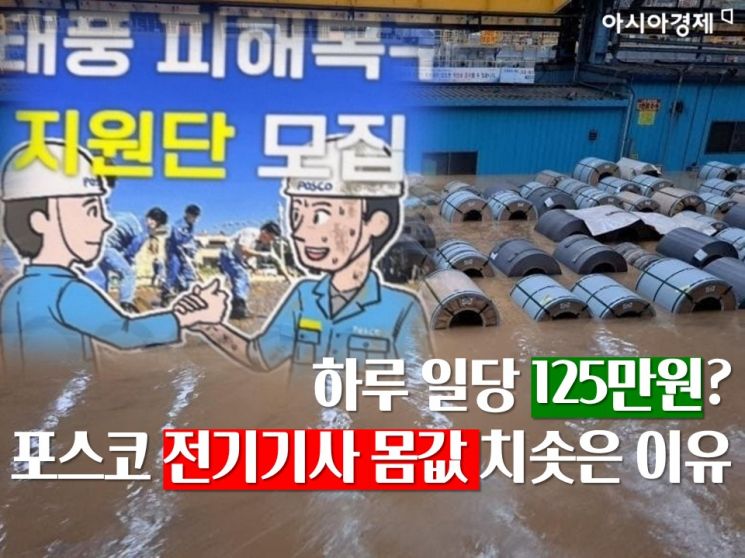
 It has been reported that POSCO Group hired skilled electricians during the last Chuseok holiday period at a daily wage of 1.25 million KRW. / Photo by Song Hyundo, Asia Economy intern reporter
[Asia Economy Reporter Lim Juhyung, Intern Reporter Song Hyundo] On the 9th, a notice was posted that POSCO Group would hire electricians for its steel mill restoration work at a 'daily wage of 1.25 million KRW,' attracting netizens' attention. This was because the amount was considerably high even considering the additional allowance for work during the Chuseok holiday.
On the 6th, due to the impact of Typhoon Hinnamnor (Typhoon No. 11), a significant area inside the Pohang Steel Mill was flooded. POSCO completely halted the steel mill's production process starting from the next day, the 7th.
The recruitment notice for electricians at a 'daily wage of 1.25 million KRW' was issued in this context. It was an attempt to gather veteran electricians nationwide to restore the power facilities inside the steel mill and fully restore the facilities as soon as possible. The technicians gathered this way worked for 14 hours from 8 a.m. to 10 p.m. over three days from October 10 to 12, during the Chuseok holiday, and received the daily wage of 1.25 million KRW.
The work hours were about 6 to 7 hours longer than usual daily work, and the holiday special allowance was added, significantly increasing the pay. POSCO reportedly paid the average daily wage to the technicians starting from the 13th, when the holiday ended and the weekday began. Nevertheless, netizens responded with surprise, saying, "Although it's a daily wage, it's an amount that salaried workers can only dream of," and "I knew the value of technicians was high, but I didn't expect it to be this much."
 A technician conducting an electrical facility safety inspection. The photo is unrelated to specific expressions in the article. Photo by Yonhap News
The phenomenon of the 'high value' of skilled electricians is not new. Electricians and electrical industrial engineers are technical professionals who must pass exams and obtain certifications before starting work, and veterans with 5 to 10 years of field experience are especially rare. The chairman of the Pohang Steel Complex Council said in an interview with a media outlet on the 12th, "We had to issue a nationwide notice because local manpower alone was insufficient."
Electricians have especially suffered from a chronic shortage of manpower. Despite high demand in various fields such as construction, manufacturing, and energy, the influx of new personnel is minimal, leading to an aging workforce in the industry.
According to data from the Korea Electrical Contractors Association, as of last year, among approximately 180,000 electrical technicians, more than half?56.97% (103,847 people)?were aged 50 or older. In contrast, the proportion of technicians in their 20s was only 5.84% (10,656 people).
There are young people aspiring to become electricians. According to the Ministry of Employment and Labor, this year, about 60,500 and 37,892 people took the electrician and electrical industrial engineer qualification exams, respectively, totaling nearly 100,000. The number of successful candidates also approaches about 20,000. The problem lies in the fact that few of those who obtain the certification actually work in the field and gain experience.
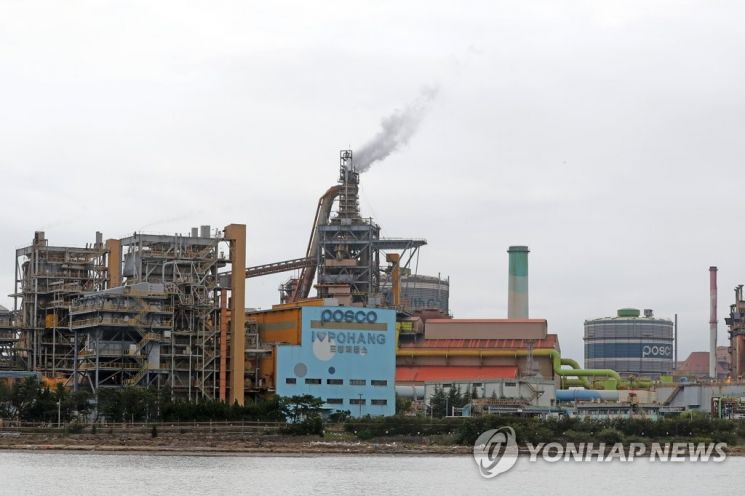 On the 12th, smoke was seen coming out of Blast Furnace No. 4 at POSCO Pohang Steelworks in Nam-gu, Pohang-si, Gyeongbuk. POSCO partially resumed operations of the steelworks facilities that had been shut down due to flooding caused by Typhoon Hinnamnor. / Photo by Yonhap News
Industry insiders point out that poor working conditions and lower-than-expected starting salaries are the issues. Mr. A (31), a third-year electrical technician working at a manufacturing company in Gimpo, Gyeonggi Province, said, "Obtaining a certification does not mean you immediately earn a salary in the hundreds of millions of KRW. Most electrician jobs, except for some large corporations or public works, are in small and medium-sized enterprises or subcontractors, where low pay and hard labor prevail." He added, "Due to the nature of the industry, there are many field dispatch jobs, so working on holidays is common, and since the work involves handling electricity, the actual working environment is dangerous. People who cannot overcome these barriers leave the electrical industry, resulting in many 'drawer licenses' (unused certifications)."
Experts suggest that measures to nurture electricians are necessary to prevent the outflow of young technical personnel. The Human Resources Development Committee for the Electric, Energy, and Resource Industries stated in a report published in April last year, "The age distribution of electrical construction technicians shows a severe shortage of young technicians under 30, while those aged 50 and over constitute more than half, forming an inverted pyramid workforce structure," and pointed out that "(electricians) are highly valuable qualifications in the industry but are perceived as undesirable jobs by young people."
They further emphasized, "The main cause was the insufficient physical and human infrastructure for manpower development and the lack of an industry demand-based human resource development system," and stressed, "Systematic human resource development is urgently needed for the survival of the industry."
© The Asia Business Daily(www.asiae.co.kr). All rights reserved.
![Clutching a Stolen Dior Bag, Saying "I Hate Being Poor but Real"... The Grotesque Con of a "Human Knockoff" [Slate]](https://cwcontent.asiae.co.kr/asiaresize/183/2026021902243444107_1771435474.jpg)

















