10,575 Drug Offenders as of July This Year
39.8% Recidivism Rate for Psychotropic Drugs like Philopon
280 Received Treatment Protection
"Active Use of Treatment Order System Needed"

[Asia Economy Reporter Oh Gyumin] Han Seohee (27), a former trainee singer, was prosecuted for inhaling marijuana four times at the home of Big Bang’s T.O.P (real name Choi Seung-hyun) in 2016 and was sentenced to three years in prison with a four-year probation. Later, during her probation period in June 2020, Han was again prosecuted for methamphetamine (Philopon) use in Gwangju, Gyeonggi Province. In the trial that continued through the appeal, Han was sentenced to one year and six months and was detained in court, but she was prosecuted again last July for methamphetamine use.
Celebrity Amy (real name Lee Yoonji) was punished twice for propofol use in 2012 and zolpidem use in 2014 and was forcibly deported. However, just 13 days after returning to Korea last February, Lee ordered narcotics through a messenger app and obtained methamphetamine by sending payment to an accomplice. She was later prosecuted for using the purchased narcotics six times and was sentenced to three years in prison.
This year, the largest number of drug offenders were users, and methamphetamine (Philopon) was the most frequently used drug based on seizure records. Due to the strong addictive nature of drugs and the high recidivism rate, systematic addiction management and treatment are necessary, but social safety nets such as related budget support appear to be insufficient.
According to the “Monthly Narcotics Trend Report for July 2022” by the Supreme Prosecutors’ Office, 10,575 people were caught for drug offenses in Korea up to July this year. Narcotics are broadly divided into three categories: marijuana such as cannabis, narcotics such as opium and poppy, and psychotropic drugs such as Philopon and LSD. The number of drug offenders increased in all three categories compared to the previous year.
Among drug offenders, including trafficking and possession, the number of users was 4,715, accounting for 44.6% of all drug offenders. A total of 426.4 kg of drugs were seized up to July this year, a 77.2% increase compared to the same period last year, with Philopon accounting for about 120 kg, the largest share.
Drugs are highly addictive. In the case of Philopon, a single dose is considered to be 0.03 mg, and when administered, the amount of dopamine (a neurotransmitter that stimulates movement and motivation) secreted in the body immediately increases by thousands of times compared to normal. This state lasts for about 72 hours and the total amount of dopamine released during this period exceeds the lifetime dopamine production of a normal person’s body.
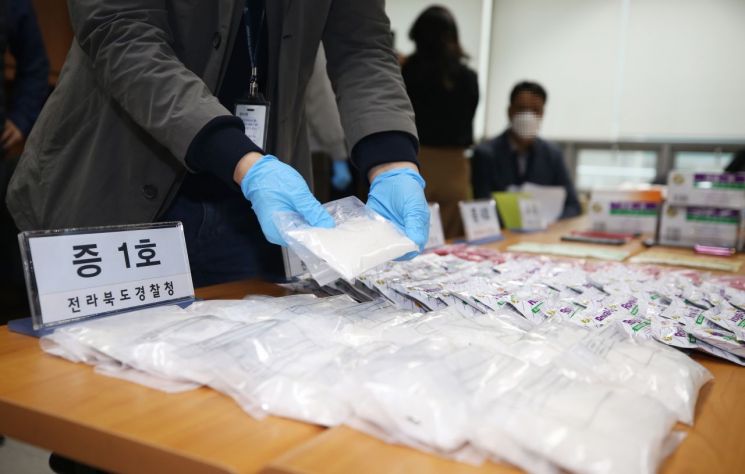
Due to its strong addictive nature, the recidivism rate is also high. Last year, 5,916 drug offenders relapsed, resulting in a recidivism rate of 36.6%. In particular, the recidivism rate for psychotropic drugs including Philopon was 39.8%, higher than that for narcotics (14.7%) and marijuana (37.8%).
To prevent relapse, addiction treatment for drug offenders is necessary, but national-level support appears insufficient. There are two ways to treat drug addicts. One is treatment protection, which involves referral for inpatient treatment at one of the 21 specialized drug addiction treatment hospitals nationwide. The other is treatment custody, where addicts are admitted to drug addiction rehabilitation centers for treatment.
In the case of treatment protection, two of the 21 specialized treatment hospitals (Gangnam Eulji Hospital and Ulsan Geunbit Hospital) were removed from the designated facilities list in 2019, and the number of drug offenders receiving treatment protection was 280 last year, down from 330 in 2017. Only about 2.6% of all drug offenders received addiction treatment last year.
The related budget from the Ministry of Health and Welfare is about 280 million KRW, and the fact that addicts must apply for treatment themselves is believed to have influenced these figures. Seung Jae-hyun, a research fellow at the Korea Institute of Criminology and Justice Policy, stated, “Given the characteristics of Korean drug offenders where suppliers and users are not separated, strict criminal punishment for suppliers and simultaneous treatment for users must be implemented. It is necessary to intervene early in drug addiction by actively utilizing treatment order systems so that treatment can be provided not only at the national level but also by the private sector.”
© The Asia Business Daily(www.asiae.co.kr). All rights reserved.
![Clutching a Stolen Dior Bag, Saying "I Hate Being Poor but Real"... The Grotesque Con of a "Human Knockoff" [Slate]](https://cwcontent.asiae.co.kr/asiaresize/183/2026021902243444107_1771435474.jpg)

















