IBS Research Team Details Structure of Lithium-Ion Battery Electrolyte Solvent
Identifies Errors in Existing Tetrahedral Theory, Reveals Various Structures Including 3- and 5-Coordination
Uncovers Causes of Low-Temperature Performance Degradation and Provides Basis for Improvement
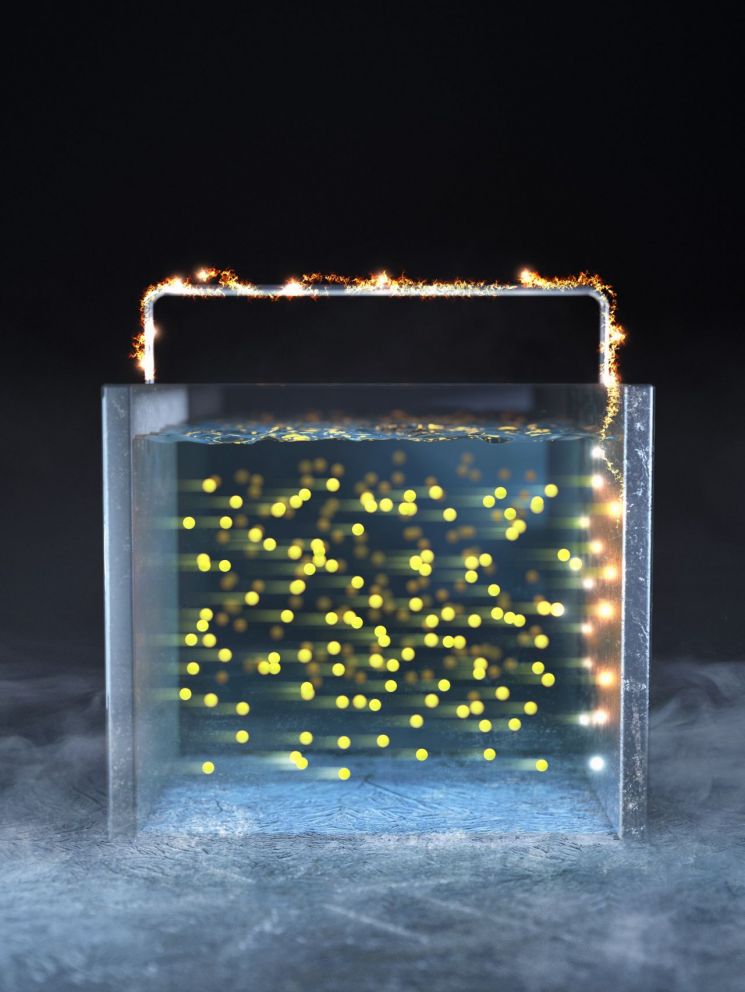
[Asia Economy Reporter Kim Bong-su] Domestic researchers have identified the cause of the decline in battery performance in cold weather and found clues to improve it.
The Institute for Basic Science (IBS) announced on the 13th that the research team led by Minhaeng Cho, head of the Molecular Spectroscopy and Dynamics Research Group (professor of chemistry at Korea University), succeeded in detailed observation of the solvent structure of lithium-ion battery electrolytes at low temperatures.
Lithium-ion batteries mainly consist of a cathode, an anode, a separator, and an electrolyte. At the anode, lithium atoms separate into lithium ions (Li+) and electrons, and the electrons move along the wiring. This flow of electrons supplies electricity. Meanwhile, lithium ions move through the electrolyte to the cathode, where they recombine with electrons. When the temperature drops, the battery’s internal resistance increases during the “desolvation” process, where lithium ions move from the electrolyte to the electrode.
Clearly identifying the lithium-ion solvation structure, which is the initial structure in the desolvation process, is the first step to solving the problem of battery performance degradation at low temperatures. The lithium-ion solvation structure refers to the arrangement formed by lithium ions and surrounding anions or solvent molecules when lithium ions dissolve in the electrolyte (solvation). Until now, it was widely accepted that the lithium-ion solvation structure forms a tetrahedral structure with four molecules coordinated around the lithium ion.
However, recent experimental results that cannot be explained by the tetrahedral solvation structure have been emerging. According to Le Chatelier’s principle, when environmental factors such as temperature or pressure change, chemical reactions proceed in a direction that offsets the change to maintain chemical equilibrium. If the surrounding temperature decreases, the reaction should proceed in a way that increases the temperature.
Accordingly, since the ionization of lithium salts (the dissociation of compounds into ions) is an endothermic reaction that absorbs heat when the lithium-ion solvation structure is tetrahedral, theoretically, when the electrolyte temperature drops, the reaction should proceed in a direction that reduces ionization. In other words, the degree of ionization (the proportion of lithium salt ionized) should decrease as the electrolyte temperature decreases, but in reality, the degree of ionization increases.
To clarify this contradiction, the research team began investigating the lithium-ion structure at low temperatures. Using a Fourier-transform infrared spectrometer (FTIR) equipped with a low-temperature device, they observed the lithium-ion solvation structure and ionization process while varying the temperature from room temperature (26.85°C, 300K) to minus 33.15°C (240K). As a result, it was confirmed that the lithium-ion solvation structure is not limited to a tetrahedral structure but can have various coordination numbers such as 3, 4, or 5 depending on the solvent environment. This finding explained experimental results that could not be understood with the tetrahedral model.
Director Cho said, “This study is significant as it shows that the prevailing notion of the lithium-ion solvation structure differs from reality and provides important clues for designing new batteries that do not degrade in performance even at low temperatures.” He added, “Follow-up research is underway to closely examine the lithium-ion solvation structure, including situations where additives are present in the electrolyte.”
The research results were published on the 18th of last month in the international journal Journal of Physical Chemistry Letters (IF 6.888), published by the American Chemical Society (ACS), and were selected as an additional supplementary cover paper.
© The Asia Business Daily(www.asiae.co.kr). All rights reserved.
![Clutching a Stolen Dior Bag, Saying "I Hate Being Poor but Real"... The Grotesque Con of a "Human Knockoff" [Slate]](https://cwcontent.asiae.co.kr/asiaresize/183/2026021902243444107_1771435474.jpg)















