Number of Employees in Zombie Firms Increased to 314,000 in 2021
2021 Exchange Zombie Firm Proportion Ranked Hong Kong-Korea-US
[Asia Economy Reporter Kim Pyeonghwa] The number of marginal companies in 2021 increased by 23.7% compared to 2019, before the spread of COVID-19. In particular, the proportion of marginal companies was prominent in the manufacturing industry and small and medium-sized enterprises (SMEs). With the ongoing trend of interest rate hikes, the increased financial burden on companies is expected to weigh on the domestic economy. There are also calls to make the Act on the Promotion of Corporate Restructuring and the Special Act for Enhancing Corporate Vitality permanent.
On the 13th, the Korea Economic Research Institute released a report titled "Improvement Measures for the Corporate Restructuring System," commissioned to Professor Kim Yoon-kyung of Incheon National University. This report analyzed 22,388 non-financial companies subject to the External Audit Act (applicable to stock companies, etc.) from 2017 to 2021 to examine the status of marginal companies in Korea. Marginal companies refer to firms continuously facing financial distress, unable to cover interest expenses through operating activities. These are companies with an interest coverage ratio (operating profit divided by interest expenses) below 1 for three consecutive years.
Number of Marginal Companies Increased by 23.7%... High Proportion in SMEs and Manufacturing
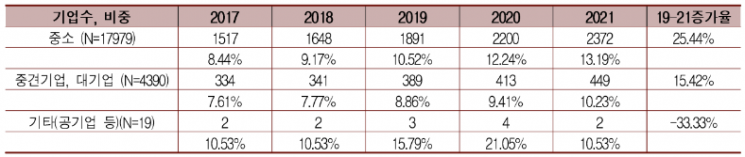
According to the report, in 2021, the total number of marginal companies was 2,823, a 23.7% increase compared to 2,283 in 2019 before the COVID-19 outbreak. The number of employees working at marginal companies rose by 26.7%, from 247,000 in 2019 to 314,000 in 2021. By company size, the increase in marginal companies was particularly noticeable among SMEs. While mid-sized and large companies increased by 15.4%, from 389 in 2019 to 449 in 2021, SMEs rose by 25.4%, from 1,891 to 2,372.
By industry, the manufacturing sector had the highest proportion of marginal companies at 40.4% (1,141 companies). In terms of the growth rate of marginal companies from 2019 to 2021, the sectors were ▲Air Transportation (H51, 300%) ▲Non-metallic Mineral Mining (B07, 300%) ▲Restaurants and Bars (I56, 200%) ▲Beverage Manufacturing (C11, 200%) ▲Furniture Manufacturing (C32, 100%) ▲Waste Collection, Transport, Treatment, and Raw Material Recycling (E38, 100%) in that order.
Analyzing marginal companies traded on major global exchanges, including Korea's KOSPI and KOSDAQ, the proportion of marginal companies among all domestic firms was 17.1% in 2021, ranking second after the Hong Kong Stock Exchange (28.9%). Compared to 2017, the growth rate was also the second highest after Hong Kong. The report suggests that the continuous increase in the proportion of marginal companies could lead to widespread insolvency.
"Need to Make the Act on the Promotion of Corporate Restructuring and the Special Act for Enhancing Corporate Vitality Permanent"
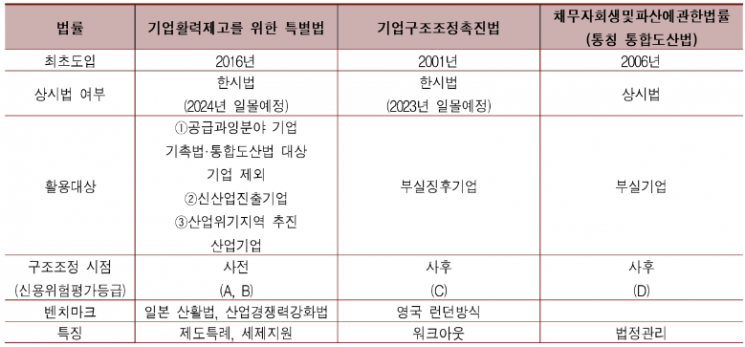
The report argued that the Act on the Promotion of Corporate Restructuring and the Special Act for Enhancing Corporate Vitality should be made permanent to promote business restructuring and activate corporate restructuring. Since there is a risk that corporate restructuring plans may be distorted due to policy uncertainty, it is necessary to advance discussions on making these laws permanent and proceed with legislative deliberations. Both laws, which are temporary and oversee workouts for companies showing signs of insolvency, are scheduled to expire in 2023 and 2024, respectively.
Regarding the Special Act for Enhancing Corporate Vitality, discussions are underway to reflect new technologies and changes in the corporate environment in the law. The report stated that including frequently changing content in the law would make it difficult to achieve the legislative intent of voluntary and swift business restructuring by companies. It also added that since there is an approval process by the Business Restructuring Plan Review Committee, the law should not limit its scope.
Professor Kim said, "There is a need to design the restructuring system to accelerate corporate restructuring and minimize social costs while revising existing legislation," adding, "active efforts by companies for sustainable growth are also necessary."
© The Asia Business Daily(www.asiae.co.kr). All rights reserved.
![Clutching a Stolen Dior Bag, Saying "I Hate Being Poor but Real"... The Grotesque Con of a "Human Knockoff" [Slate]](https://cwcontent.asiae.co.kr/asiaresize/183/2026021902243444107_1771435474.jpg)
















