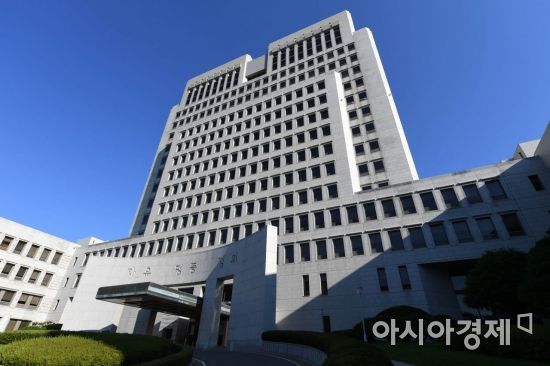
[Asia Economy Reporter Choi Seok-jin, Legal Affairs Specialist] The Supreme Court has ruled that a public relations judge who allowed court reporters to view criminal judgments recognized as having public interest, or reporters who wrote articles based on them, are not liable for damages to the defendant in the case.
According to the ruling, since judgments must be disclosed under our Constitution and the articles were written anonymously without identifying the defamation victim, even if the victim’s acquaintances could infer the article was related to the victim from various circumstances, the illegality is excused if the report is truthful and in the public interest, thus no tort liability under civil law can be established.
On the 12th, according to the legal community, the Supreme Court’s Third Division (then presided by Justice Kim Jae-hyung) finalized the lower court’s ruling on the appeal in a damages claim lawsuit filed by Ms. A against the Republic of Korea, media company B, and reporter C of B, seeking several hundred million won in damages for tort, confirming the lower court’s dismissal of the plaintiff’s claims on the 19th of last month.
The court stated, "There is no error affecting the judgment such as misinterpretation of the laws related to the 'Personal Information Protection Act,' 'Rules on Viewing and Copying Criminal Judgments,' and 'Regulations on Viewing and Copying Criminal Judgments,' or misapprehension of facts beyond the limits of free evaluation of evidence contrary to logic and experience, as claimed in the grounds for appeal in the lower court ruling."
Ms. A, a piano instructor in her late 30s in 2013, received a summary order imposing a fine of 1 million won in June 2012 for charges of falsifying official electronic records and using falsified official electronic records after unilaterally registering a marriage without the consent of Mr. D, whom she had a one-sided crush on.
Ms. A appealed the summary order by requesting a formal trial, but in June 2013, the court sentenced her to a fine of 1 million won. She appealed again, but the appeal was dismissed in August of the same year. The Supreme Court also rejected her appeal, finalizing the guilty verdict.
Reporter C viewed the judgment document of Ms. A’s case, in which the names of the defendant (Ms. A) and the victim (Mr. D) were anonymized, through public relations judge E of a certain district court around August 2013 when the second trial verdict was announced, and wrote and published an article based on it.
The article reported that Ms. A had been found guilty in the first trial for submitting a marriage registration without Mr. D’s consent, and that the appellate court dismissed the appeal based on evidence such as text messages Mr. D sent to Ms. A, Mr. D’s filing of a nullity of marriage lawsuit against Ms. A, and a criminal complaint.
Ms. A then filed a lawsuit against the Republic of Korea, reporter C, and media company B, claiming damages totaling 375 million won, including 175 million won in actual damages and 200 million won in consolation money, plus delayed damages.
In court, Ms. A argued that the public relations judge unlawfully disclosed her criminal case judgment document to court reporters including reporter C without her consent, making the article public, thus the Republic of Korea is responsible for the judge’s tort. She also claimed that reporter C damaged her reputation by publishing an article with a sensational headline based solely on the judgment document without further investigation, and that she suffered mental distress and humiliation from malicious comments by the general public on the article.
However, the court did not accept Ms. A’s claims.
The first trial court first examined whether Ms. A was specifically identified in the article, as identification of the victim is necessary for defamation to be established.
Regarding this, the Supreme Court holds that even if an article uses initials, pseudonyms, or aliases instead of names, if the content can be understood by readers or the victim’s acquaintances as referring to the victim based on surrounding circumstances, the victim is considered identified.
The court judged, "In this article, Ms. A’s name was recorded only as 'Ms. D (38, piano instructor)' and the victim as 'Mr. J,' so contrary to Ms. A’s claim, it is difficult to consider that acquaintances or those around Ms. A could recognize the article as referring to her."
It added, "Therefore, the plaintiff’s claims against the defendants based on the premise that the plaintiff was identified as the victim by this article are unfounded without further examination."
Furthermore, the first trial court concluded that even if Ms. A was identified in the article, no tortious act by the state or reporters could be established.
Regarding the responsibility of the defendant Republic of Korea, the court cited Article 109 of the Constitution, which mandates disclosure of judgments, and Article 21, which guarantees freedom of the press and publication, stating, "Although allowing reporters to view an anonymized, non-final judgment document may seem inappropriate, disclosure of judgments is a fundamental principle established by the Constitution and cannot be refused under any circumstances. Reflecting this, each court appoints a public relations officer responsible for publicity and media relations. The public relations judge took necessary measures such as anonymizing personal information to prevent leakage. Therefore, merely allowing reporter C to view the judgment document does not constitute illegality or intentional or negligent infringement of the plaintiff’s honor, personality rights, or personal information self-determination rights."
Regarding the responsibility of reporter C and media company B, the court found, "Reporter C included the important fact in the article that 'criminal punishment may be imposed if a marriage registration is made without the other party’s knowledge.' Additional investigation was not necessarily required for this. The expression 'one-sided crush' used to describe the man Ms. A liked was intended to indicate 'someone she liked.' Although such expressions may attract public interest, it is difficult to see them as sensational or intended to criticize or insult the plaintiff."
After losing in the first trial, Ms. A appealed and expanded her claims to seek 258 million won in property damages and 300 million won in consolation money, totaling 558 million won plus delayed damages.
However, the second trial court also found no problem with the first trial court’s dismissal of the tort liability of the Republic of Korea and reporter C.
The second trial court acknowledged, "There is a possibility that the public relations judge’s act of allowing reporters to view the judgment document before finalization may violate the Personal Information Protection Act and the Criminal Procedure Act provisions on viewing and copying finalized judgments."
However, it concluded, "Considering the facts recognized earlier and the overall context of the trial, the public relations judge’s disclosure of the judgment document was an act within the scope of official duties, with recognized necessity and legitimacy, so it is difficult to conclude it was an illegal act infringing the plaintiff’s honor, personality rights, or personal information self-determination rights intentionally or negligently."
Meanwhile, Ms. A also raised the issue that the trial judges in the first and second trials did not inform her that she could request restrictions on viewing and copying the judgment documents when delivering their rulings.
However, the second trial court ruled, "Based solely on the evidence submitted by the plaintiff, it is difficult to recognize that the trial judges failed to notify her of such information at the time of the rulings. Even if the plaintiff’s claim that she was not notified is accepted, the regulations related to notification are procedural guidelines for official duties, so violation of these does not constitute illegality."
© The Asia Business Daily(www.asiae.co.kr). All rights reserved.

















