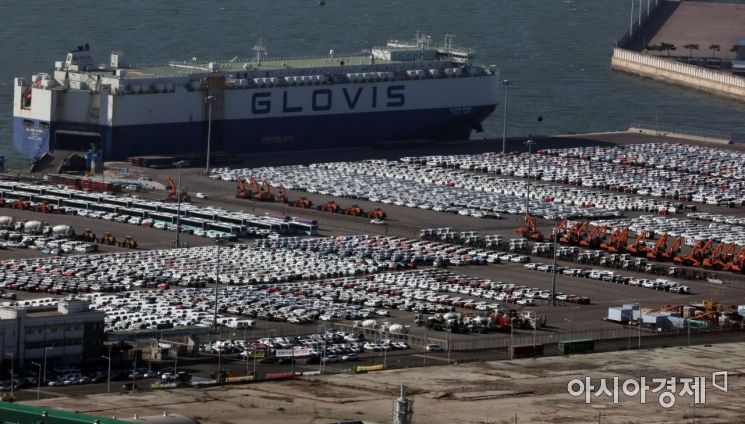
[Asia Economy Reporter Myung-hwan Lee] As the won-dollar exchange rate soars, expectations arise that domestic automakers, whose exports are their mainstay, will benefit. There is also analysis suggesting that the negative impact of the Inflation Reduction Act (IRA), implemented in the United States last month, may be limited.
According to the Korea Exchange on the 12th, examining the recent one-month (August 9 to September 8) stock price fluctuations of Hyundai Motor and Kia, Hyundai Motor rose 2.04%, while Kia fell 0.61%. Considering that during this period the KOSPI fell 4.36% and the KOSDAQ index dropped 6.38%, reflecting a decline in the domestic stock market due to the high exchange rate effect, these are decent results. On the most recent trading day, the 8th, in the Seoul foreign exchange market, the won-dollar exchange rate closed at 1,380.8 won per dollar, down 3.4 won from the previous day's closing price. Although the won-dollar exchange rate halted its rise after six trading days, it remains in the 1,380 won range.
There is also analysis that the negative factor of the Inflation Reduction Act will not significantly affect these stocks. When the Inflation Reduction Act was passed, concerns arose that domestic automakers might suffer losses in the U.S. market because the law provides tax benefits only for electric vehicles produced in North America.
The securities industry expects that the short-term damage from the Inflation Reduction Act will not be significant. This is because the number of automakers that can fully receive the tax benefits is limited. Yong-kwon Moon, a researcher at Shin Young Securities, said, "The U.S. Congressional Budget Office estimates that in 2023, only about 11,000 electric vehicles eligible for the $7,500 tax credit will account for just 0.1% of the U.S. annual new car market," adding, "Even if domestic companies suffer some loss in price competitiveness, the short-term damage will not be that large."
There is also analysis that the recent high exchange rate effect can be used to respond to the Inflation Reduction Act. Eun-young Lim, a researcher at Samsung Securities, said, "Currently, the won-dollar exchange rate is depreciated by 15% compared to the 2021 average, resulting in a price difference of $15,000 to $20,000 compared to Tesla vehicles, so subsidies do not affect price competitiveness," and evaluated, "The $3,750 subsidy gap for automakers is a level that can be sufficiently offset by the weak won."
There is also a forecast that attention should be paid to the moves of domestic automakers responding to the Inflation Reduction Act. Moon-soo Jang, a researcher at Hyundai Motor Securities, analyzed, "With directly benefiting models concentrated in 2024, Hyundai Motor Group’s planned line conversion and the accelerated operation of new plants are expected to alleviate concerns," adding, "Due to the internal and external strategies and concrete responses, stock price volatility will continue until early 2023, and early conversion is expected to strengthen the bargaining power of partners and create favorable operating conditions."
© The Asia Business Daily(www.asiae.co.kr). All rights reserved.
![Clutching a Stolen Dior Bag, Saying "I Hate Being Poor but Real"... The Grotesque Con of a "Human Knockoff" [Slate]](https://cwcontent.asiae.co.kr/asiaresize/183/2026021902243444107_1771435474.jpg)















