2019 Opening of National Goesan Memorial Cemetery
Visitors Flock During First Holiday Without Social Distancing
From Solo Visitors to Family Groups
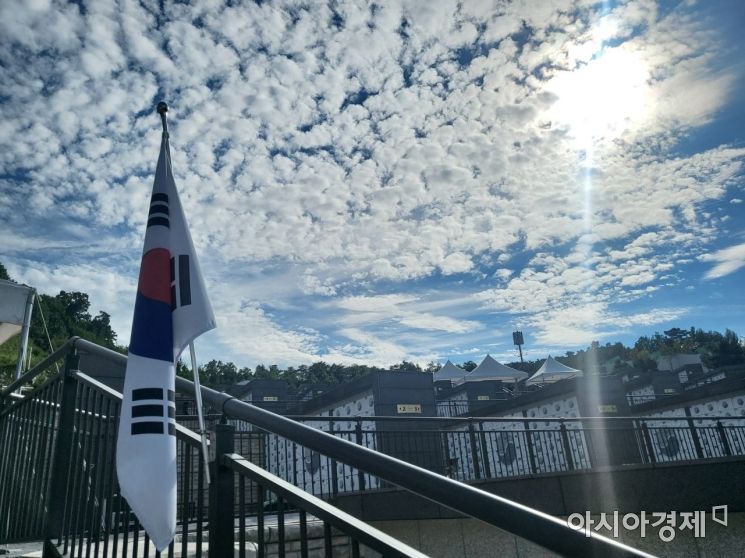 On the afternoon of the 10th around 3 PM, visitors continued to come to the National Goesan Memorial Cemetery located in Goesan, Chungbuk, to pay respects during the first holiday since social distancing measures were lifted.
 Photo by Oh Gyumin moh011@
[Asia Economy Reporter Oh Gyumin] “He loved drinking so much when he was alive...”
On the day of the Chuseok holiday, around 3 p.m. on the 10th, at the National Goe-san Memorial Cemetery located in Goesan, Chungbuk Province. The national cemetery without COVID-19 social distancing was filled with crowds visiting to pay respects. Dozens of vehicles were parked along the roadside from the entrance of the memorial cemetery. Passing the entrance and reaching the parking lot, a bus waiting to take visitors up to the 1st burial area was lined up with dozens of people. Because of the crowd, my family decided to walk up. Beyond the parking lot, there is the Hyeonchung Hall and Hyeonchung Plaza. Going up through there leads to the 1st burial area. The 2nd and 3rd burial areas are still under construction. As of August, about 15,000 graves are said to be interred here.
The National Goe-san Memorial Cemetery opened in 2019. According to the official website, it was established as a sacred place of national defense where those who sacrificed their lives for the country rest in peace. National cemeteries are broadly divided into three types: the National Hyeonchungwon in Seoul and Daejeon, where national merit recipients and presidents are buried; the National Democratic Cemetery for democratic martyrs; and the National Memorial Cemetery for veterans of the Korean War and others.
My maternal grandfather is buried at Goe-san Memorial Cemetery. He was a Korean War veteran. He served as a medic and administered injections to wounded soldiers. After safely being discharged, he lived an ordinary life farming in a very small island village in Wando, Jeonnam, his hometown. Coincidentally, my grandfather passed away on June 25, 1998, when I was seven years old. I don’t remember, but according to my parents, I cried heavily upon hearing the news. Perhaps because he was my only grandfather, whether or not I had met my paternal grandfather.
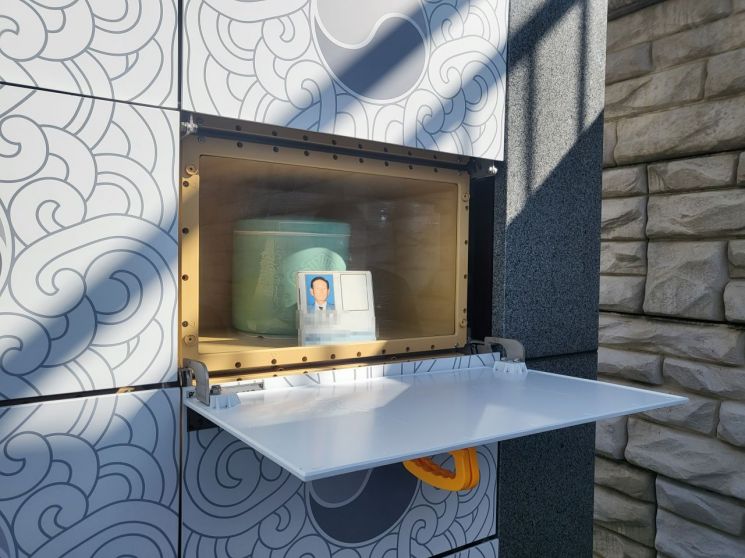 Next to the memorial shelf, there is a switch storage box where you can open the box using the switch. Inside the box, there were jars along with the grandfather's name and the names of family members written./Photo by Oh Gyumin moh011@
This was the first time I visited my maternal grandfather’s resting place. Two years ago, while I was in the military, my maternal relatives decided to move his grave because it became difficult to visit the island village where he was buried. My maternal grandmother, who lived alone on the island and whom I used to see every holiday, is now 96 years old and in poor health, currently residing in a nursing hospital in Gimpo, Gyeonggi Province. Due to COVID-19 visitation restrictions, it has been difficult to see her for several years. Given these circumstances, knowing about the existence of the memorial cemetery where veterans can be buried, they decided to relocate the grave.
My grandfather was enshrined in the 1st burial area’s ossuary. After cremation, the remaining ashes are stored in an urn placed inside a box of a certain size. The box is usually closed and has a nameplate reading “Army Sergeant Jeon OO.” Next to the ossuary is a storage box for an opener device, which can be used to open the box. Inside the box, along with the urn, were my grandfather’s name and the names of family members.
My mother, who wanted to visit even just the place where my grandfather rests due to visitation restrictions on my grandmother, looked at his photo and said with a smile, “He loved drinking so much, and even the photo has yellowed.” After sharing stories about my grandfather with my father and offering a final prayer, my father closed the box and said, “Father, we will visit you again.”
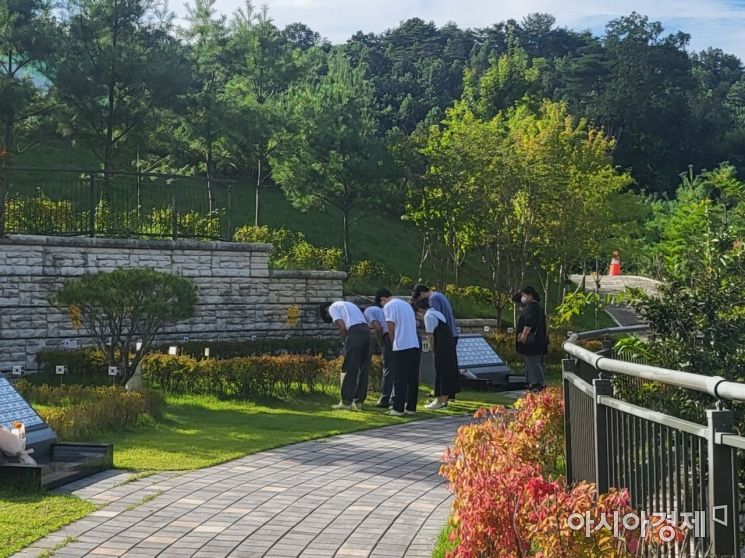 Visitors to the National Cemetery were diverse. A man in his 40s sitting behind my family came alone and sat for a while, looking at photos of his parents. A family of about ten, who had laid their parents to rest in a natural burial ground where urns are buried in the ground, gathered with bowed heads in prayer.
 Photo by Oh Gyumin moh011@
The people visiting the national cemetery were diverse. A man in his 40s behind my family came alone and sat for a while looking at his parents’ photos. A family of about ten who had their parents buried in a natural burial ground where urns are buried in the ground bowed their heads in prayer. A couple was busily placing ancestral ritual foods on a marble table set up in front of the boxes.
The first holiday without social distancing. It was a time when many people met their ancestors and shared family affection.
© The Asia Business Daily(www.asiae.co.kr). All rights reserved.
![Clutching a Stolen Dior Bag, Saying "I Hate Being Poor but Real"... The Grotesque Con of a "Human Knockoff" [Slate]](https://cwcontent.asiae.co.kr/asiaresize/183/2026021902243444107_1771435474.jpg)

















