At the End of This Month's UN General Assembly, Move to Adopt Resolution Banning Satellite Interceptor Missile Tests
Consideration of Mandatory Satellite Deorbit Within 5 Years After Mission End to Prevent Space Debris
Active Response to China-Russia Hostile Space Weapon Threats
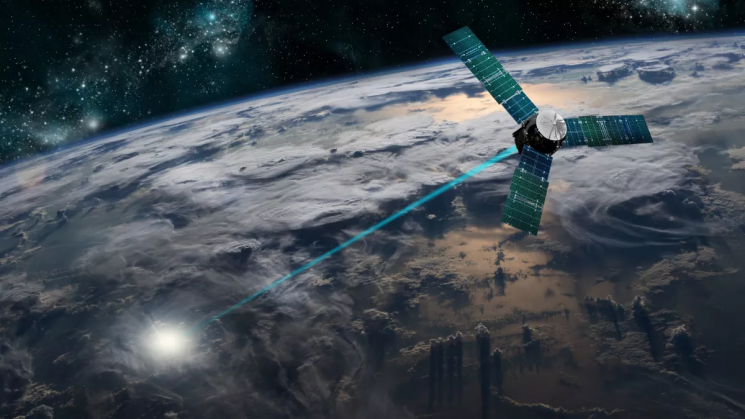
[Asia Economy Reporter Kim Bong-su] The United States is taking proactive measures to ensure national security in outer space. In addition to promoting the April declaration banning satellite interceptor missile tests to other countries, it is also considering mandating the removal of defunct satellites from orbit within five years. The U.S. is seriously preparing countermeasures against the expansion of space attack weapons by hostile countries such as China and Russia.
On the 9th (local time), U.S. Vice President Kamala Harris announced at the National Space Council held at NASA's Johnson Space Center that she plans to urge other countries to refrain from satellite interceptor missile tests at the upcoming United Nations (UN) General Assembly this month.
The U.S. declared in April that it would no longer conduct satellite interceptor missile tests that cause a surge in space debris. This was in response to the catastrophic situation caused by Russia's satellite interceptor missile test last November, which created tens of thousands of debris pieces threatening the International Space Station (ISS) at speeds exceeding 7 km/s.
Monica Medina, U.S. Deputy Assistant Secretary of State, also stated at the meeting, "We are working hard to involve other countries in the satellite interceptor missile test ban treaty during the UN General Assembly held in New York City from the 13th to the 27th," adding, "A dedicated team will conduct extensive consultations at the UN next week, and our goal is to gain broad support for the adoption of a resolution."
The U.S. Federal Communications Commission (FCC) is preparing stringent regulations for satellites that are defunct or abandoned in orbit. On the 8th, the FCC announced a draft regulation requiring operators of satellites in low Earth orbit (LEO) to deorbit and cause satellites to re-enter the atmosphere within five years after failure or end of life.
Specifically, the regulation will apply to satellites operating at altitudes below 2,000 km launched two years after the adoption of the rule. This includes both U.S.-made and imported satellites. This is a much stricter regulation compared to the existing 25-year guideline, and strong opposition from U.S. satellite companies is expected. The FCC plans to hold a public meeting at the end of this month to decide on the adoption of this regulation.
Measures to address space security threats from China, Russia, and others are also being actively pursued. On the 6th and 7th, U.S. Defense Secretary Lloyd Austin and senior officials from the Department of Defense and the Defense Policy Board met to discuss ways to protect U.S. military orbital assets from space weapons being developed by hostile countries such as China and Russia. The meeting reportedly focused particularly on last year's Chinese development and testing of hypersonic vehicles and the Fractional Orbital Bombardment System (FOBS). Deputy Secretary of Defense Colin Kahl explained, "China's FOBS test raised serious questions about whether this type of technology could destroy the U.S. missile early warning system," adding, "We do not yet believe China has developed capabilities to undermine U.S. nuclear deterrence."
© The Asia Business Daily(www.asiae.co.kr). All rights reserved.

















