Establishment of Police Agency, Presidential Office Favoritism Allegations and Other Variables
Ruling Party's Large-Medium-Small Business Win-Win Act, Long-Term Public Rental Housing Act
Opposition's Half-Price Transportation, Yellow Envelope Act Promises
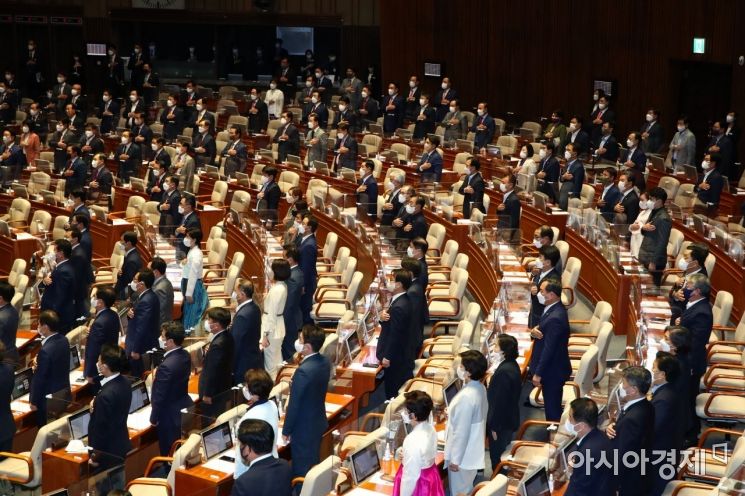 On the 1st, members of the National Assembly are performing the national ceremony at the opening ceremony of the regular session held at the National Assembly. Photo by Dongju Yoon doso7@
[Asia Economy Reporter Park Jun-yi] The first regular session of the National Assembly since the launch of the Yoon Suk-yeol administration has begun. Both the ruling and opposition parties have emphasized 'livelihood legislation' and announced their agendas, but it is expected that contentious issues such as the establishment of the Police Bureau and allegations of preferential treatment in the Presidential Office will inevitably lead to clashes in this session as well.
On the 1st, the National Assembly held the opening ceremony of the 400th regular session in the plenary hall and embarked on a 100-day schedule. The ruling and opposition parties will deliver their respective negotiation group representative speeches on the 14th by the Democratic Party and on the 15th by the People Power Party, followed by government questioning from the 19th to the 22nd. Subsequently, the audit of state affairs will be conducted from the 4th to the 24th of next month.
Ahead of the regular session, both parties expressed their determination to promote 'livelihood legislation.' On the 30th of last month, the Democratic Party held the '2022 Regular Session Preparation Workshop for Members of the National Assembly' and selected the '22 Major Livelihood Legislative Tasks for the Regular Session.'
Among the legislative tasks are the 'Half-Price Transportation Fare Support Act,' which expands the scope of state financial support for public transportation to include public transportation users and refunds 50% of public transportation expenses from August to the end of the year, and the 'Yellow Envelope Act,' which guarantees the three labor rights by prohibiting employers from claiming damages caused by labor union activities. Also included are the 'Flood Damage Support Act' and bills supporting small business owners and self-employed persons affected by COVID-19.
The People Power Party also announced plans to promote legislation for the vulnerable, livelihood, and future. Sung Il-jong, chairman of the People Power Party Policy Committee, set a goal of pushing 100 legislative tasks, categorizing them as "First, national unity accompanying the vulnerable; second, recovery of the livelihood economy; third, leap toward the future," and stated, "To achieve national unity accompanying the vulnerable, we will create an environment where fair prices are paid for supply through the Large, Medium, and Small Enterprises Win-Win Act, build livable public rental housing through the Long-Term Public Rental Housing Act, and create a society where everyone prospers together through the Fire Safety Education Act for the Disabled."
Additionally, legislative plans include the Parental Care Allowance Act, the First-Time Homebuyer Activation Act, and the Special Act on New Towns. They also aim to foster future growth industries through the Semiconductor Special Act and the Local Education Finance Grant Act.
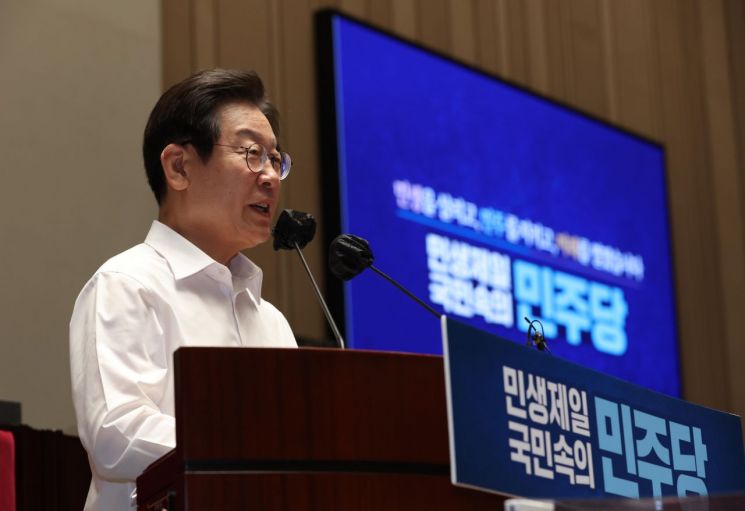
However, in this regular session, it is expected that the ruling and opposition parties will engage in fierce debates over contentious issues such as the government budget bill, the establishment of the Police Bureau, and the complete removal of prosecutorial investigation rights (known as 'Geomsu Wanbak'). In particular, clashes between the ruling and opposition parties are anticipated over the Presidential Office, including preferential treatment in the relocation of the presidential office and official residence construction contracts, as well as controversies over private hiring.
From the start of the regular session, the prosecution's summons and indictment of Lee Jae-myung, leader of the Democratic Party, are seen as variables that could affect the passage of bills and budget bills. The Democratic Party has announced that it will push for a special prosecutor law regarding First Lady Kim Geon-hee and demand a state audit of the Presidential Office as a party policy.
© The Asia Business Daily(www.asiae.co.kr). All rights reserved.
![Clutching a Stolen Dior Bag, Saying "I Hate Being Poor but Real"... The Grotesque Con of a "Human Knockoff" [Slate]](https://cwcontent.asiae.co.kr/asiaresize/183/2026021902243444107_1771435474.jpg)

















