[Asia Economy Reporter Minji Lee] Since last month, the stock prices of the three major telecom companies have been sluggish. This is due to a large volume of profit-taking sales amid concerns about profit peak-out. Although concerns about profit growth continue, experts believe that these stocks remain attractive as dividend stocks because they generate profits regardless of external conditions.
According to the Korea Exchange on the 9th, the stock prices of the three telecom companies have continued to show a weak trend over the past month. KT fell by 8.57% during this period, while SK Telecom (-2%) and LG Uplus (-11%) also showed a downward trend. Rather than individual company issues, it is analyzed that the attractiveness of the sector itself has declined, and since the sector had a larger increase compared to other sectors in the first half of the year, profit-taking sales have emerged.
In fact, foreign and institutional investors increased their net selling of these stocks. They sold a total of 53.8 billion KRW worth of LG Uplus shares and net sold KT shares worth 74.7 billion KRW. Foreign investors net sold SK Telecom shares worth 178.2 billion KRW.
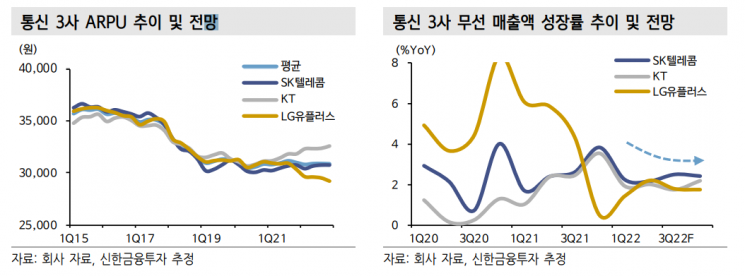
The biggest momentum that could affect telecom stocks going forward is the activation of flagship smartphones. Samsung’s flagship smartphones were activated on the 23rd, and the iPhone 14 series will begin pre-orders on the 23rd. Considering the extended phone replacement cycle and diversification of 5G plans, 5G subscriber growth is expected to continue in the second half of the year. The possibility of a sharp increase in marketing expenses is also low. Aram Kim, a researcher at Shinhan Financial Investment, said, “All three companies have been communicating that they will avoid marketing competition,” adding that “the 5G penetration rate will also increase.”
National audits must also be taken into account. The three telecom companies have been regular subjects of the national audit conducted from early to mid-October. Since mentions of related telecom companies begin from early to mid-September, sales pressure may emerge. Especially since there has been no special pressure on telecom companies since the inauguration of the Yoon Seok-yeol administration, there is a possibility that demands for additional fee reductions or network investment expansions will arise around the national audit period.
There is also a possibility of inflow of demand for dividends. KT only pays a year-end dividend, with an expected dividend yield of 5.5%. SK Telecom’s expected annual dividend yield this year is 6.5%, and LG Uplus is expected to yield 5.8%. Researcher Aram Kim analyzed, “However, considering the recent trend in government bond yields, dividend yields of other sectors, and both quarterly and interim dividends, the attractiveness of the telecom sector may be somewhat lower than in previous years.”
Finally, Researcher Kim said, “Although there is a possibility that investors may proactively reduce sector weight ahead of profit growth peak-out concerns and the national audit, the sector remains attractive as a defensive and dividend stock,” adding, “It is also important to consider that structural profit growth is occurring after the 5G transition.”
© The Asia Business Daily(www.asiae.co.kr). All rights reserved.

















