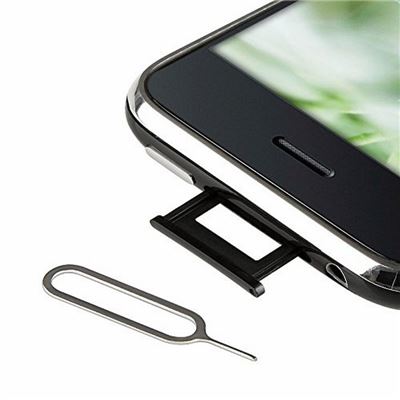
 To replace a regular USIM, a separate pin is required. Additionally, a tray to hold the USIM chip is needed. An eSIM, however, is embedded directly within the smartphone itself, eliminating the need for both a tray and a pin.
[Asia Economy Reporter Lim Hye-seon] Apple announced that it will remove the USIM (Universal Subscriber Identity Module) and provide only eSIM for the new smartphone 'iPhone 14' US model. This move is faster than South Korea, which introduced the eSIM system starting this month.
At the product launch event held on the 8th, Apple stated, "For the first time, the SIM tray is removed from all US models," adding, "There is no longer a need to deal with physical SIM cards." Apple highlighted the security advantage of not being able to physically remove the SIM card. Apple explained, "Thanks to the efforts of carriers, the iPhone eSIM experience has become possible," and "Multiple eSIMs can be stored on one device, allowing the use of multiple plans and phone numbers." The embedded digital SIM (eSIM) is built into the device during the manufacturing process, so consumers do not need to purchase a separate USIM. By scanning a QR code provided by mobile carriers, the carrier's profile is downloaded to the eSIM, completing the activation process.
eSIM has already become widespread overseas. The GSMA (Global System for Mobile Communications Association) published the eSIM standard specification in 2016. As of December last year, 175 operators in 69 countries including the US, UK, and Germany provide commercial eSIM services. According to market research firm Counterpoint Research, the number of eSIM-compatible phones is expected to surge from 364 million units in 2018 to 2 billion units by 2025. This means that 50% of global smartphones will support eSIM.
In South Korea, eSIM service started on the 1st of this month. The introduction of eSIM in Korea is somewhat delayed compared to overseas. Carriers have been reluctant to adopt eSIM so far. From the carriers' perspective, USIM sales revenue decreases and average revenue per user (ARPU) also declines. Number portability becomes easier, leading to increased subscriber churn.
Mobile carriers have launched eSIM-exclusive plans. KT introduced the 'Dual Number' plan for 8,800 KRW per month, allowing two numbers on one phone. This dual SIM plan uses both physical USIM and eSIM simultaneously, providing 1GB of data, with speeds up to 400Kbps after data exhaustion. LG Uplus's 'Dual Number Plus' issues a second number on one smartphone, offering 250MB of data (QoS 400Kbps after exhaustion) for 8,800 KRW per month, and allows sharing of call and text usage from the first number. Notably, the second number can also share the data included in the first number's plan for unlimited use. SK Telecom's 'My Two Number' service provides voice line sharing, basic text messages, and 250MB data plus shared data from the main line (up to 400kbps after exhaustion) for 8,800 KRW per month. eSIM is available on Galaxy Z Fold4, Flip4, and iPhone XS or later devices.
© The Asia Business Daily(www.asiae.co.kr). All rights reserved.
















