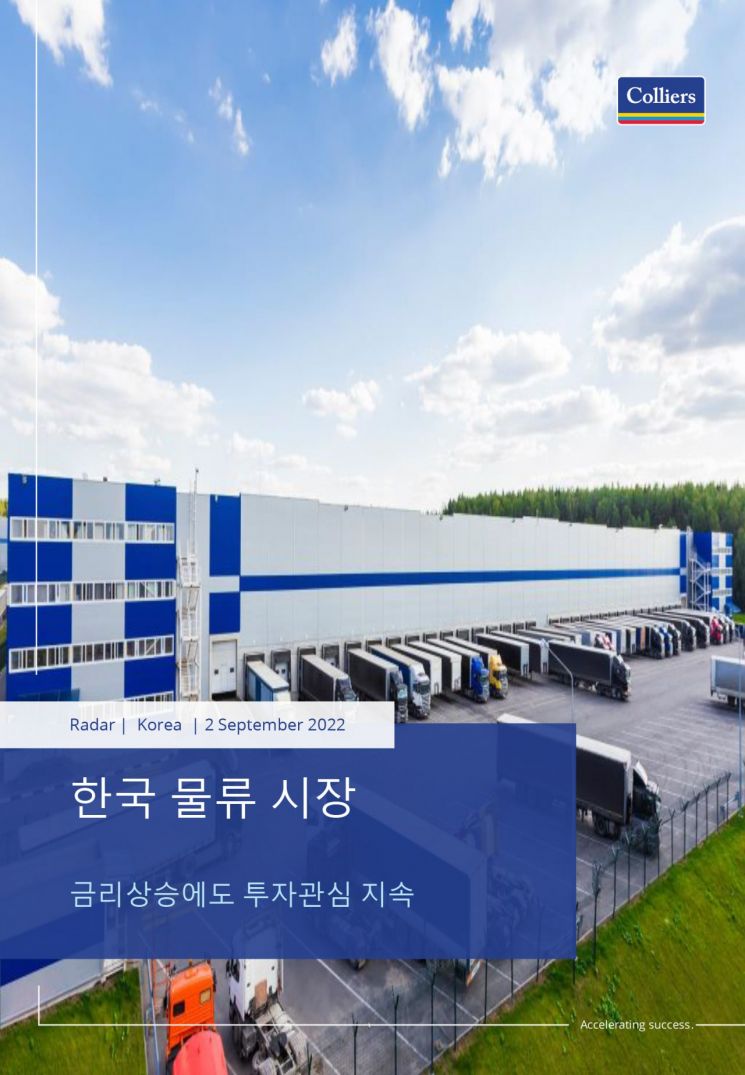
[Asia Economy Reporter Tae-min Ryu] Global real estate consulting firm Colliers forecasts that investment interest in the Korean logistics market will continue despite the rising interest rate environment.
Global real estate consulting firm Colliers released a logistics market report on the current status and key issues of the Korean logistics center investment market. According to the report, last year, the total logistics transaction asset size in Korea was approximately KRW 10.4 trillion, of which about KRW 7.4 trillion (over 70%) occurred in the Seoul metropolitan area.
Despite the rising transaction prices driven by the preference for logistics center investments, some investors are postponing investment decisions due to rising interest rates and increased construction costs for logistics center development. The logistics transaction volume is expected to be about KRW 2 trillion in the first half of this year, with the total transaction volume for this year projected to decrease compared to last year.
Jong-wook Cho, Executive Director of Colliers Korea (Capital Markets and Investment Services Team), stated, “Due to the rising interest rate trend and increased construction costs, the logistics transaction volume this year is expected to decrease compared to last year,” adding, “Nevertheless, long-term investor interest in logistics centers will continue.” He further noted, “Due to the rise in development costs, investors are shifting from a strategy of maximizing returns through development to investing in already completed logistics assets.”
Robert Wilkins, CEO of Colliers Korea, said, “Last year, logistics investments were led by domestic investors,” and added, “With recent interest rate hikes, we expect overseas investors with secured capital to become active again.”
Hyun-joo Jang, Director of Research at Colliers Korea, mentioned in the report, “Due to rising construction costs and stricter permit regulations, the supply timing of logistics centers may be delayed beyond expectations,” and “Contrary to expectations, the supply volume of logistics centers over the next two years is likely to decrease due to construction delays.”
This Colliers logistics market report analyzed the status and transaction cases of major logistics centers by dividing the Seoul metropolitan area into four large zones: Northwest, Northeast, Southwest, and Southeast, based on logistics centers owned by major investors.
As of 2021, there are about 350 logistics centers owned by major investors in the Seoul metropolitan area. Among these, nearly half of the logistics centers are concentrated in the Southeast region, which includes Yongin and Icheon, based on the number of logistics centers owned by major investors. Following the Southeast, the Northwest region, including Incheon, is another area with a large supply of logistics centers. The Northwest is expected to become the second-largest logistics center supply area following the Southeast, with supply expected to increase.
Based on investment amounts in the first half of 2022, the investor owning the most logistics assets is Maston Investment Management, which owns about 20 logistics assets as of the first half of this year. The next most active investors are ADF Asset Management, a domestic logistics center specialist investor, and ESR Kendal Square REIT.
Due to the surge in material prices and resulting development cost increases, developers and asset managers investing in logistics center development are delaying supply timing due to concerns over rising construction costs. In fact, construction companies developing logistics centers that have already started construction are reportedly demanding increased construction costs from developers. Due to rising development costs, investors are shifting from a strategy of maximizing returns through development to investing in already completed logistics assets. To mitigate yield declines, investors are expected to require more risk management for construction cost increases during new developments.
Additionally, concerns about vacancies in cold storage warehouses are increasing due to the expansion of the fresh food market and the resulting increase in cold storage supply. As demand for cold storage has increased with the expansion of the fresh food delivery market, investors have increased supply and investment in cold storage. For pre-purchased cold storage logistics assets that have not secured tenants, vacancy risk may increase. Furthermore, cases of design changes in planned logistics assets originally designed as cold storage are expected to rise.
Colliers stated that e-commerce and parcel volumes will continue to increase, sustaining tenant demand from 3PL and e-commerce companies. They also forecast that technologies for efficient logistics center management will advance and that the adoption of ESG in logistics centers will increase.
© The Asia Business Daily(www.asiae.co.kr). All rights reserved.
![Clutching a Stolen Dior Bag, Saying "I Hate Being Poor but Real"... The Grotesque Con of a "Human Knockoff" [Slate]](https://cwcontent.asiae.co.kr/asiaresize/183/2026021902243444107_1771435474.jpg)















