August Food Prices Up 8.4% YoY... Highest in 13 Years
Paprika Rises 77% in One Month... Food Prices Surge Amid Typhoon Hinnamnor Damage
Statistics Korea Conducts Only 3 Surveys Monthly, Fails to Reflect Perceived Inflation Speed
[Asia Economy Sejong=Reporter Kwon Haeyoung] Concerns are growing that prices, especially for food items, could soar even higher as the high inflation coincides with the upcoming Chuseok holiday and a typhoon. Some items such as radish, napa cabbage, and hairtail fish have already seen sharp price increases following the typhoon. If agricultural production worsens due to the typhoon and dining-out demand rises because of substitute holidays in October, food prices could be further driven up, increasing the financial burden felt by ordinary citizens.
According to the Korea Agro-Fisheries & Food Trade Corporation on the 8th, the retail price of one radish was 3,919 won as of the previous day, a 28.1% surge within a week compared to 3,059 won at the end of last month, just before Typhoon Hinnamnor occurred. Tomato prices rose 21.2% in a week to 7,481 won per kilogram, while prices of napa cabbage (14.7%), cabbage (14.7%), and oriental melon (6.8%) also increased consecutively. Hairtail fish prices also rose 8.5% in a week, reaching 7,776 won per fish, as fishing days decreased due to the typhoon.
Typhoon Hinnamnor caused significant damage mainly in the southern regions, disrupting the logistics of harvesting and fishing for agricultural and marine products, further fueling the already soaring food prices centered on vegetable prices. Additionally, the demand for Chuseok holiday goods, which arrived earlier than usual, is pushing prices up.
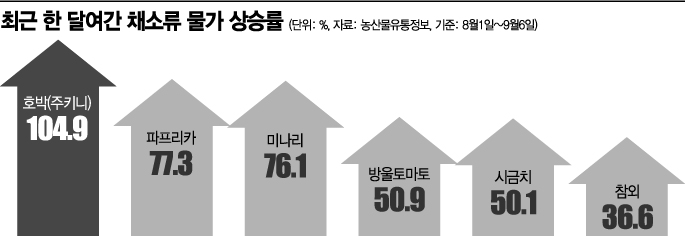
The pressure on prices, especially for agricultural products, is even more pronounced when looking at the past month. This is due to poor crop yields caused by summer heatwaves and heavy rains. The price of one zucchini reached 3,524 won on the 6th, a 104.9% increase compared to 1,720 won on August 1st. In just over a month, the price more than doubled. During the same period, the price of one Korean zucchini (aehobak) rose 83.6%, from 1,548 won to 2,842 won. Paprika prices increased 77.3% to 2,456 won per 200 grams, while water dropwort (minari) rose 76.1%, cherry tomatoes 50.9%, spinach 50.1%, and oriental melon 36.6%, all showing steep upward trends.
As vegetable prices surged, the food price index compiled by Statistics Korea rose 8.4% in August compared to a year ago, marking the highest level in 13 years. However, this is insufficient to fully reflect the actual basket prices felt by consumers.
Looking at individual items, the August price increase rate for paprika is 43.1% according to Statistics Korea. However, the Korea Agro-Fisheries & Food Trade Corporation reports a 73.6% increase, 30.5 percentage points higher than the government statistics. For spinach, Statistics Korea recorded a 32.0% increase, while the corporation reported 49.1%. The price increase rate for water dropwort was 17.9% and 65.7%, respectively, showing a significant gap between government and corporation statistics. Unlike the corporation, which surveys daily agricultural product prices, Statistics Korea compiles data only three times a month, so government statistics do not fully capture the speed of price increases experienced by consumers. A Statistics Korea official explained, "The government does not survey daily prices but reflects various factors such as regional weighting."
It remains uncertain whether the instability in agricultural product prices will subside. If crop damage from the typhoon is severe, food prices could rise further. To make matters worse, there will be two substitute holidays next month, which could further stimulate the already soaring dining-out prices. Dining-out prices rose 8.8% last month, the largest increase in about 30 years since October 1992 (8.8%). This is due to rising food material costs and labor expenses, raising concerns that the rate could reach 9% within the year.
An official from the Ministry of Economy and Finance stated, "The government has supplied additional goods, focusing on items with insufficient supply compared to current demand, such as Chuseok holiday goods," and added, "We will continue to closely monitor supply and demand situations and take necessary measures."
© The Asia Business Daily(www.asiae.co.kr). All rights reserved.
![Clutching a Stolen Dior Bag, Saying "I Hate Being Poor but Real"... The Grotesque Con of a "Human Knockoff" [Slate]](https://cwcontent.asiae.co.kr/asiaresize/183/2026021902243444107_1771435474.jpg)
















