[Asia Economy Reporter Jeong Hyunjin] The Biden administration in the United States has unveiled a detailed implementation plan for the 'Chips and Science Act (CSA),' created to support securing semiconductor production facilities domestically. To secure leadership in semiconductors, it plans to provide funding amounting to $39 billion (approximately 54 trillion KRW) starting next spring, aiming to attract global semiconductor companies to the U.S. Korean companies that announced investment plans in the U.S. can now expect support funds, but they face a difficult situation due to so-called 'China investment restrictions' as guardrail regulations. Meanwhile, it has been revealed that some overseas companies that intended to invest in Korea are now heading to the U.S.
◇ "Some funds from the Chips and Science Act expected to be disbursed by next spring"
The Biden administration released the 'A Strategy for The CHIPS for America Fund' on the same day. U.S. Secretary of Commerce Gina Raimondo stated in a White House briefing that they plan to accept applications for support funds from companies before February next year for disbursement, adding, "We hope to provide support funds to some companies by next spring." This announcement came just one month after President Biden signed the Chips and Science Act on the 9th of last month, revealing specific implementation details.
The U.S. will prioritize using $39 billion out of the $52 billion support fund in the Chips and Science Act to support the establishment of facilities for the development and technological maintenance of the U.S. semiconductor industry. Regarding the facility construction support that semiconductor companies are most focused on, the Department of Commerce plans to allocate about $28 billion to support domestic production of advanced logic semiconductors and memory semiconductors required for precise manufacturing processes. Approximately $10 billion will be used to support the expansion of mature process semiconductor production facilities used in automobiles, military, and medical devices.
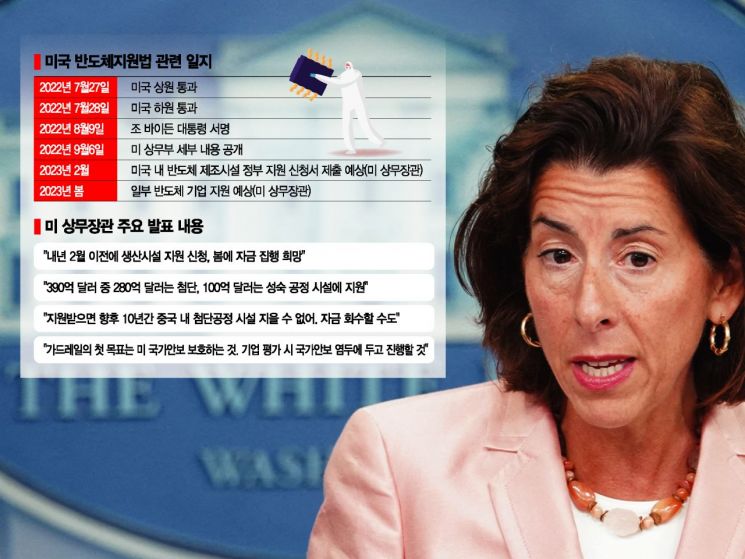
Secretary Raimondo said that detailed application guidelines related to this will be announced in early February next year, and a group of about 50 experts to be formed soon will review them. She said, "We want to negotiate each deal one by one. Companies must prove that the support funds are necessary for semiconductor production."
◇ "If investing in advanced semiconductors in China after receiving U.S. support, funds will be reclaimed"
However, Secretary Raimondo stated that since tax money is involved, they will set 'guardrails' to ensure that funds are focused on expanding U.S. semiconductor production capacity. Regarding the China investment restrictions that the Korean semiconductor industry is paying attention to, she said, "Companies receiving funds cannot build advanced process facilities in China for the next 10 years," adding, "They can only expand mature process factories in China for the Chinese market." She explained that mature process semiconductors are only capable of producing inexpensive semiconductors used in devices like computer monitors or automobiles, and added, "If companies receive support funds and exceed this, the funds will be reclaimed."
The U.S. semiconductor support law specifically states that semiconductor foundry investments below 28 nanometers (nm; 1 nm is one-billionth of a meter) cannot be newly made in China. When reporters asked for more details, Secretary Raimondo said, "We will review each case individually," and added, "What I can say is that the primary purpose of implementing these (China-related guardrails) is to protect U.S. national security. Every factor we consider when evaluating companies will be viewed through the lens of national security protection."
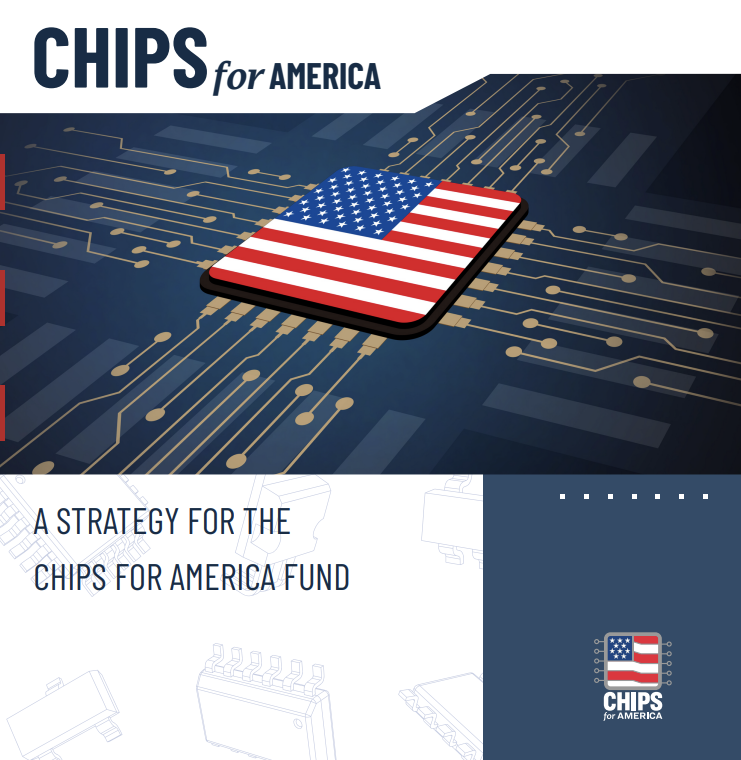 Cover of the document "Support Strategy for the Development of the U.S. Semiconductor Industry" released by the Joe Biden administration on the 6th (local time)
During the White House briefing, Secretary Raimondo repeatedly emphasized that global semiconductor companies have announced investments in the U.S. one after another. She said, "If this law had not passed, Micron in the U.S. would not have announced a large-scale expansion plan in Idaho," and mentioned that the $5 billion Texas new plant investment by Taiwanese semiconductor company GlobalWafers announced in June reflects the law's effectiveness.
In an interview with the Wall Street Journal (WSJ) released that day, Secretary Raimondo said, "The most important thing we can do to compete with China is investment in the U.S.," adding, "The U.S. needs to dominate certain technology sectors such as critical minerals, electric vehicle batteries, semiconductors, and artificial intelligence (AI)."
She also revealed that she contacted former senior national security officials from the Donald Trump administration to garner congressional support for the Chips and Science Act. Secretary Raimondo said that after hearing from her security team that former White House National Security Advisor H.R. McMaster praised her on a podcast, she invited McMaster and three other former Trump administration officials to emphasize that the Chips and Science Act is bipartisan and crucial for U.S. national security. WSJ reported that McMaster described the meeting as "a conversation defining competition with China as a bipartisan issue." Four months later, the Chips and Science Act passed the Senate with the support of 17 Republican senators.
◇ Korea in a difficult position, even losing investments to the U.S.
As the U.S. takes a further step toward reshaping the global semiconductor market centered on itself, Korea finds itself in a difficult situation. Major semiconductor companies such as Samsung Electronics and SK Hynix, which have factories in China, plan to make large-scale investments in the U.S. and receive local government support, but they must consider this in connection with their investments in China. The schedule for the so-called 'Chip 4 (Fab 4)' semiconductor supply chain forum with Korea, Japan, and Taiwan, originally planned by the U.S. for early this month, continues to be postponed.
Moreover, due to the U.S. semiconductor support law, global semiconductor companies are even losing investments to the U.S. Secretary Raimondo shared in an interview with WSJ that Taiwanese company GlobalWafers abandoned a $5 billion expansion plan for a semiconductor plant in Germany and was reviewing other investments as of last February. She revealed that she persuaded Doris Su, GlobalWafers' CEO, during a one-hour phone call in June. At that time, CEO Su said that without U.S. support funds, they would build a new plant in Korea, where construction costs are about one-third of those in the U.S. Raimondo responded by saying, "Let's do the math," and persuaded her. Two weeks later, GlobalWafers announced plans to build a new plant in Texas with a $5 billion investment, creating 1,500 jobs.
© The Asia Business Daily(www.asiae.co.kr). All rights reserved.



















