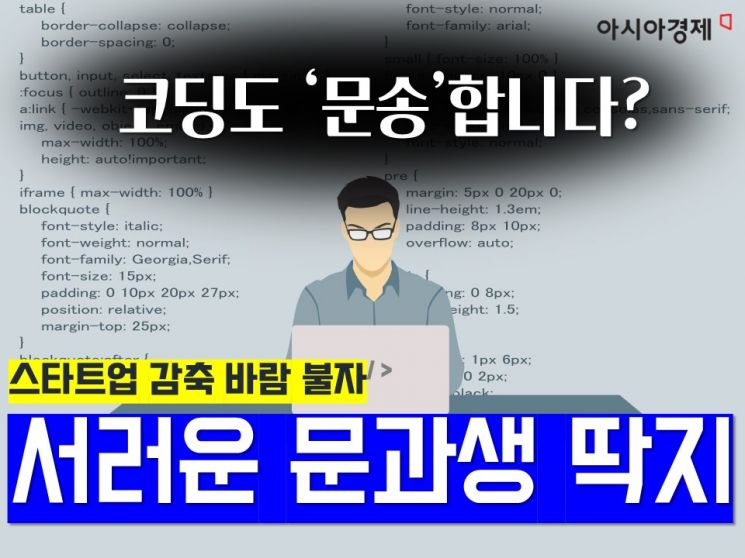
 The so-called 'liberal arts graduates aspiring to become developers' who have learned development job skills at boot camps and short-term programming academies are finding it increasingly difficult to get employed. / Photo by Song Hyundo, Asia Economy intern reporter
[Asia Economy Reporter Lim Juhyung, Intern Reporter Song Hyundo] #A (26), a prospective graduate of the College of Humanities, is currently filled with worries about employment issues. Majoring in 'Munsacheol' (Literature, History, Philosophy), he recently completed an 8-week short-term coding training program. This is an effort to gain even a slight advantage in the job market. However, for someone already labeled as a 'liberal arts student,' securing a job in IT development remains distant. A said, "From what I heard from friends who got jobs at IT companies first, these days companies don't welcome liberal arts graduates that much," adding, "Graduation is just around the corner, and I feel lost about how to make a living."
Due to the global economic slowdown, IT giants and tech startups are reducing hiring, narrowing the employment opportunities for so-called 'liberal arts graduates aspiring to be developers.' Companies prefer experienced veterans with proven skills over novice developers who learned programming through intensive courses. Concerns are rising that the already severe employment difficulties faced by liberal arts job seekers compared to science majors are worsening.
A is not the only job seeker distressed by the 'liberal arts student' label. Another liberal arts graduate, B (27), said, "Fields once considered liberal arts jobs like banking, PR, and sales now require coding," expressing frustration, "Even if you hurriedly learn programming at bootcamps or intensive academies, how can you compare with those who have built knowledge over four years of university? Does graduating from a liberal arts college mean you have to give up on employment altogether?"
 A cram school district in Gangnam-gu, Seoul, densely populated with short-term coding academies commonly called 'boot camps.' The photo is not related to any specific expression in the article. / Photo by Juhyung Lim skepped@
Employment difficulties for liberal arts students have been a chronic problem. According to a 2019 report from the Korea Labor Institute's 'Monthly Labor Review,' the employment rate for humanities majors was 56.0%, the lowest among all majors, and the average monthly starting salary was 2.2 million KRW, below the overall average of 2.5 million KRW.
Amid this, liberal arts students have turned to intensive coding academies as a 'breakthrough.' Known as 'coding bootcamps,' these programs last 3 to 6 months, or as short as 6 to 8 weeks, training non-majors in basic development skills needed for IT jobs and supplying labor to IT companies. Recently, many bootcamps are offered entirely online, and some provide courses at affordable prices with government support such as the 'National Tomorrow Learning Card.'
The digital transformation and ICT boom, which became a hot topic after the COVID-19 pandemic, also encouraged the emergence of 'liberal arts developers.' To develop new IT systems, IT companies hired many developers, including novice developers with basic programming skills.
However, with economic setbacks such as the energy price surge caused by the Russia-Ukraine war and the global inflation crisis this year, IT companies have also been hit, and novice developers appear to be the first to suffer.

According to employment trend data published by the Korea Software Policy Research Institute in the first half of this year, IT companies posted about 5,700 job openings for entry-level developers this year, down 900 from 6,600 last year. Meanwhile, job postings for experienced positions increased by about 1,600 to approximately 10,600 from 8,900 last year. This indicates that IT companies preparing for the recession have shifted their focus from novice developers to veteran engineers with proven skills.
There are also criticisms that some coding academies provide overly inadequate curricula to non-major developer aspirants, reinforcing IT companies' 'prejudices.' C (32), an engineer in charge of security development at an IT company in Pangyo, said, "Development is not a job you can master by cramming for a few months. You have to learn step by step from the bottom up, but some academies only teach superficial programming. So companies pay a lot to hire developers but end up with people who can't really do the job, causing losses for the companies."
Experts diagnose that the problem lies in the poor learning curricula of some coding academies. Theory-centered coding education, detached from practical work, cannot cultivate programmers suitable for companies.
Professor Kim Hyuncheol of Korea University’s Department of Computer Science pointed out, "There is a significant gap between learning programming theory and actually writing code to create software in companies. Corporate practitioners work in teams centered on 'projects' and know how to write code efficiently, but theory alone cannot teach these skills."
He added, "Bootcamps run by large companies like Naver and Kakao, and educational institutions with solid government support, have established teaching methods where experienced practitioners pass coding knowledge to students, allowing non-majors to grow into excellent programmers. Skipping this apprenticeship-style education and only teaching theory at some private academies has its limits."
© The Asia Business Daily(www.asiae.co.kr). All rights reserved.
![Clutching a Stolen Dior Bag, Saying "I Hate Being Poor but Real"... The Grotesque Con of a "Human Knockoff" [Slate]](https://cwcontent.asiae.co.kr/asiaresize/183/2026021902243444107_1771435474.jpg)

















