A Game Where 'Not Understanding Speech Well' Is Used as Humor
Concerns Over Distorting and Mocking Actual Communication Methods of the Hearing Impaired
Calls for Raising Awareness About Hearing Disabilities Before the Game
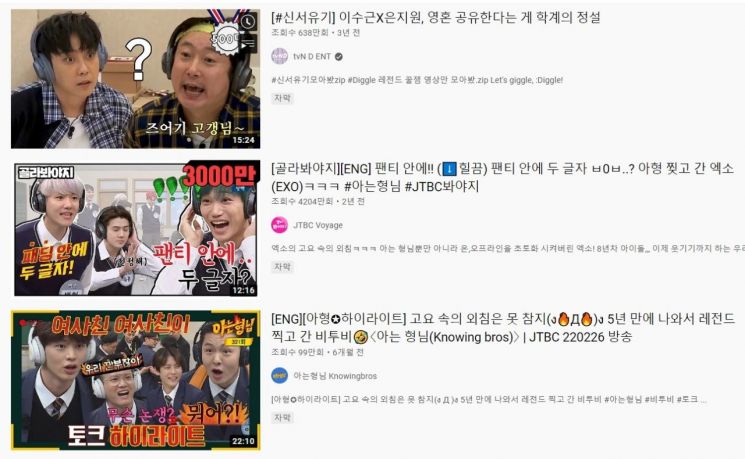 Screenshot of YouTube search results for 'Goyo Sok-ui Oechim'. The game video of the variety show 'Goyo Sok-ui Oechim' is gaining popularity with high view counts.
[Asia Economy Intern Reporter Yoonjin Kim] The popular game "Whisper in the Silence" featured on variety shows is facing controversy over alleged discrimination against the hearing impaired. While some criticize the issue as an excessive interpretation unrelated to the game's intent, others emphasize the need for a cautious approach given the ongoing concerns about media mockery of disabilities.
The way "Whisper in the Silence" is played is similar to a typical word-guessing quiz with a questioner and a respondent. The most distinctive feature is that all participants must wear headphones with the volume turned up so high that they cannot hear any surrounding sounds. The respondent must rely solely on the questioner's lip movements to understand the explanation and guess the correct answer.
During the game, misunderstandings and frustrating moments arise when participants fail to understand each other, exaggerated lip movements, or loud explanations provoke laughter from viewers. Searching "Whisper in the Silence" on YouTube reveals videos with over 10 million views, establishing the game as a popular "laughter cheat code" in variety shows.
However, there have been consistent criticisms that "Whisper in the Silence" mocks the communication difficulties experienced by the hearing impaired. The game fails to consider the perspective of hearing-impaired individuals who rely on speechreading (口話) to communicate because they cannot depend on sound. Hearing-impaired people point out that the elements consumed as humor in the game resemble the real challenges they face in communication.
For example, scenes where a player becomes frustrated and angry because the other person cannot understand their lip movements are depicted as humorous moments for viewers. However, this situation evokes the image of hearing people (聽人, people without hearing loss) who are unfamiliar with communicating with the hearing impaired getting angry simply because they "cannot understand speech well."
Deaf YouTuber Young+Young highlighted in the video "Intuitive Deaf Perspective - Whisper in the Silence Edition" that behaviors portrayed comically in the game?such as getting angry at someone who does not understand speech, exaggerating lip movements for each syllable, and speaking loudly?actually cause harm. A netizen who identified as hearing impaired stated, "Even if there is no bad intention, these elements hurt hearing-impaired people, and non-disabled people take those wounds lightly," adding, "This is also a form of ableism."
On the other hand, some netizens argue, "Then is the zombie game where the seeker is blindfolded offensive to the visually impaired? If you think that way, everything becomes a problem," or "The game was not created to mock anyone. Some hearing-impaired people do not see it as hateful, so you cannot say it is always discrimination," requesting that the game not be misunderstood or distorted. One netizen said, "Although the game does not specifically target hearing impairment, there is a perception in daily life that not understanding speech well is funny. We should play the game as a game but avoid getting angry at or making humor out of those who have difficulty hearing."
Regarding the expanding debate over discrimination against disabled people in "Whisper in the Silence," Professor Jiyoung Shin of Korea University’s Department of Korean Language and Literature stated, "Unless the game itself specifically targets disabled people, the context and attitude of participants considering disabled people during the game are important," adding, "If someone expresses discomfort, instead of getting angry, we should adopt an intellectual attitude to consider why it might be uncomfortable," emphasizing the need for a debate aimed at mutual understanding rather than conflict.
© The Asia Business Daily(www.asiae.co.kr). All rights reserved.
![Clutching a Stolen Dior Bag, Saying "I Hate Being Poor but Real"... The Grotesque Con of a "Human Knockoff" [Slate]](https://cwcontent.asiae.co.kr/asiaresize/183/2026021902243444107_1771435474.jpg)















