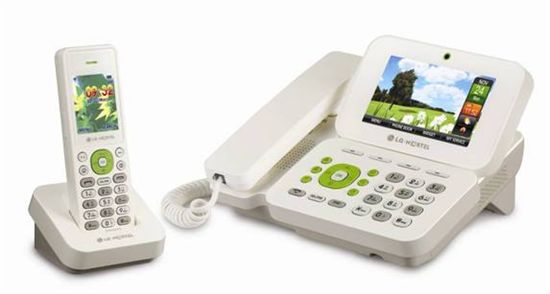
[Asia Economy Reporter Lim Hye-seon] Just 20 years ago, every household had a telephone placed right in the middle of the living room, and people would wait to talk with friends. Now, children get smartphones from elementary school age, and home phones have become 'relics of a bygone era.' As every family member owns their own mobile phone, the significance of home phones has faded.
Since 2007, the spread of mobile phones and the increase in data-centric communication services have led to a decline in the number of landline subscribers. While landlines used by businesses are maintained, the number of home phones is estimated to have fallen below 10 million. Their use as a 'supplementary means' for voice calls also appears to be declining.
According to the Ministry of Science and ICT and the telecommunications industry, as of July, the number of personal home phone lines installed in households dropped below 10 million. Considering that the total number of households in South Korea is 20.89 million according to Statistics Korea, only about half of all households still have a home phone. This is nearly a 30% decrease compared to 10 years ago.
According to the Ministry of Science and ICT's wired communication service subscription status, as of July, the total number of landline phone lines was 22.9 million. Of these, 11.86 million were local telephone lines, and 11.04 million were internet phone lines. Landlines are divided into business and personal use. According to data from the National Tax Service and the Ministry of SMEs and Startups, there are about 6.3 million companies in South Korea. Most of these use two or more landlines for main numbers and customer centers. It is estimated that at least 13 million lines are used for business purposes.
The number of landline phone lines has been declining since surpassing 30 million in 2014. In particular, the number of local telephone lines peaked at 10 million in 1988 and 23.49 million in 2002. However, as mobile phone penetration increased, the number of local telephone lines steadily decreased, dropping to 11 million this year. The number of internet phone lines, introduced in 2012 and effectively provided free through bundled products, has stagnated around 11 million. As of last year, the mobile phone penetration rate in South Korea reached 99%.
A telecommunications industry official explained, "We are minimizing churn by offering bundled products such as high-speed internet, internet TV, and internet phone services virtually free of charge, but the results are not satisfactory."
While landlines are disappearing as relics of a past era, the telecommunications market is seeing rapid growth in Internet of Things (IoT) lines. After crossing the 10 million IoT service line mark last year, the number surpassed 15 million in just over a year. This is interpreted as a result of increased corporate demand for digital transformation.
According to Ministry of Science and ICT statistics, the number of IoT subscription lines in South Korea reached 15,032,313, surpassing 15 million for the first time. This is an increase of nearly 7 million compared to December 2019 (8,083,767). It accounts for about 20% of the total mobile communication subscription lines (75,546,942). By service, remote monitoring accounts for 7,757,738 lines, vehicle monitoring 6,014,478 lines, and wireless payment 1,106,181 lines. By provider, SK Telecom has 5,351,425 lines, MVNOs 4,621,342 lines, LG Uplus 3,339,300 lines, and KT 1,720,246 lines.
The number of remote monitoring lines, mainly used for industrial site management by companies, and vehicle monitoring lines, widely used in car-sharing services, both increased by around 2 million over the past year. IoT services are expanding as the telecommunications industry offers various enterprise infrastructures combined with 5G, and further growth is expected.
© The Asia Business Daily(www.asiae.co.kr). All rights reserved.
![Clutching a Stolen Dior Bag, Saying "I Hate Being Poor but Real"... The Grotesque Con of a "Human Knockoff" [Slate]](https://cwcontent.asiae.co.kr/asiaresize/183/2026021902243444107_1771435474.jpg)














