[Asia Economy Reporter Kwon Jae-hee] Battery recycling stocks are gaining attention as hidden beneficiaries of the U.S. 'Inflation Reduction Act,' which involves large-scale investments to address climate change and energy security. Additionally, the resource security crisis caused by the Russia-Ukraine war, combined with the European Union's (EU) electric vehicle battery regulations announced last December that require a certain portion of battery materials to be recycled raw materials, have elevated battery recycling stocks to blue-chip status in the stock market.
According to the Korea Exchange on the 4th, three battery recycling companies have surged an average of 123% over the past month. Among the top three battery recycling leaders, Seongil Hi-Tech, considered the leader, was listed on the KOSDAQ market on July 28 with an initial public offering (IPO) price of 50,000 KRW, rising more than 65%. As of the most recent trading day on September 2, the closing price stood at 134,200 KRW. Seongil Hi-Tech plans to collect batteries from Samsung SDI's Hungary plant and recycle them. Accordingly, the more Samsung SDI invests in its Hungary plant, the more attention Seongil Hi-Tech receives.
Saevit Chem entered the stock market on August 9 and surged approximately 163% within a month. As of the most recent trading day on September 2, the closing price was 171,700 KRW. In March, Saevit Chem received approval from LG Chem to supply precursor composite solutions and signed a memorandum of understanding (MOU) to supply precursor composite solutions to Korea Precursor Co., Ltd., a joint venture between LG Chem and Korea Zinc. The structure involves receiving raw materials from LG Chem and delivering precursor composite solutions to Korea Precursor Co., Ltd., with the supply period expected to start in June 2024 and continue for ten years, enabling long-term sales growth. Initially, Saevit Chem's IPO price range was 25,000 KRW to 30,000 KRW, but the final IPO price was set at 35,000 KRW, exceeding the top of the range.
Cosmo Chemical also surged more than 142% this year, with the closing price at 24,450 KRW as of September 2. Cosmo Chemical plans to establish a battery recycling production capacity of 7,000 tons by 2024, consisting of 4,000 tons of nickel, 2,000 tons of cobalt, and 1,000 tons of lithium. Based on recent prices, this is expected to generate sales of approximately 300 billion KRW.
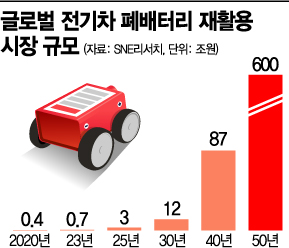
According to market research firm SNE Research, the global electric vehicle battery recycling market size is projected to grow from about 400 billion KRW in 2020 to 3 trillion KRW in 2025, with an average annual growth rate of 47%. It is expected to reach 12 trillion KRW by 2030 and 87 trillion KRW by 2040, with an average annual growth rate of 26% between 2025 and 2040.
Hainhwan KB Securities analyst said, "Resource security is a long-term issue due to the Russia-Ukraine war and U.S.-China conflicts," adding, "Countries like Korea, which rely on imports for raw materials, are inevitably exposed to supply chain risks, and one of the representative efforts to hedge these risks is 'battery recycling.'"
© The Asia Business Daily(www.asiae.co.kr). All rights reserved.
![Clutching a Stolen Dior Bag, Saying "I Hate Being Poor but Real"... The Grotesque Con of a "Human Knockoff" [Slate]](https://cwcontent.asiae.co.kr/asiaresize/183/2026021902243444107_1771435474.jpg)














