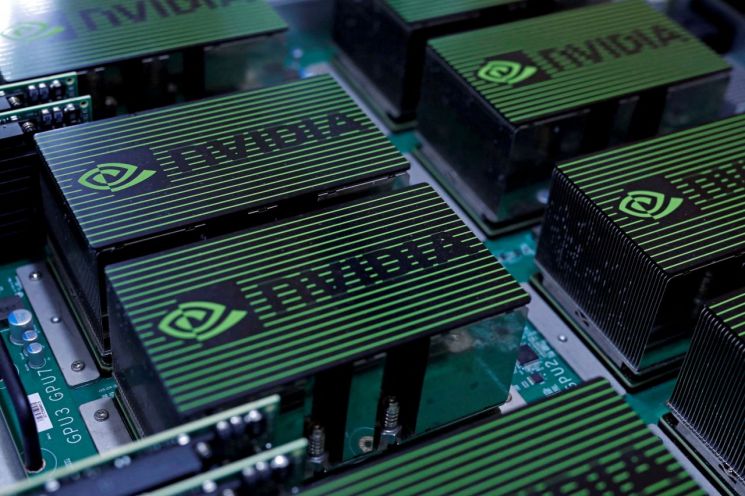
[Asia Economy Reporter Park Byung-hee] The U.S. government has effectively blocked the export of cutting-edge semiconductors for artificial intelligence (AI) to China by requiring new government approval for its domestic semiconductor giants Nvidia and AMD to export such advanced AI semiconductors to China. Following this news, the stock prices of related semiconductor companies plummeted. Concerns are also growing that U.S.-China tensions may escalate.
According to CNBC on the 31st of last month (local time), Nvidia confirmed the U.S. government's semiconductor export restrictions to China in a report submitted to the U.S. Securities and Exchange Commission (SEC) on the same day. Nvidia stated in the report that on the 26th, the U.S. government notified them that new approval would be required to export semiconductors to China and Hong Kong.
The U.S. government is said to have regulated exports due to concerns that the exported semiconductors could be used by Chinese military authorities. Nvidia identified AI graphics processing unit (GPU) semiconductors such as the A100 (code-named Ampere) and H100 (code-named Hopper) as subject to these regulations.
The U.S. authorities explained to Nvidia that the measures aim to address the risk of the A100 and H100 semiconductors being used by the Chinese military. Accordingly, these products can no longer be exported to China. Future Nvidia semiconductors with performance roughly equivalent to or better than the A100, as well as systems containing these semiconductors, will also be subject to export bans.
CNBC confirmed with AMD that AMD received the same guidelines from the U.S. government as Nvidia. AMD also announced that exports of its AI GPU semiconductor, the 'AMD Instinct MI250,' to China will be halted under the same regulations. However, exports of the previous generation MI100 semiconductor are expected to remain unaffected. The semiconductors from Nvidia and AMD are primarily used for AI-related tasks such as machine learning.
Over the past few years, the U.S. government has tightened export controls to China due to concerns about the risk of use by Chinese military units and the leakage of trade secrets.
Nvidia stated that due to decreased sales in China, its revenue for this quarter is expected to drop by about $400 million. Previously, Nvidia had forecasted this quarter's revenue at $5.9 billion. The U.S. government has applied the same regulations to Russia, but Nvidia said it has no customers there. Nvidia is working with its customers in China to supply alternative products and indicated that if alternatives are insufficient, it might provide licenses to customers.
Without semiconductors from Nvidia and AMD, Chinese companies are expected to be unable to effectively perform AI tasks, especially image and voice recognition. Technologies such as image and voice recognition and natural language processing are used not only in the private sector but also for military purposes, including processing satellite imagery and filtering vast amounts of data such as intercepted chats and emails by intelligence agencies.
Following the U.S. government's semiconductor export restrictions, Nvidia's stock price fell 2.42% on the New York Stock Exchange that day and dropped an additional 6.56% in after-hours trading. AMD also fell 2.38% during regular trading hours and 3.79% in after-hours trading.
© The Asia Business Daily(www.asiae.co.kr). All rights reserved.
![Clutching a Stolen Dior Bag, Saying "I Hate Being Poor but Real"... The Grotesque Con of a "Human Knockoff" [Slate]](https://cwcontent.asiae.co.kr/asiaresize/183/2026021902243444107_1771435474.jpg)
















