Next Year's Semiconductor Industry Development Budget Totaling 1.0137 Trillion Won
Excluding Power and Water Infrastructure Support Plans... Limitations in Workforce Training
Tax Reform Plan Balanced... Support Still Insufficient Compared to US and Japan
[Asia Economy Reporter Han Yeju] The budget for fostering the semiconductor industry next year is only 1 trillion won, which is criticized as being far too insufficient compared to global semiconductor competitor countries. Excluding the 450 billion won budget allocated for talent development, the actual total budget amounts to less than 0.1% of the overall budget.
While the industry cannot overlook the fact that the national fiscal management policy has shifted to sound finance, there are voices expressing disappointment over the scale, considering that the new government has set the goal of achieving a "semiconductor superpower."
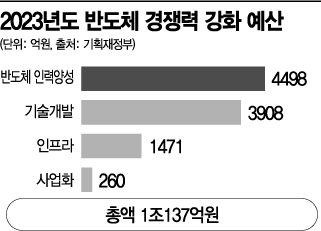
According to the '2023 Budget Proposal' announced by the Ministry of Economy and Finance on the 1st, the budget allocated to strengthen semiconductor competitiveness next year is 1.0137 trillion won. By category, 449.8 billion won is allocated for workforce training, and 563.9 billion won is allocated for technology development (390.8 billion won), infrastructure (147.1 billion won), and commercialization (26 billion won). This is less than 0.1% of the total expenditure for next year (639 trillion won). The budget proposal will be finalized at the end of the year after parliamentary review.
The Yoon Seok-yeol administration has made fostering the semiconductor industry its top industrial policy priority, including establishing the 'Semiconductor Superpower Achievement Strategy' last month. During his presidential campaign, President Yoon proposed creating a semiconductor fund called the 'Komatech Fund (tentative name),' where the government would invest 50 trillion won and the private sector would add more, to foster the fabless (design-specialized) and foundry (semiconductor contract manufacturing) industries. Since taking office, President Yoon has presented the vision of a semiconductor superpower as a key national agenda and has directly encouraged related ministries through cabinet meetings. However, experts still point out that the government's understanding of the semiconductor industry is severely lacking.
In fact, the current budget proposal excludes support for establishing power and water infrastructure for semiconductor complexes, which had raised expectations in the industry. Previously, the Ministry of Trade, Industry and Energy mentioned that it would consider national funding support for essential infrastructure costs in the Pyeongtaek and Yongin semiconductor complexes, where large-scale new and expanded facilities are underway. Compared to major overseas countries, Korea requires companies to directly build infrastructure such as water and power, which has led to unfavorable public opinion in surrounding areas. Therefore, there were considerable expectations that government support through national funding for infrastructure related to the semiconductor industry would accelerate competitiveness enhancement. However, it is reported that during internal review at the Ministry of Economy and Finance, concerns were raised about the burden of national funding support for infrastructure construction amid an overall expenditure restructuring policy.
Limitations of the government's proposed talent development budget are also mentioned. An industry official said, "Semiconductor talent development is not a problem that can be solved by simply injecting funds," adding, "Qualified teachers and systematic educational programs are needed to nurture talent, but there has been no discussion on how to develop such programs, which is regrettable."
At least, the government's tax reform plan extends the tax credit period for facility investments in national advanced strategic industries such as semiconductors to 2030 and increases the tax credit rates from 6% to 20% for large corporations, from 8% to 25% for mid-sized companies, and from the existing 10% to 30% for small and medium enterprises, balancing the tax support benefits compared to competitor countries. However, this amendment must pass through the National Assembly to be finalized.
There are also views that the support scale is insufficient compared to other countries fostering the semiconductor industry. According to the Korea Institute for Industrial Economics and Trade, the United States passed the 'CHIPS Act' last month, which provides direct subsidies of $39 billion over five years until 2027 for semiconductor manufacturing facility construction and invests $11 billion in advanced semiconductor research and development (R&D). Additionally, funds supported by the Department of Defense, Department of State, and others amount to $2 billion. Last year, Japan passed a supplementary budget that provides direct subsidies for building advanced semiconductor production plants domestically. The fund for subsidy payments, managed by the New Energy and Industrial Technology Development Organization (NEDO), amounts to 774 billion yen (75 trillion won). China is a representative country that provides so-called "blanket subsidies" to its domestic semiconductor companies.
© The Asia Business Daily(www.asiae.co.kr). All rights reserved.
![Clutching a Stolen Dior Bag, Saying "I Hate Being Poor but Real"... The Grotesque Con of a "Human Knockoff" [Slate]](https://cwcontent.asiae.co.kr/asiaresize/183/2026021902243444107_1771435474.jpg)
















