Introduction to the Joseon Dynasty and Modern History... Special Lecture on Finding Historical Lessons
"Reduce Regulations and Strengthen National Power Through Competition with Foreign Countries"
"Expand Economic and Cultural Territories Ba
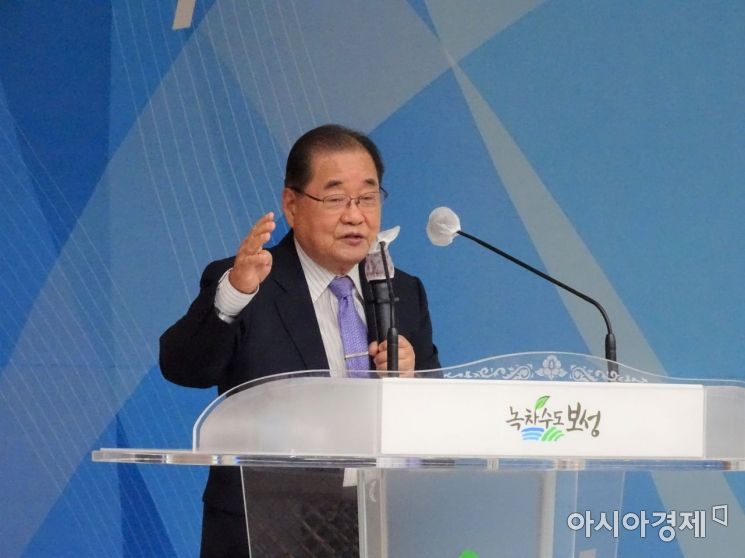 Former National Intelligence Service Director Lee Jong-chan is giving a keynote lecture titled "Our Tasks on the 77th Anniversary of Liberation" at the main conference room of Boseong County Office, Jeollanam-do, on the 30th.
[Asia Economy Honam Reporting Headquarters Reporter Park Jin-hyung] "We must move away from a regulation-only policy, respect market order, and compete fiercely with foreign countries."
Former National Intelligence Service Director Lee Jong-chan said this on the 30th during a keynote lecture titled "Our Tasks on the 77th Anniversary of Liberation" at the large conference room of Boseong County Office in Jeollanam-do.
Former Director Lee delivered his lecture by introducing various scenes from the Joseon Dynasty and modern and contemporary history, seeking historical lessons.
In particular, he repeatedly emphasized the "importance of openness" by comparing and analyzing the isolationist policy of the late Joseon period and the open policy of Japan's Meiji Restoration.
He pointed out that because they were insensitive to the global order, the two countries suffered the Eulsa Treaty humiliation, which greatly widened the development gap, stressing that the same mistake must not be repeated.
As a recent example, former Director Lee criticized the Moon Jae-in administration's nuclear phase-out policy as one that ignored global trends.
He said, "Carbon zero is becoming a global movement, and nuclear power is essential to reduce emissions, with its necessity increasing over time," adding, "It seems former President Moon did not quite realize this."
Former Director Lee added, "Although it has slightly stalled, nuclear power technology is at a world-class level," and "The defense industry is also on par with the United States, Russia, and China, and industries such as semiconductors and batteries are advancing to the global cutting edge."
He especially noted, "K-pop and dramas are gaining tremendous popularity in Japan," explaining, "Through fierce competition, we can strengthen national power."
Based on national pride glimpsed in the school song of the Shinheung Military Academy, an independence army training school, the expression of the year 4252 of Joseon in the March 1st Independence Declaration, and the preamble of the Constitution, former Director Lee also suggested that "our country should further expand its economic and cultural territories."
He continued, "As we mark the 77th anniversary of liberation, our country has risen to the ranks of the world's advanced nations," and "Our industries and lives should spread out and contribute globally," adding, "I believe this is the task our ancestors left us."
He further emphasized, "Fifteen million Jews control global wealth, and in the East, the Korean people are as intelligent as the Jews," and "We also have seven million overseas Koreans; if we can coexist with the world, wouldn't this be Korea's development?"
Meanwhile, former Director Lee, born in 1936 into a family of independence activists in Shanghai, graduated from the 16th class of the Korea Military Academy and was commissioned as an army second lieutenant. After entering politics as the 11th National Assembly member in 1981, he served four terms. He served as the first National Intelligence Service Director under the Kim Dae-jung administration and currently operates the "Udang Memorial Hall," which highlights the life of his grandfather and independence activist Udang Lee Hoe-young.
© The Asia Business Daily(www.asiae.co.kr). All rights reserved.