
[Asia Economy Reporter Lim Juhyung, Intern Reporter Song Hyundo] The Seoul Namsan Hilton Hotel, designed by architect Kim Jongseong, known as the "textbook of Korean architecture," stands at a crossroads between preservation and demolition. Aegis Asset Management, which purchased the hotel, plans to demolish the building by 2027 and construct a new building on the site. Some in the architectural community argue that "a building of great significance in Korean architectural history should not be easily torn down." Can historically significant architecture coexist with market-driven development logic?
The "Millennium Hilton" hotel was built near Namsan in Seoul in 1983. It is the first Hilton hotel in Korea, part of the global hotel chain "Hilton," and was designed by architect Kim Jongseong, who is considered a first-generation Korean architect alongside the late Kim Joongup (1922?1988) and Kim Sookeun (1931?1986).
Including underground and above-ground floors, the Hilton Hotel has a total of 25 floors, a gross floor area of 82,856㎡, and 684 guest rooms. Not only in terms of scale but also technically, it was state-of-the-art at the time. The large atrium?a spacious courtyard inside the building, equivalent to the height of a six-story apartment?was a highly challenging design attempted for the first time with domestic architectural technology.
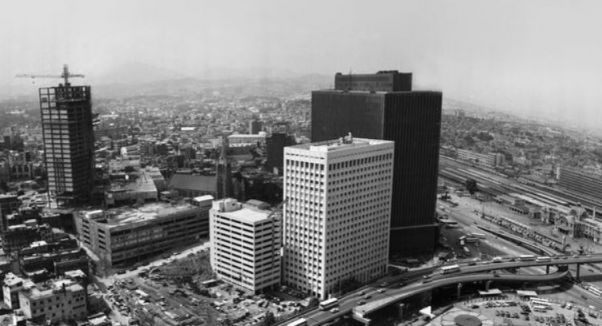
Over the past 40 years, the Hilton Hotel has experienced many ups and downs at the foot of Namsan. During the 1999 financial crisis, Daewoo Development under the Daewoo Group transferred ownership to CDL Hotel Korea. The hotel industry was hit hard by the COVID-19 pandemic, shaking Hilton as well. Eventually, CDL Hotel Korea signed a memorandum of understanding (MOU) last year to sell Hilton to Aegis Asset Management. The sale price was in the trillion-won range.
Aegis Asset Management plans to redevelop the site into an office and residential complex. Voices of regret have emerged from the architectural community. At a discussion jointly organized by architectural organizations including the Korean Institute of Architects on April 8, architectural scholars expressed opinions such as "a symbol of modernity in architectural history," "a landmark cherished in the public memory," and "a strategy to generate profit while preserving architectural culture must be found."
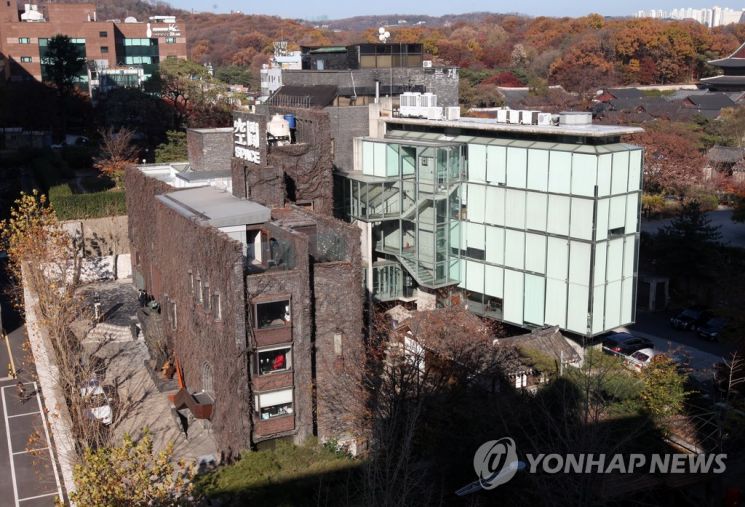 'Gonggan Building' in Jongno-gu, Seoul, used as the studio by architect Kim Sookeun / Photo by Yonhap News
Is demolition an unavoidable fate for buildings that meet owners with different views? Some buildings have been given new life through cooperation between the arts community and private companies. One example is "Space," which was used as the office of architect Kim Sookeun. Completed in 1972, Space is considered a representative "red brick" building in Korea. After entering court receivership due to bankruptcy in 2013, Space was put up for public sale, but no company bid, fearing that its high historical value would likely lead to cultural heritage registration and development restrictions.
However, the situation changed when Arario, a local company in Cheonan, purchased Space. Chairman Kim Changil of Arario reportedly made this decision out of regret that Space was stuck in court receivership. Subsequently, Space was confirmed as a registered cultural heritage by the Cultural Heritage Administration's Cultural Heritage Committee, and Arario preserved the building's form while renovating the interior to rebirth it as a new exhibition and art space called "Arario Museum in Space."
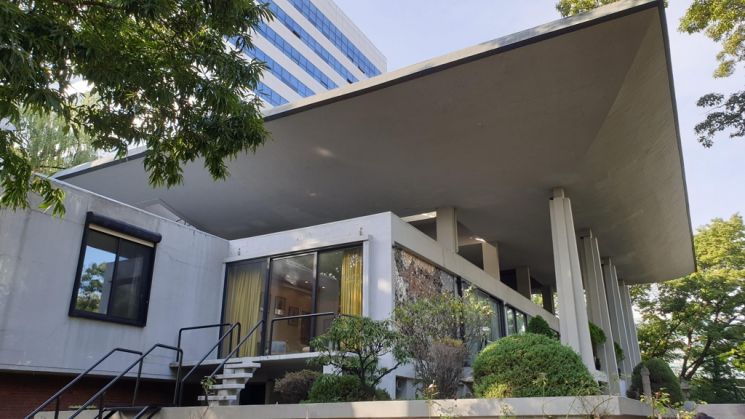 The Embassy of France in Korea, designed by architect Kim Joong-up. It features a Korean-style eaves roof made of concrete. / Photo by Yonhap News
The French Embassy in Korea, ranked second among Korean modern architectural masterpieces by the architectural magazine "Monthly SPACE," is a similar case. This building, completed in 1961, is a representative work of architect Kim Joongup. It is famous for its bold design that combines Western aesthetics and Korean beauty by placing a straight and curved eave roof on a concrete building. Thanks to this building, Kim Joongup received the Seoul City Cultural Award in 1962 and was awarded the National Order of Merit and the title of Chevalier by French President Charles de Gaulle in 1965.
However, after more than half a century, the building gradually deteriorated, and part of the roof edge collapsed, losing its original appearance. The French Embassy moved to another building, losing its original function. Nevertheless, the French side decided to restore the original through renovation rather than demolishing the building and launched a large-scale restoration project.
Given this, voices have emerged suggesting that there might be a way to find a compromise between preservation and development for the Hilton Hotel as well. Architect Kim Jongseong, who designed the Namsan Hilton, proposed a compromise in an interview with a media outlet last year, saying, "Reconstruction could be done by preserving the important parts of the Hilton Hotel, such as the atrium and the exterior walls of the basic framework, while maintaining the gross floor area."
© The Asia Business Daily(www.asiae.co.kr). All rights reserved.
![Clutching a Stolen Dior Bag, Saying "I Hate Being Poor but Real"... The Grotesque Con of a "Human Knockoff" [Slate]](https://cwcontent.asiae.co.kr/asiaresize/183/2026021902243444107_1771435474.jpg)













