Widespread Price Increases Cause Sighs Among Common People and Self-Employed
Ten Days Before Chuseok... Vegetable Prices Continue to Rise
Heatwaves and Heavy Rain Combine to Push Prices Up
Charyesang Costs Also Burdening... Easily Exceed 300,000 Won
Government "Full Effort to Restore Seasonal Goods Prices to Last Year's Levels"
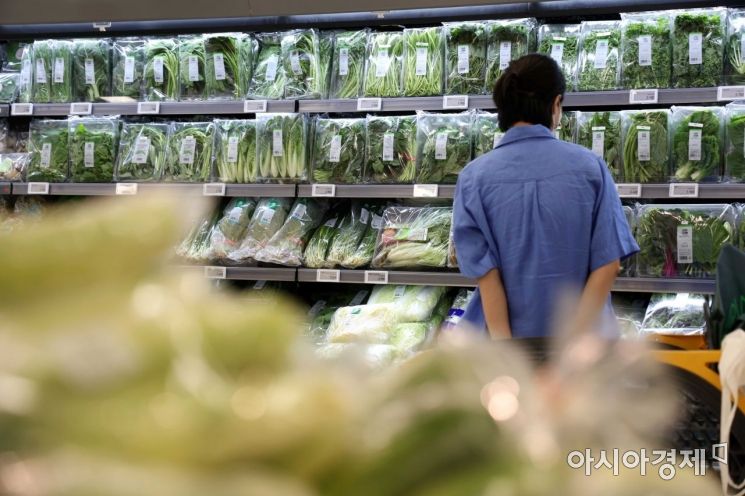 Ahead of Chuseok, there is an emergency in the price of dining table staples. According to the National Statistical Portal (KOSIS) of Statistics Korea, the food and non-alcoholic beverage price index in July was 113.12 (2020=100), up 8.0% from a year earlier. Food prices rose the most in one year and five months since February last year. In particular, prices of processed foods such as edible oils (34.7%) and fresh foods such as vegetables and seaweed (24.4%) increased significantly. Citizens are shopping at a large supermarket in downtown Seoul on the 7th. Photo by Moon Honam munonam@
[Asia Economy Reporter Song Seung-yoon] "I'm even afraid to look at the prices."
Oh Hye-jin (35), a housewife living in Gangdong-gu, Seoul, is deeply worried with Chuseok just around the corner. Just thinking about the expenses for Chuseok makes her chest feel tight. Relatives from her in-laws gather at her large house, and when she considers the cost of gifts for the ancestral rites table, she already sighs involuntarily. The sellers feel just as frustrated. Kim Ki-man (52), a vendor who has been selling vegetables for over 10 years at a traditional market in Incheon, is deeply concerned about the unusual Chuseok atmosphere. Although there is still some time left until Chuseok, customers are noticeably absent compared to usual. Kim said, "Occasionally some customers pass by, but they often turn away after hearing the prices," adding, "Because vegetable prices have risen unprecedentedly, I don't think sales will be like in the past even during the holiday peak."
With ten days left until Chuseok, widespread price increases continue. Especially due to adverse weather conditions such as heatwaves and heavy rains that started early this year, vegetable prices are soaring sky-high. As prices of essential goods rise sharply overall, not only consumers but also self-employed business owners are growing increasingly worried.
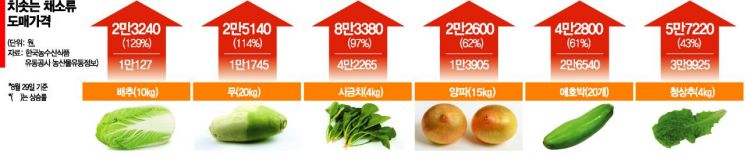
According to the Korea Agro-Fisheries & Food Trade Corporation's Agricultural Products Distribution Information on the 30th, the wholesale price of 4 kg of spinach was 83,380 won as of the previous day, nearly double the 42,265 won at the same time last year, a 97% surge. Compared to the average year, it increased by 106%, already exceeding double the usual level. Prices of napa cabbage and radish also more than doubled. The wholesale price of 10 kg of napa cabbage rose 129% from 10,127 won a year ago to 23,240 won, and radish prices increased 114% from 11,745 won to 25,140 won for 20 kg.
The price of 7.5 kg of minari (water dropwort) rose 70% to 89,133 won from 52,365 won last year. Onion (15 kg) and zucchini (20 pieces) also became more expensive, rising from 13,905 won and 26,540 won a year ago to 22,600 won and 42,800 won respectively, surging 62% and 61%. The price of 4 kg of green leaf lettuce increased 43% to 57,220 won from 39,925 won a year ago, and red leaf lettuce (4 kg) rose 39% to 64,460 won from 46,185 won last year.
Fruits are no different. The price of 10 kg of apples (Hongro variety) was 54,040 won as of the previous day, which is much lower than a week ago but still more than 14% higher compared to 47,090 won a year ago. Cooking essentials frequently used in Chuseok dishes such as frying oil and flour are also continuing to rise. The reasons for price increases vary by item, but for vegetables, it is largely due to reduced cultivation areas compared to average years and ongoing abnormal weather conditions like heatwaves and heavy rains. The earlier-than-usual Chuseok has also delayed the shipment of new harvest products, affecting prices.
Accordingly, the cost of the Chuseok ancestral rites table is also expected to rise sharply. Recently, Korea Price Information, a price survey organization, investigated the cost of purchasing ancestral rites table items (for a family of four) at traditional markets and large supermarkets three weeks before Chuseok. It is expected that 301,000 won will be needed to purchase ancestral rites table items at traditional markets, which is 26,500 won (9.7%) more than last Chuseok. When purchasing at large supermarkets, it costs 408,420 won, which is 24,600 won (6.4%) more than the previous year.
The government is making every effort to control prices. Earlier, the government decided to lower the average prices of 20 major seasonal products including napa cabbage, radish, pork, and pollock to last year’s Chuseok levels before the holiday. The supply volume of seasonal products will also be increased to a record high of 230,000 tons (1.4 times the usual amount). Local governments are also rolling up their sleeves to curb prices. Seoul City has introduced various measures to control grocery prices, including increasing the supply of agricultural and marine products. Specialized auctioneers at Garak Market will visit major production areas of five types of vegetables whose prices surged due to heatwaves and heavy rains to sign shipment agreements and maximize supply.
© The Asia Business Daily(www.asiae.co.kr). All rights reserved.
![Clutching a Stolen Dior Bag, Saying "I Hate Being Poor but Real"... The Grotesque Con of a "Human Knockoff" [Slate]](https://cwcontent.asiae.co.kr/asiaresize/183/2026021902243444107_1771435474.jpg)

















