Banks Are Raising Savings and Deposit Rates One After Another
'Base Rate Hike → Savings and Deposit Rate Increase → KOPIS Rise → Loan Rate Increase'
High Possibility of Significant KOPIS Increase Next Month
'KB Kookmin Bank raises savings and deposit interest rates by up to 0.4%p' 'Woori Bank raises savings and deposit interest rates by up to 0.5%p' 'K Bank CodeK time deposit raised to 3.5% annually' 'BNK Busan Bank raises savings and deposit interest rates by 0.40%p'....
Since the Bank of Korea raised the base interest rate on the 25th, commercial banks, internet banks, and regional banks alike have joined the wave of raising savings and deposit interest rates. Due to rapidly rising interest rates and a sluggish asset market including stocks and real estate, the amount of new fixed savings and deposits inflow into the five major banks (KB Kookmin, Shinhan, Hana, Woori, NH Nonghyup) from January to August this year reached 67.6442 trillion KRW (from 690.0366 trillion KRW to 757.6808 trillion KRW).
However, the financial sector is concerned that the rise in savings and deposit interest rates will boomerang back by pushing up loan interest rates. Since the Yoon Suk-yeol administration faced heavy criticism for the widening interest rate spread between loans and deposits (loan interest rate - deposit interest rate), banks have started to feel pressured. Every time the Bank of Korea raised the base rate this year, banks immediately raised savings and deposit interest rates. The problem is that the increase in savings and deposit interest rates directly impacts COFIX, which is the basis for calculating mortgage and credit loan interest rates.
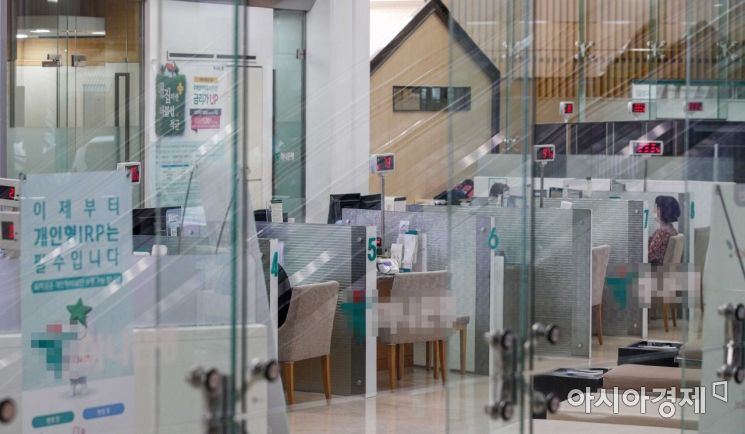 On the 7th, a scene at a bank counter in downtown Seoul shows major commercial banks lowering loan interest rates while raising interest rates on regular savings and installment savings products./Photo by Kang Jin-hyung aymsdream@
COFIX is the weighted average interest rate of funds raised by eight domestic banks. It reflects changes in interest rates of deposit products such as savings, deposits, and bank bonds handled by banks. When savings and deposit interest rates rise, COFIX also rises accordingly. In summary, throughout this year, the cycle of 'base rate hike → savings and deposit interest rate increase → COFIX increase → loan interest rate increase' has been ongoing.
This can be seen in the actual interest rate trends. The Bank of Korea raised the base rate on January 14 (0.25%p), April 14 (0.25%p), May 26 (0.25%p), and July 15 (0.5%p). Each time, banks raised savings and deposit interest rates by up to 0.5%p. COFIX, especially from April to July when the base rate started to rise sharply, increased by a total of 1.18%p to reach 2.90%. The variable rate for mortgage loans is renewed every six months and rises by the same amount as the COFIX increase. New loan interest rates are also calculated by adding a bank margin to COFIX, so they inevitably rise.
An official from a commercial bank said, "Last week, with the simultaneous announcement of the loan-deposit interest rate spread disclosure and the Bank of Korea's base rate hike, banks are raising savings and deposit interest rates one after another," adding, "The COFIX for August, to be announced next month, is also likely to rise sharply, which could trigger another wave of loan interest rate increases next month." Meanwhile, the Financial Services Commission has improved the system so that deposit interest rates are reviewed at least once a month by each bank to reflect market interest rate changes in the base rate.
© The Asia Business Daily(www.asiae.co.kr). All rights reserved.
![Clutching a Stolen Dior Bag, Saying "I Hate Being Poor but Real"... The Grotesque Con of a "Human Knockoff" [Slate]](https://cwcontent.asiae.co.kr/asiaresize/183/2026021902243444107_1771435474.jpg)
















