Lee Chang-yong, BOK Governor, Interview at Jackson Hole
"BOK Not Independent from Fed, Difficult to End Rate Hikes Early"
If Fed Takes Giant Step Next Month and Big Steps in Nov-Dec,
Interest Rate Gap Between Korea and US Will Widen Further
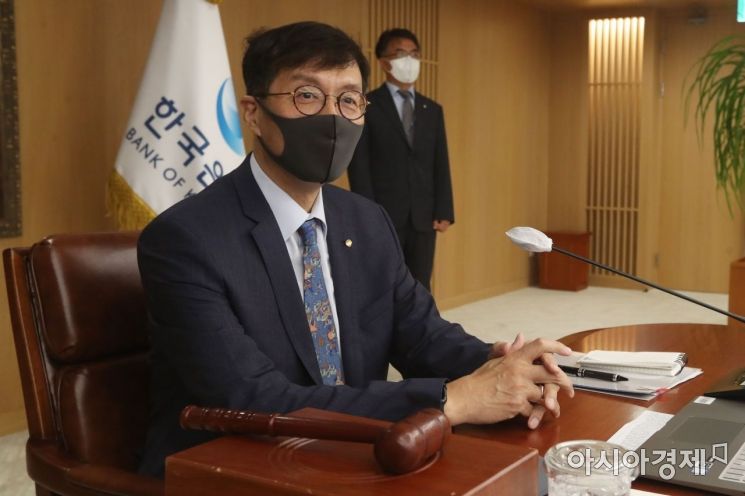 Lee Chang-yong, Governor of the Bank of Korea, is presiding over the Monetary Policy Committee meeting held on the 25th at the Bank of Korea in Jung-gu, Seoul. 220825
[Asia Economy Reporter Seo So-jeong] Jerome Powell, Chairman of the U.S. Federal Reserve (Fed), forecasted a third giant step (a 0.75 percentage point increase in the benchmark interest rate) at the Jackson Hole meeting, complicating the Bank of Korea's (BOK) monetary policy calculations. BOK Governor Lee Chang-yong holds the view that a baby step (a 0.25 percentage point increase in the benchmark interest rate) is appropriate for domestic conditions, but he must act flexibly depending on the Fed's moves. Governor Lee's remark at the Jackson Hole meeting that "the BOK is not independent from the Fed" directly reflects this dilemma. His indication of the possibility of a monetary policy change if inflation falls below the 3% range in the second half of next year is in the same context.
In an interview with some foreign media (Bloomberg TV) on the 27th (local time) in Jackson Hole, Wyoming, USA, Governor Lee said, "If inflation remains around 5%, the normalization period of monetary policy will be extended," but he also questioned, "However, inflation is expected to fall below 3% by the end of next year, but who knows if that will happen?" According to the BOK's August economic outlook, the consumer price inflation rate is expected to decrease from 4.6% in the first half of next year to 2.9% in the second half. Even if the rate hike trend continues in the first half, if inflation falls below 3% in the second half, there is a possibility of changing the direction of monetary policy.
When asked whether a big step (a 0.50 percentage point increase in the benchmark interest rate) would be possible in the first half of next year if Korea's inflation remains above 5%, he replied, "Given the current high uncertainties such as international oil and gas prices, China's COVID-19 policy, and economic slowdowns in China and the U.S., it is difficult to comment in advance," and emphasized, "If inflation continues to significantly exceed about 5%, the BOK will prioritize price stability, as Chairman Powell mentioned." In an earlier interview with another foreign media outlet, Governor Lee also said, "The BOK's monetary policy is independent from the Korean government but not completely independent from the Fed's monetary policy," and lamented, "Although the BOK started raising rates ahead of the Fed in August last year, an early end is difficult."
The BOK Monetary Policy Committee raised the benchmark interest rate by 0.25 percentage points on the 25th, but with the Fed signaling a giant step next month, the possibility of raising the benchmark interest rate by at least another 0.5 percentage points by the end of this year has increased. Currently, the benchmark interest rates between Korea and the U.S. are the same at 2.50%, but if the Fed raises rates by 0.75 percentage points next month, the upper bound of the U.S. benchmark interest rate (3.00?3.25%) will be 0.75 percentage points higher than Korea's. Also, if the Fed takes big steps in November and December respectively, and Korea's benchmark interest rate remains unchanged, the rate gap could reach 1.75 percentage points by the end of the year. Regarding this, Governor Lee said at a briefing after the Monetary Policy Committee meeting, "Historically, when the gap widened significantly, it fluctuated around 1 percentage point, so I think it is necessary to monitor negative impacts to ensure the gap does not become too large."
The market expects the BOK to continue its rate hike trajectory in the first half of next year as the U.S. rate hike trend continues. Park Seok-gil, Head of JP Morgan's Financial Market Operations Department, forecasted, "The BOK will consecutively raise rates by 0.25 percentage points three times this year (August, October, November) and once more in January next year, reaching a benchmark interest rate of 3.25%."
© The Asia Business Daily(www.asiae.co.kr). All rights reserved.
![Clutching a Stolen Dior Bag, Saying "I Hate Being Poor but Real"... The Grotesque Con of a "Human Knockoff" [Slate]](https://cwcontent.asiae.co.kr/asiaresize/183/2026021902243444107_1771435474.jpg)















