Opposition Environment Committee: "Legislation Neutralized by Enforcement Decree Coup"
Ruling Party Also Proposes Bill to Reduce Punishment Sentences
[Asia Economy Reporter Park Jun-yi] Just three days before the opening of the regular National Assembly session, the government and opposition parties clashed over the Serious Accidents Punishment Act. The Ministry of Economy and Finance decided to revise the enforcement decree of the Serious Accidents Punishment Act to allow the Chief Safety and Health Officer (CSO) to be regarded as the person responsible for management instead of the CEO, prompting opposition parties to protest. The ruling party plans to discuss measures to ease excessive punishment of business owners under the Serious Accidents Punishment Act on the same day. Concerns are rising that the controversy over the Serious Accidents Punishment Act will become another flashpoint of conflict between the ruling and opposition parties in this regular session.
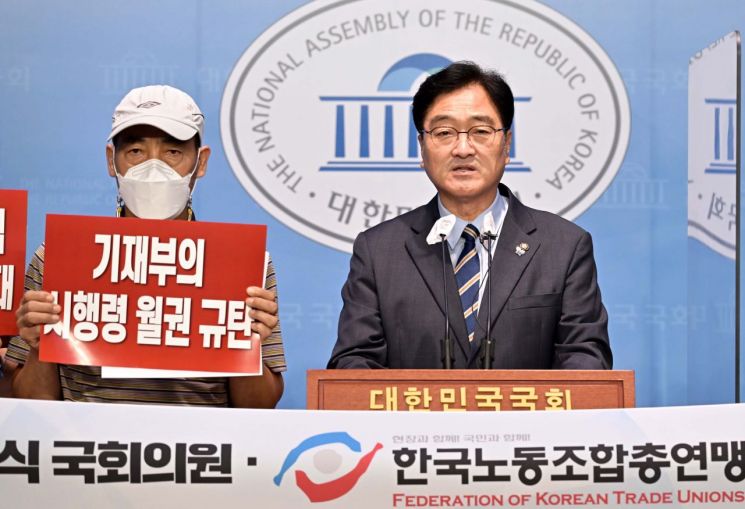
Members of the Environment and Labor Committee from the Democratic Party of Korea, along with the Korean Confederation of Trade Unions and the Federation of Korean Trade Unions, held an emergency press conference at the National Assembly on the 29th, stating, "There has been a revelation that the Ministry of Economy and Finance under the Yoon Seok-yeol administration is attempting to worsen the enforcement decree of the Serious Accidents Punishment Act," and criticized it as "an anti-democratic act aimed at nullifying the National Assembly's legislation through an enforcement decree coup."
The Democratic Party's backlash was triggered by the government's plan to revise the enforcement decree to consider the Chief Safety and Health Officer (CSO) as the person responsible for management. Under the current law, the person responsible for management is obligated to ensure the safety and health of workers, and if a serious accident occurs due to failure to fulfill this duty, the person responsible for management is punished. However, the Ministry of Economy and Finance included provisions allowing the CSO to be regarded as the person responsible for management instead of the CEO. This could undermine the original intent of the law, which holds the CEO accountable.
In addition, the enforcement decree reportedly includes a policy to ease punishment by stipulating that "if the business owner obtains certification related to workplace safety and health, it is considered that the safety and health management system under the Serious Accidents Punishment Act has been established." Lawmaker Woo Won-shik pointed out immediately after the press conference, "We worked hard to create this law and accepted industry opinions as much as possible when making it. If this is changed again and the purpose of the bill is distorted, there will be no reason for having made the law."
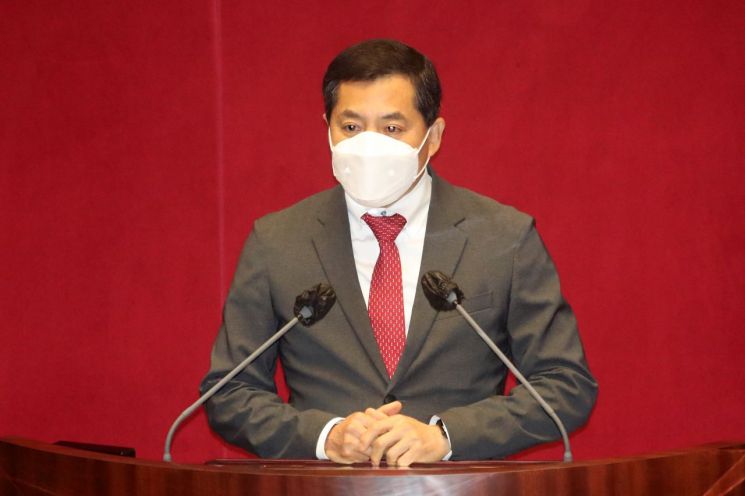
As the opposition parties oppose the enforcement decree revision plan, a fierce confrontation over the Serious Accidents Punishment Act is inevitable in the regular National Assembly session. Earlier, the People Power Party, led by lawmaker Park Dae-chul, proposed an amendment in June that allows the Minister of Justice to announce prevention standards for serious accidents in cooperation with related ministries, and business owners and persons responsible for management who receive certification under these standards would receive reduced penalties.
On the same day, People Power Party lawmaker Choi Jae-hyung held a press conference at the National Assembly to discuss improvement measures for the Serious Accidents Punishment Act. He pointed out concerns about the current law's excessively broad scope of application and excessive punishment. A People Power Party member of the Environment and Labor Committee said, "There is no consolidated party stance yet," and added, "It is scheduled to be discussed in the regular National Assembly session."
© The Asia Business Daily(www.asiae.co.kr). All rights reserved.
![Clutching a Stolen Dior Bag, Saying "I Hate Being Poor but Real"... The Grotesque Con of a "Human Knockoff" [Slate]](https://cwcontent.asiae.co.kr/asiaresize/183/2026021902243444107_1771435474.jpg)
















