Report Presentation on the Development Status and Implications of China's Telemedicine Industry
[Asia Economy Reporter Han Yeju] There is a claim that we should benchmark China, which overcame the COVID-19 crisis by utilizing telemedicine and further turned it into an opportunity to foster new industries.
The Federation of Korean Industries (FKI) announced on the 29th, in a report titled "The Development Status and Implications of China's Telemedicine Industry," commissioned to Professor Kim Wook of Konkuk University, that China is complementing the weaknesses of its vulnerable medical environment through continuous deregulation of the telemedicine industry and nurturing it as a future new industry.
According to the report, since China allowed non-face-to-face medical consultations between doctors and patients in 2014, it has steadily relaxed regulations and implemented nurturing policies for telemedicine through measures such as presenting the development direction of telemedicine in 2018, permitting online sales of pharmaceuticals in 2019, and including the fostering of the telemedicine industry in the national long-term development strategy in 2021.
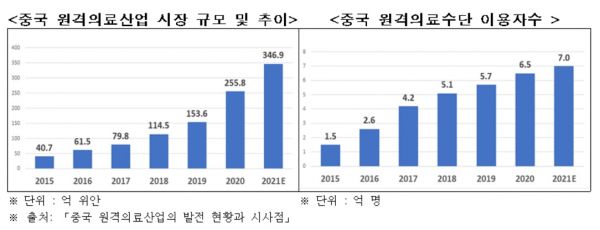
Accordingly, China's telemedicine market has steadily grown, expanding 8.5 times in size compared to six years ago, reaching 34.69 billion yuan in 2021. The number of telemedicine users is also expected to reach 700 million in 2021. Additionally, globally competitive telemedicine-related companies have emerged, such as Ping An Good Doctor, which recorded sales of 1.4 trillion won in 2021, and Haodaifu Zaixian Online Hospital, ranked 351st in the 2020 global unicorn rankings. By June 2022, over 1,700 online hospitals had been approved nationwide in China, strengthening integrated online and offline medical service supply.
Due to the Chinese government's active intention to foster telemedicine, the scope of telemedicine-related services allowed in China is broader than in Korea. Not only non-face-to-face consultations between doctors and patients but also remote patient monitoring, online pharmaceutical sales, and remote surgery?where a doctor from Hospital A can participate in surgery on a patient at Hospital B via a remote platform?are possible.
In Korea, only remote consultations between medical professionals are allowed under the Medical Service Act; remote consultations between doctors and patients, remote surgery, and online pharmaceutical sales are all prohibited. Although telephone consultations and prescriptions between doctors and patients were temporarily permitted in 2020 to respond to COVID-19, unless the Medical Service Act is amended, non-face-to-face consultations will become impossible again once the severe phase of the COVID-19 crisis response is lifted.
Professor Kim Wook stated in the report, "China has effectively utilized the opportunity presented by COVID-19 to significantly enhance the international competitiveness of its previously underdeveloped telemedicine industry," adding, "It is necessary to pay close attention to the timely and proactive telemedicine ecosystem-building policies of the central and local Chinese governments and the swift innovations by companies aligned with these policies."
Yoo Hwan-ik, head of the FKI Industry Headquarters, said, "Telemedicine is an inevitable trend after COVID-19, and since the potential of telemedicine has been proven in Korea as well, active deregulation and the establishment of precise standards are necessary," forecasting, "The emergence of global telemedicine companies is also possible."
© The Asia Business Daily(www.asiae.co.kr). All rights reserved.
![Clutching a Stolen Dior Bag, Saying "I Hate Being Poor but Real"... The Grotesque Con of a "Human Knockoff" [Slate]](https://cwcontent.asiae.co.kr/asiaresize/183/2026021902243444107_1771435474.jpg)















