Left-Leaning Father Abandoned Family When Meloni Was 1 Year Old
 Giorgia Meloni, leader of Brothers of Italy (FdI), emerging as Italy's first female prime minister
 [Photo by AFP Yonhap News]
[Asia Economy Reporter Park Byung-hee] On the 26th (local time), the British BBC introduced Garbatella, a southern district of Rome where Giorgia Meloni, the leader of Brothers of Italy (FdI) and a leading candidate for Italy's next prime minister, grew up.
Garbatella is a southern district of Rome where workers reside and has traditionally been considered a stronghold of the left. Meloni grew up as a far-right politician in a region with strong leftist tendencies.
Anna Maria Tortora, who ran a grocery store in Garbatella for 40 years, said in an interview with the BBC that she never imagined the girl who grew up eating beans and tomatoes she cultivated herself would become a leader of Italy. "Meloni does not represent Garbatella, which has traditionally been a red (leftist) area," she said. Tortora's mother described herself as "a staunch anti-fascist" and said, "If Meloni becomes prime minister, it will be a very terrible era."
The BBC reported speculation that Meloni's rise as a far-right politician was motivated by a desire for revenge due to her father's absence. Meloni's father, who was left-leaning, abandoned the family and left for the Canary Islands in North Africa when she was just one year old. Meloni's mother, who was right-leaning, moved with her young daughter to Garbatella, close to her own parents, and raised her alone.
◆ Meloni: "Fascism is a thing of the past" = Although FdI is classified as a far-right party inheriting fascism, Meloni strongly detests being labeled a fascist, the BBC reported.
In a video sent to foreign journalists on the 10th, Meloni stated in English, Spanish, and French, "The Italian right handed fascism over to history decades ago," and insisted, "Fascism is a thing of the past."
However, the BBC pointed out that unlike Germany after World War II, Italy has not purged the remnants of fascism. Fascist parties have continuously maintained a presence in modern Italian politics, and FdI, founded in 2012 under Meloni's leadership, traces its roots to the Italian Social Movement (MSI), established the year after Benito Mussolini's death. MSI was founded in 1946 by Mussolini's followers.
MSI was dissolved in 1995 and succeeded by the National Alliance (AN), which merged with the People of Freedom (PdL) party founded in 2007 by former Prime Minister and current Forza Italia (FI) leader Silvio Berlusconi, disappearing into history. The centrist-right PdL lasted only about six years. In December 2012, hard-right factions including Meloni split from PdL to establish the current FdI, and PdL dissolved about a year later in November 2013.
FdI uses the tricolor flame as its party symbol, which was also used by MSI and AN, leading to its perception as a party inheriting fascism. The BBC explained that the tricolor flame is perceived as the flame burning at Mussolini's tomb.
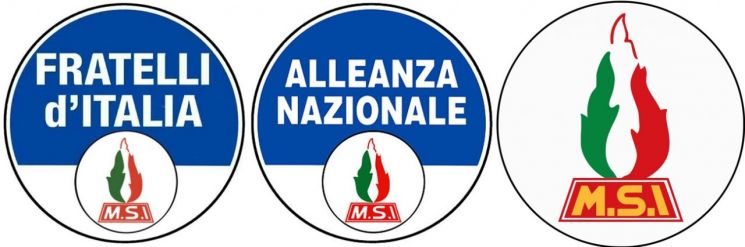 Symbols of, from left to right, Brothers of Italy (FdI·since 2012), National Alliance (AN·1995~2007), Italian Social Movement (MSI·1946~1995)
Meloni also has political roots in MSI. She began her political activities by joining MSI's youth organization at age 15. She served as the youth organization leader of AN, MSI's successor. She was elected to the Chamber of Deputies in 2006 and, at age 31 in 2008, became the youngest minister in Italian political history by joining Berlusconi's cabinet as Minister for Youth.
◆ FdI party support slightly ahead of Democratic Party = Ahead of the early general election scheduled for the 25th of next month, FdI led by Meloni is topping opinion polls.
According to a poll released on the 26th, FdI garnered 24.7%, pushing the center-left Democratic Party (PD, 24.1%) to second place and securing the highest party support. In the previous poll, PD led by 0.2 percentage points, but FdI's support rose by 0.4 points while PD's dropped by 0.4 points, reversing the rankings.
The far-right League (Lega) and center-right Forza Italia (FI), which are forming a right-wing coalition with FdI, recorded 13% and 6.6% respectively, ranking third and fifth in party support.
Overall, the combined support for progressive parties including PD was 30.6%, trailing the conservative camp by 15 percentage points.
Another poll showed FdI's support at 27.7%, comfortably ahead of PD's 23.3%.
The right-wing coalition has already agreed that the party with the most votes will have the right to nominate the prime minister candidate, so if the current trend solidifies, Meloni is highly likely to become Italy's first female prime minister.
Since the gap in party support is narrow, the possibility of PD winning first place cannot be ruled out. However, it is uncertain whether PD can secure enough seats to form a government through negotiations. On the 2nd, PD formed a strategic alliance with centrist parties such as Azione (meaning "Action" in Italian) and +Europa to win the election, but Azione soon withdrew from the alliance, showing signs of division within the progressive camp. Even if PD wins first place, failure in government formation negotiations would likely transfer the lead to FdI, the probable second-place party, and the right-wing coalition is expected to have an easier time forming a government than the progressive camp.
◆ Differentiation through criticism of Putin and strengthening NATO ties = After leading the founding of FdI in 2012 and being elected party leader in 2014, Meloni expanded her support base with a clear far-right stance infused with anti-immigration and conservative Catholic ideology.
She increased her presence by declaring in February last year that she would be the only major party not to join the national unity government led by Prime Minister Mario Draghi, which included both left and right-wing parties.
In a recent interview with a foreign media outlet, Meloni said she would comply with the European Union's fiscal rules and dismissed concerns that Italy's finances would collapse if a right-wing coalition came to power. This is interpreted as an effort to shed her far-right image ahead of the general election.
Regarding the Ukraine war, Meloni strongly criticized President Vladimir Putin and advocated strengthening ties with the North Atlantic Treaty Organization (NATO) and providing weapons support to Ukraine. This stance differentiates her from other right-wing leaders. Both Berlusconi and Matteo Salvini, leader of the League, face allegations of ties with Russia. In May, the Russian daily La Stampa reported that a Russian diplomat asked Salvini's foreign affairs advisor whether the League would withdraw from Draghi's coalition government. Another Italian daily, La Repubblica, alleged that on the day FI withdrew from Draghi's government, Berlusconi informed a Russian diplomat. Berlusconi is known to maintain a long-standing friendship with Putin.
Professor Gianluca Passarelli of Sapienza University in Rome said that FdI is not a fascist party. Professor Passarelli explained, "Fascism intends to seize power and destroy the system, but Meloni neither wants nor can do that. However, there are factions within FdI related to neo-fascist movements, and Meloni has taken a middle ground among them."
Professor Passarelli said Meloni would not give up the tricolor flame symbol of FdI, as she began her political career in MSI and it represents her political identity from her youth.
© The Asia Business Daily(www.asiae.co.kr). All rights reserved.



















