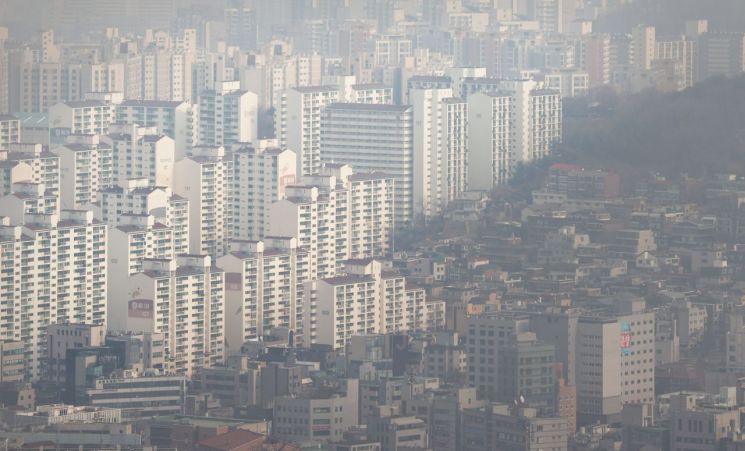
[Asia Economy Reporter Cha Wanyong] The phenomenon of people moving out of Seoul due to the inability to afford housing prices and rent is accelerating. Those leaving Seoul have dispersed and moved to new towns and housing development districts in Gyeonggi-do, where housing prices are relatively low and many new apartments have been built.
According to an analysis of the Population Census data by Statistics Korea on the 27th, the total population nationwide increased by 0.9%, from 51,269,554 in 2016 to 51,738,071 in 2021. During the same period, Seoul's population decreased by about 3.4%, from 9,805,506 to 9,472,127, showing one of the largest declines among the 17 metropolitan cities and provinces, alongside Ulsan (-3.8%) and Daejeon (-3.6%).
On the other hand, the population of Gyeonggi Province increased by 7.7%, from 12,671,956 to 13,652,529, recording the third highest growth rate nationwide after Sejong and Jeju.
Looking at the regions within Gyeonggi-do, areas close to Seoul or where new towns and housing development districts are actively being developed showed remarkable growth.
Hanam, adjacent to Songpa-gu and Gangdong-gu, showed the highest growth rate at 56.3%, while Gimpo, near Gangseo-gu, and Siheung, close to Guro-gu, recorded growth rates around 30%, ranking among the top. Notably, Siheung surpassed a population of 500,000 during this period, gaining the status of a large city.
Hwaseong and Pyeongtaek, which are somewhat farther from Seoul, also showed high growth rates of 38.3% and 21.0%, respectively, which is attributed mainly to population inflow into housing development districts such as Dongtan 2 New Town and Godeok International City.
Conversely, areas where new housing development has been slow, such as Gwangmyeong (-13.1%), Anyang (-7.4%), Gunpo (-4.8%), and Seongnam (-3.9%), experienced relatively large population declines despite their proximity to Seoul. Yeoncheon, which is far from Seoul, also showed a significant decrease of -6.2%.
Kwon Il, head of the research team at Real Estate Info, said, “In recent years, as housing prices in Seoul have skyrocketed, population movement to the Gyeonggi area has been active. While the population in local areas including metropolitan cities is rapidly decreasing, it is expected that the growth trend will continue for the time being, centered on areas in Gyeonggi with relatively low housing prices compared to Seoul and active new housing development.”
© The Asia Business Daily(www.asiae.co.kr). All rights reserved.
![Clutching a Stolen Dior Bag, Saying "I Hate Being Poor but Real"... The Grotesque Con of a "Human Knockoff" [Slate]](https://cwcontent.asiae.co.kr/asiaresize/183/2026021902243444107_1771435474.jpg)
















